

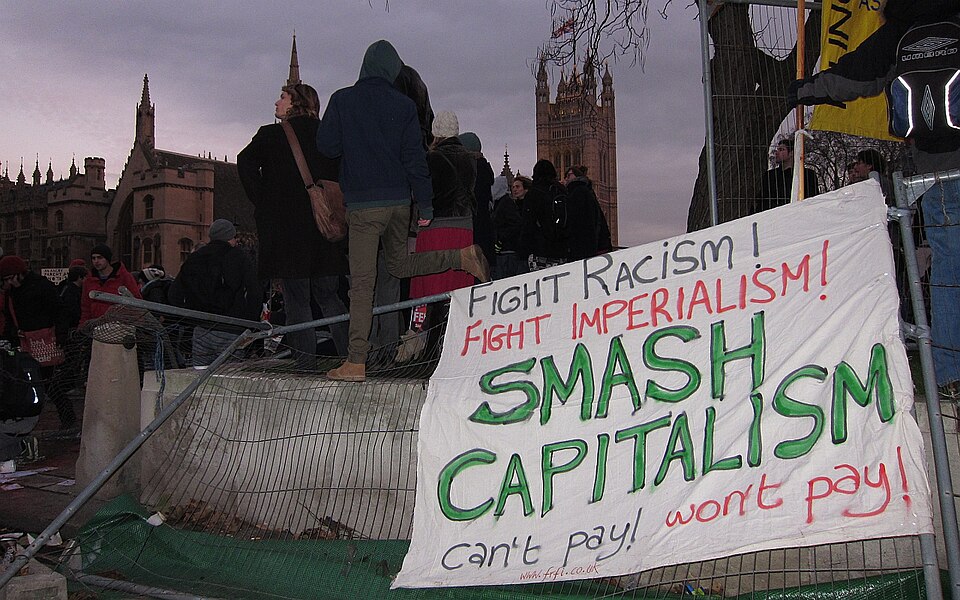
Once class recedes and the professional class sets the agenda, politics changes character. It becomes a contest over symbols rather than substance, over the words we use and the images we project rather than the distribution of power and resources. This is the most visible fault to ordinary people, who can sense when a movement is more exercised about terminology than about whether they can pay for insulin.
I want to be careful here, because symbols matter and language has real effects. The mistake is not attending to them; it is letting them substitute for the material struggle that the tradition placed at the center. Harrington defined socialism as the democratization of economic decision making, the redistribution not merely of income but of control. Measured against that standard, a politics that wins a change in official vocabulary while ownership and investment remain untouched has won almost nothing.
This is a result that the powerful can live with comfortably, which is why the analysis of Chomsky and Herman in Manufacturing Consent is so pertinent. Their argument was that the media system filters public debate so that a narrow range of acceptable opinion gets aired while the fundamental questions of ownership and class are kept off the table. A left that pours its energy into symbolic contests does the filtering work for free, accepting a debate about representation precisely because that debate never threatens the distribution of property. The boardroom is entirely willing to update its language; what it will not do is surrender the decisions that Harrington said democracy must claim.
Here, a misreading of Antonio Gramsci has done real damage. Gramsci argued that the ruling class sustains its power not only by force but through cultural hegemony, its grip on the everyday ideas circulated through schools, media, and popular culture, and that the left must therefore wage a long war of position across these institutions. The insight was sound, but in the hands of the new new left it curdled into the belief that contesting the images in pop culture is itself the central struggle.
That is a diversion, not a strategy. The decisive question is not what is depicted in popular culture but who controls what is depicted, who owns the studios and platforms and sets the terms on which culture is made. To fight over the content of the images while leaving their ownership untouched is to mistake the screen for the projector. Gramsci wanted the working class to capture the means of cultural production, not merely to lobby for better representation within a system someone else still owns.
The symbolic turn also corrodes solidarity in a way the material struggle does not. A demand for higher wages or universal health care or the right to organize unites people across every line of identity, because the benefit is shared and concrete, and this is what solidarity means. A politics of symbol and recognition, by contrast, rests on status rather than solidarity. It sorts people into ever finer categories, each owed its particular acknowledgment, and ranks those categories by a moral hierarchy of grievance.
The trouble is that an agenda built on identity and status does not gather people; it divides them, and it alienates many whose support a majority would require. The worker who is told that his position in the hierarchy of privilege disqualifies his complaint, rather than that he shares an interest with workers unlike him, will not be recruited to the cause. He will be repelled by it, and he will remember the insult at the ballot box. Solidarity invites; status excludes.
Here the contrast with Jurgen Habermas is instructive. In his account of the public sphere, democratic legitimacy arises from reasoned argument among citizens about their common life, tested by better reasons. The symbolic politics of the new new left often inverts this, treating claims as expressions of identity that others are obliged to affirm rather than as arguments open to deliberation, and measuring progress by the policing of speech rather than the quality of collective reasoning.
The symbolic turn carries one further hazard: it is endlessly escalating and never satisfied. Material demands have natural stopping points, since a living wage or universal coverage can be defined, won, and consolidated. Symbolic demands have no such terminus, because the supply of language to revise and offense to police is inexhaustible. A politics built on this terrain is condemned to perpetual motion without arrival, and it generates the very factionalism it cannot resolve.
The deepest cost is that symbolic victory feels like progress while leaving the machinery of inequality running. A movement can celebrate a long string of such victories and find, at the end, that wages have stagnated, that the union is gone, that wealth has concentrated further, and that working people conclude the left has nothing to offer them but instruction in how to speak. Bernstein’s ethical socialism and Harrington’s economic democracy both demanded more: a real shift in who holds power. The symbolic turn offers the appearance of that shift while quietly conceding the thing itself.
ZNetwork is funded solely through the generosity of its readers.
Donate




