


Source: The Guardian
Bolivia has descended into a nightmare of political repression and racist state violence since the democratically elected government of Evo Morales was overthrown by the military on November 10. That month was “the second-deadliest month, in terms of civilian deaths committed by state forces, since Bolivia became a democracy nearly 40 years ago,” according to a study by Harvard Law School’s (HLS) International Human Rights Clinic and the University Network for Human Rights (UNHR) released a month ago.
Morales was the first Indigenous president of Bolivia, which has the largest percentage of Indigenous population of any country in the Americas. His government was able to reduce poverty by 42 percent and extreme poverty by 60 percent, which disproportionately benefited Indigenous Bolivians. The November coup was led by a white and mestizo elite with a history of racism, seeking to revert state power to the people who had monopolized it before Morales’s election in 2005. The racist nature of the state violence is emphasized in the HLS/UNHR report, including eyewitness accounts of security forces using “racist and anti-Indigenous language” as they attacked protesters; it is also clear from the fact that all of the victims of the two biggest massacres committed by state forces after the coup were Indigenous.
What has gotten even less attention, but is equally important to understanding how Bolivia’s democracy was destroyed last November, is the role of the Organization of American States in this terrible crime.
As The New York Times finally reported on June 7, the organization’s “flawed” analysis immediately following the October 20 election “fueled a chain of events that changed the South American nation’s history.” As the Times noted, the OAS analysis “raised questions of vote-rigging — and helped force out a president ….”
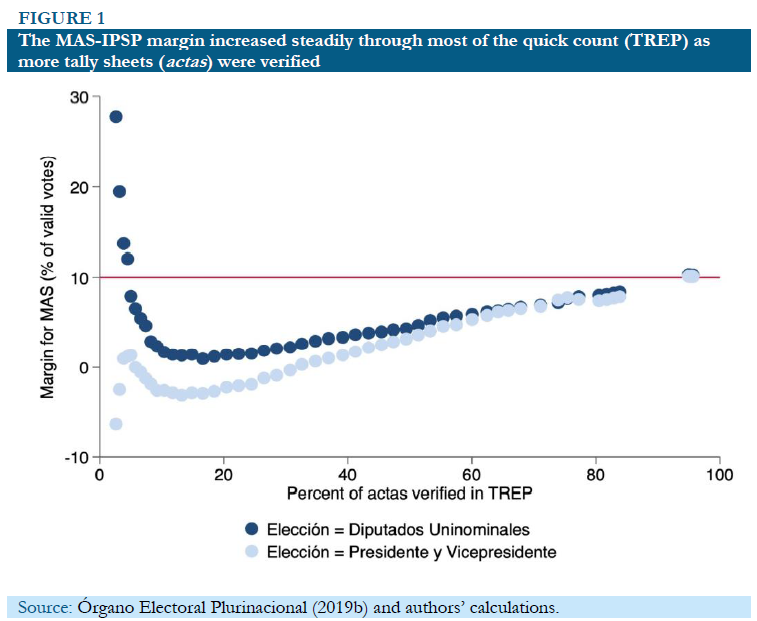
The OAS allegations were indeed the main political foundation of the coup that followed the October 20 election three weeks later. And they continued for many months following the coup. In Bolivia, the electoral authorities report a preliminary vote count, which is unofficial and does not determine the result, while the votes are being counted. When 84 percent of the votes were counted in this preliminary tally, Morales had 45.7 percent of the vote, and was leading the second-place vote-getter by 7.9 percentage points. The reporting in this unofficial, nonbinding tally was then interrupted for 23 hours, and when it picked up again, Morales’s lead had increased to 10.2 percentage points. By the end of the official count, it was 10.5 percent. According to Bolivia’s election rules, a candidate with more than 40 percent of the vote and at least a 10 point lead wins in the first round, without a run-off election.
The opposition claimed that there was fraud and took to the streets. The OAS Electoral Observation Mission (EOM) issued a press statement the day after the election expressing “deep concern and surprise at the drastic and hard-to-explain change in the trend of the preliminary results after the closing of the polls.” But they provided no evidence to support these allegations ― because there wasn’t any.
This has since been established repeatedly by a slew of expert statistical studies, including the one that formed the basis of the New York Times article of June 7. As sometimes happens when numbers become the subject of political controversy, the statistical studies were needed mainly to refute other ― in this case, often bogus ― statistical analyses. But the truth was quite plain and easy to seefrom data available on the web immediately following the election. And indeed the Center for Economic and Policy Research ― where I am Co-Director ― used that data to disprove the OAS’s initial allegations the next day, and followed up with a number of statistical analyses and papers in the ensuing months, including a refutation of the OAS’s final audit report.
There was no inexplicable change in trend. All that happened was that areas reporting later were more pro-Morales than the ones that reported earlier, for various geographical and demographic reasons. That is why Morales’s lead increased when the last 16 percent of votes came in, just as it had been increasing throughout the preliminary count. This is a fairly common occurrence in elections all over the world.
But after its initial press release, the OAS produced three more reports, including its preliminary audit of the election results, without ever considering the obvious possibility that the later-reporting areas were politically different from those where votes came in earlier. This by itself is overwhelming evidence that OAS officials did not simply make a mistake in their repeated allegations of fraud, but in fact knew that their allegations were false. It defies the imagination to conceive of how this simple explanation ― which is the first thing that would occur to most people, and turned out to be true ― would not even occur to election experts, in the process of months of investigation.
On December 2, 133 economists and statisticians published a letter to the OAS, noting that “the final result was quite predictable on the basis of the first 84% of votes reported” and calling on the OAS “to retract its misleading statements about the election.”
Four members of the US Congress, led by Congresswoman Jan Schakowsky, also weighed in with a letter to the OAS asking 11 basic questions about the OAS analysis. One concerned whether they had considered the possibility that the later-reporting areas were “different in any ways that would make them more likely to vote for Evo Morales, by a wider margin, than voters in the typical precinct in the first 84 percent of reported votes?” More than nine months later, the OAS has yet to answer.
In July, the US Congress held briefings with top officials of the OAS, and confronted them with some of the same questions; they gave no substantive answers.
With the original and politically decisive allegations of fraud increasingly discredited, the OAS turned to “irregularities” in the election to maintain their assault on its legitimacy. But it turned out that these allegations, like the ones based on statistical claims, could not withstand scrutiny. The OAS appears hell-bent on justifying its initial, and clearly false, allegations of wrongdoing that precipitated the coup.
Meanwhile, Bolivia has a de facto president, Jeanine Áñez, who has called Indigenous religious practices “satanic;” in January she warned voters against “allowing the return of ‘savages’ to power, an apparent reference to the indigenous heritage of Morales and many of his supporters,” according to The Washington Post. Hers was supposed to be a “caretaker” government, but new elections ― now scheduled for October 18 ― have already been postponed three times.
The wheels of justice grind much too slowly in the aftermath of US-backed coups. And the Trump administration’s support has been overt: the White House promoted the “fraud” narrative, and its Orwellian statement following the coup praised the overthrow: “Morales’s departure preserves democracy and paves the way for the Bolivian people to have their voices heard.”
Senator Marco Rubio is one of the most important influences on the Trump administration’s policy in Latin America. In this case, he got in on the action even before the first OAS press release: “In #Bolivia all credible indications are Evo Morales failed to secure necessary margin to avoid second round in Presidential election,” he wrote the day after the vote, and there was “some concern he will tamper with the results or process to avoid this.”
According to the Los Angeles Times, “Carlos Trujillo, the U.S. ambassador to the OAS, had steered the group’s election-monitoring team to report widespread fraud and pushed the Trump administration to support the ouster of Morales.”
This week, US Representatives Jan Schakowsky and Chuy Garcia called for the US Congress to “investigate the role of the OAS in Bolivia over the past year, and ensure that taxpayers’ dollars do not contribute to the overthrow of democratically elected governments, civil conflict, or human rights violations.”
That would be a good start.


Mark Weisbrot is Co-Director of the Center for Economic and Policy Research in Washington, D.C. He received his Ph.D. in economics from the University of Michigan. He is author of the book Failed: What the "Experts" Got Wrong About the Global Economy (Oxford University Press, 2015), co-author, with Dean Baker, of Social Security: The Phony Crisis (University of Chicago Press, 2000), and has written numerous research papers on economic policy.
ZNetwork is funded solely through the generosity of its readers.
Donate






1 Comment
We knew this is what happened, it does not take great insight or reportial skills to have this knowledge. It is the established pattern and the OAS, long dominated by the US, is always involved in such matters. I visited Bolivia during the years of Evo Morales. It was an amazing country. Racism wins again, the US pattern of domination is rather universal, but not all, of course, caused by the US, but its dirty and bloody hands are always there somewhere.