

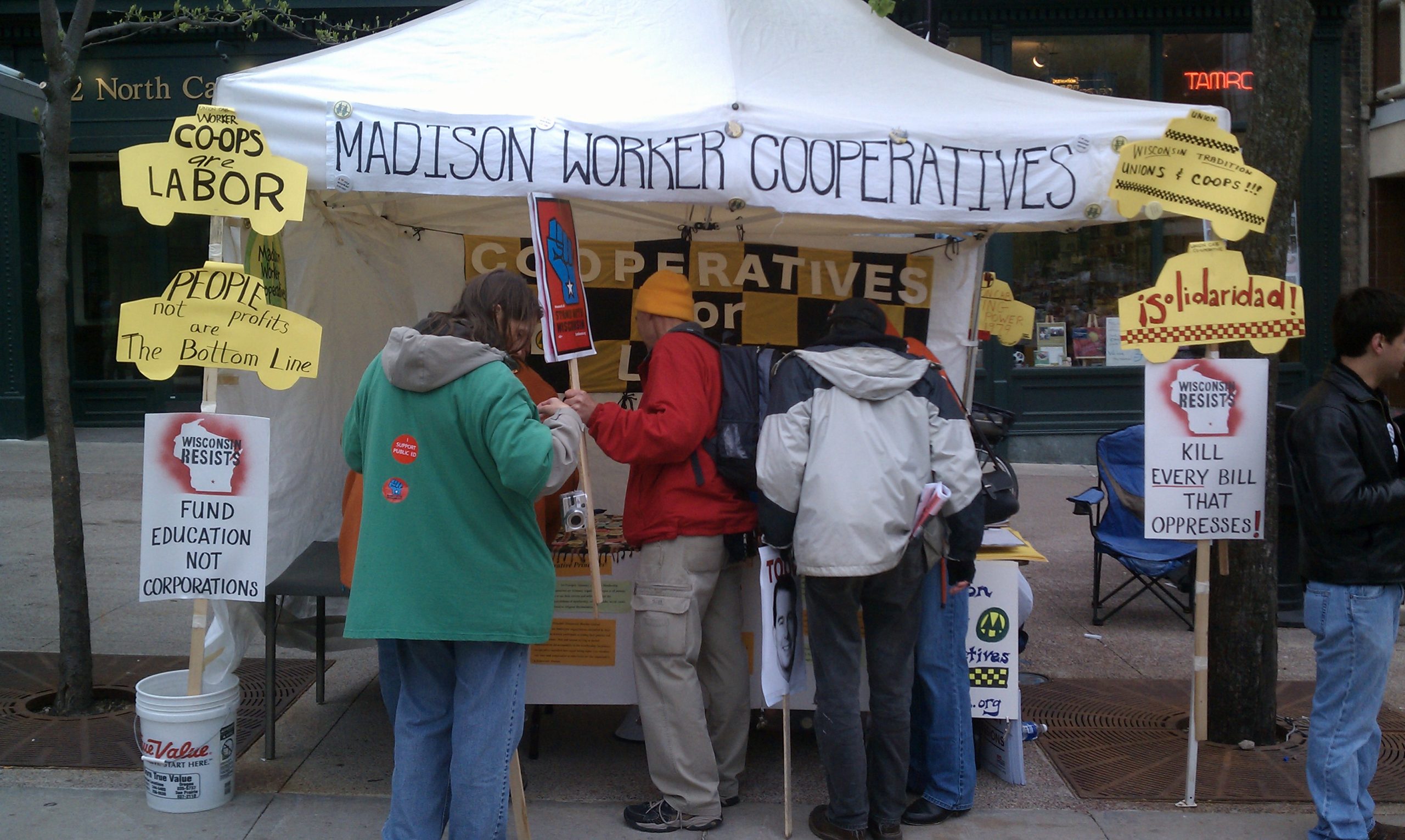
Jacobin’s David Moscrop recently talked with Canadian Centre for Policy Alternatives senior economist and public finance policy analyst Alex Hemingway about his new cowritten report, Expanding Democratic Employee Ownership in Canada: Policy Options and why now might be the time for labor to finance ownership of the means of production.
Models of Worker Ownership
David Moscrop
What are we talking about when we talk about a democratically owned business?
Alex Hemingway
At its most basic, we’re talking about firms that are owned and controlled by the people who work there, rather than by a narrower set of capital owners. That can take different forms and structures. The traditional form is a worker cooperative, which is a form of collective ownership. There can be a lot of variation in how those are run.
It could be operated in a relatively flat, nonhierarchical way, or it could have a more traditional hierarchy with managers that are — and this is an important distinction — elected and recallable by the rest of the workers. So workers have more control, and they share in the value of what they produce. In this model, usually worker cooperatives are started from scratch, but they are sometimes created by the conversion of existing businesses.
The other model I’d want to highlight, which is quite an interesting one, is called an employee-ownership trust. This is a quite powerful model that allows a trust to acquire a firm on behalf of its employees. And importantly, this happens without workers paying anything out of pocket. Instead, the outgoing business owners agree to take deferred payments that come out of the firm’s profits over several years. After that, the profits begin flowing to the workers.
This is a more indirect form of worker ownership where employees will sit on the board of the trust structure. The trust is more at arm’s length from the day-to-day operations of the company, which could in theory continue operating in much the same way if that’s what the trustees decided. In practice though, you do tend to see mechanisms of day-to-day participation for workers emerge on the operational level, and that’s important to realizing the benefits of democratic employee ownership.
David Moscrop
Why aren’t these models more common in Canada?
Alex Hemingway
There are barriers to creating democratic employee-owned firms, and they come in a few categories. It’s really helpful to have clear legal structures that enable the creation of these types of firms, so we’re actually just now in Canada in the process of passing federal legislation that will create an employee-ownership trust structure in this country. So that’ll give a new option for creating employee-owned firms. And that comes with the capital-gains tax break for owners who want to sell to their employees.
Another, broader, set of barriers to employee ownership is accessing capital. Now obviously workers don’t have a lot of capital at their disposal, almost by definition. If they’re looking to start a worker cooperative together, they will often find that banks and other lenders are less familiar with democratic employee-ownership models in Canada because we don’t have many of them. And that can lead to challenges in accessing loan financing. We need policy interventions to deal with that.
There are also collective action problems that arise when you’re trying to create a worker cooperative from scratch. Starting any business is challenging, and it normally requires a lot of legwork by a relatively small set of individuals at the outset. So employee-owned firms don’t offer a ready way to compensate for that start-up work and the risk inherent in it.
Entrepreneurs have an incentive to structure their businesses as a conventional investor-owned business. One way around that collective action challenge is to convert existing businesses to employee ownership rather than starting them from scratch. But another is to have institutions that can help support and incubate new democratic employee-owned firms. And that’s what we see in jurisdictions where these models have been particularly successful. You have sectoral organizations, you have business services companies that are already set up to assist employee-owned firms and worker cooperatives, and that makes getting them off the ground a lot easier. And you also have public capital being put to work — patient capital — to enable the start-up of these types of firms from a financial perspective.
Worker Ownership Is Good for Everyone
David Moscrop
Once a business is stood up as a worker-owned and -controlled enterprise, there seemed to be two categories of goods that emerge. One is economic goods for both the worker and society at large, and the second is the inherent value of democratic control over your workplace. What do these goods look like in practice?
Alex Hemingway
What we see is that employee-owned firms lead to less inequality in terms of wages, greater job security within those firms, and higher pay for the workers since they’re sharing in the profits.
We also see employee-owned firms having more resilience during economic downturns. It tends to be the case that workers get together and try to avoid layoffs. In those situations, they might decide that everyone’s going to temporarily reduce their hours and pay to weather the storm. So there’s that resilience factor. Also, when you have employee-owned firms that are more anchored in the community, the owners are by definition part of that community and more committed to the broader community interests.
We see more job satisfaction, not surprisingly, in employee-owned firms; it turns out that being alienated from your labor in the Marxian sense isn’t such a good thing for job satisfaction. Workers like having some control over their daily lives rather than being at the whims of a boss who’s not accountable. And they’d rather be paid full value for their work. So, not surprisingly, if you look at the polling in the United States, three-quarters of people say they prefer to work in an employee-owned firm — and that preference crosses party lines.
Economic research also shows that employee firms are equally or more productive than conventional firms once you’ve got them stood up. And again, that makes sense when you think about the motivation for workers to contribute to a firm that’s truly their own.
David Moscrop
In the report, you write “We generally take for granted, at least in principle, that everyone has the right to a say and certainly a vote in what our governments do. But in the corporations and workplaces that rule many of our waking hours . . . these minimal democratic rights are largely absent.”
You also point out that revenues in the private model are concentrated among owners, not workers. Why have workers and the country more generally been slow to prioritize a shift to worker-owned and controlled businesses?
Alex Hemingway
I think it goes back to some of those barriers we talked about earlier. As we’ve seen from the polling, there is a lot of latent interest among workers in this type of model. It’s not easy to start up from scratch, and it’s particularly not easy when you’re a working-class person without the capital to put up to start a firm. I think from a worker perspective, it’s pretty straightforward in that sense.
Over the past few years in Canada we’ve seen the emergence of the Canadian Coalition for Employee Ownership, which includes many business owners among its members. There is a section of capital that is interested in this model. I think plenty of business owners who might be retiring in the years ahead are thinking about their succession planning and don’t necessarily want to sell off their business to a large corporation or to a competitor, and they may not have kids that they want to pass it on to or who want to take over the business.
The polling of these owners shows that lots of them are interested in selling to their employees. So, there’s a big window of opportunity in this country for the expansion of employee-owned firms. And combined with the introduction of this new employee-ownership trust legal structure, this conversion process will become easier and more attractive to business owners. It’s being combined with the capital-gains tax break at least for the next few years, since it’s only a temporary tax break at this point.
A Specter Is Haunting Canada
David Moscrop
It sounds to me like we’ve reached a critical juncture. With boomers retiring, there’s going to be a generational shift in capital and control of businesses. How do we tear down the institutional barriers and the psychological barriers that prevent democratic employee ownership of businesses from flourishing?
Alex Hemingway
It’s an interesting question. I think part of the answer relates to many of the other struggles that are needed right now, whether that’s union organizing or fighting for redistribution of wealth through something like a wealth tax. Part of it just comes down to continuing to build up centers of working-class power to fight for these types of priorities in the political system.
I think the ground is fertile in many ways, some of which will result from the retiring boomers, some in terms of the recent policy developments. But we’re also in this era of extremely high inequality. I think there’s growing social and political polarization and disillusionment with institutions, so I think there’s an opening for some fundamental shifts in the way our economy runs. It’s not a great leap for many working people to imagine that life might be better with ownership and control over the company they work in.
In terms of how this plays out over time, I think one of the exciting things about the introduction of the employee-ownership trust structure in Canada is that we’ve seen this become very successful in a short period of time in the UK. Now there are hundreds of employee-owned businesses created in that country each year since the model was introduced in 2016. And I think the expansion of that sector can hopefully be self-reinforcing and create a new resource base for working class-power and struggles complimentary to the union movement and social movements.
I think there’s no doubt that if democratic employee ownership is able to reach a critical mass in Canada one day, it’s going to start making big capital pretty worried. So, like any other struggle, it comes down to having that base of organized working-class power to sustain it and push it forward.
ZNetwork is funded solely through the generosity of its readers.
Donate




