


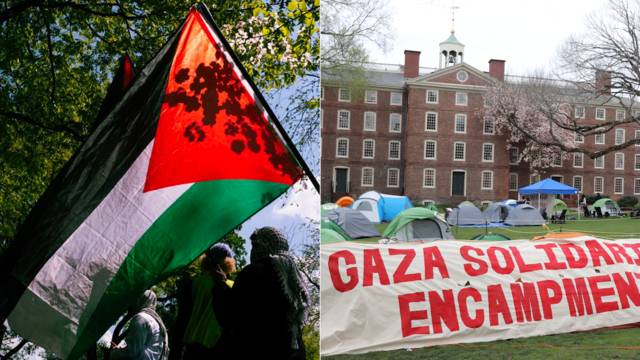
What if universities negotiated with students engaged in Gaza solidarity protests, instead of calling the police to violently arrest them? A mass movement opposing Israel’s ongoing assault on Gaza has spread like wildfire this Spring. Student organizers have issued demands ranging from university divestment from companies profiting from the war on Gaza and from Israel’s occupation of Palestine, to the creation of Palestinian studies programs, and more. In most cases, sadly, officials have responded with brute force, calling in police and destroying encampments. Republican House Speaker Mike Johnson called for the deployment of the National Guard, while New Jersey Democratic Congressman Josh Gottheimer wants to get the FBI involved, The Intercept reports. Thousands of students and faculty have been arrested so far this Spring, with several seriously injured.
“We set up for seven days,” Rafi Ash, a student at Brown University, said on the Democracy Now! news hour, describing Brown’s Gaza solidarity encampment. “Disciplinary threats…really did not sway students,”Rafi, part of Brown Jews for a Ceasefire Now, explained. “We were able to force them to the table on Monday of last week, and that led to a multi-day negotiation process…we were able to actually push to force a vote on divestment, that’s never happened before at Brown, something that we’ve been pushing for for a long time.”
For many Brown students, the war on Gaza hit home last Thanksgiving, when a white man shot Brown junior Hisham Awartani, along with his two close friends, all Palestinian Americans, while they were taking a walk near Hisham’s grandmother’s home in Burlington, Vermont. Hisham was paralyzed.
Students at Evergreen State College in Olympia, Washington, also successfully negotiated with their administration. The Evergreen community has its own painful connection to Gaza. Rachel Corrie was an Evergreen student in 2003 when she traveled to Rafah, in southern Gaza. Rachel was crushed to death by an Israeli military Caterpillar bulldozer on March 16th, 2003, while non-violently defending a Palestinian home from demolition.
Alex Marshall, a graduating Evergreen senior, explained on Democracy Now! how that history influenced negotiations:
“She’s been gone for 20 years, but her memory lives on amongst the student body… I’ve read her emails to her parents in multiple classes that I’ve taken at Evergreen.”
Through negotiations, Alex summarized, “we focused on divesting from companies that are profiting off of Israel’s occupation of Palestine…they also agreed to release a statement calling for a ceasefire and acknowledging the International Court of Justice’s genocide investigation.”
At Rutgers, New Jersey’s main public university, students also achieved a negotiated settlement.
“It was a four-day encampment. As a result of our collective efforts, we were able to have the Rutgers administration agree to commit to eight out of 10 demands,” Aseel, a Palestinian student at Rutgers-New Brunswick with family in Gaza, said on Democracy Now!, using only her first name for safety reasons.
“We demanded [Rutgers] divest from Israel, from Israeli apartheid and settler colonialism,” Aseel explained. “We did get an agreement to have a meeting with the Joint Committee on Investments, with the Board of Governors, with President Holloway, for divestment…we had been asking for a meeting for five years, and we finally got one.”
Calls for a ceasefire are mounting, pressuring the Biden administration. Sadly, any negotiated ceasefire will be too late for many Palestinians in Gaza, where the official death toll approaches 35,000.
“Nearly a hundred of my [family] members were martyred,” Aseel said. “I still have family left. I am still in contact with them. But they are all displaced. Our family home is basically destroyed…The Gaza that I once knew is essentially gone. But I am more than confident, along with my family, that we will return and that we will rebuild it.”
While many Jewish students have participated in the Gaza protests, mainstream media outlets focus on Jewish students who are opposed, saying the protests make them feel uncomfortable or threatened.
Frederick Lawrence, former president of Brandeis University, responded on Democracy Now!
“Many people feel that when they hear views that they deeply disagree with, that’s threatening to them. That’s not how universities operate. You are not entitled to be intellectually safe. You are entitled to be physically safe.” Brandeis was founded after World War II in the wake of the Holocaust, and named after Louis Brandeis, the first Jewish Supreme Court justice, known for his advocacy of free speech. Universities, Lawrence said, “exist for the purposes of creating and discovering knowledge.”.
Additional negotiated settlements have been announced at Pitzer College, University of California–Riverside, Sacramento State and Middlebury College. All these examples should be studied closely by university administrators, before they call in the police with their batons, rubber bullets, tear gas and handcuffs.
ZNetwork is funded solely through the generosity of its readers.
Donate

