
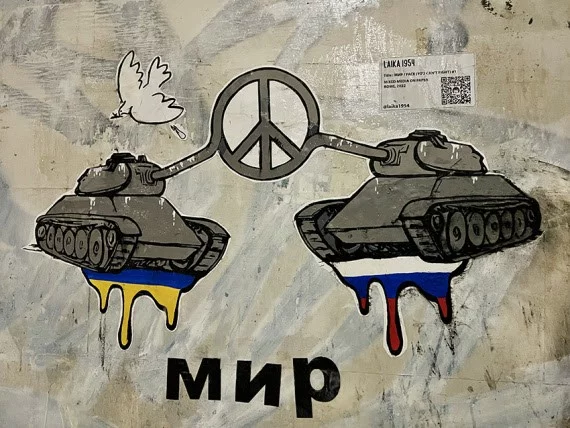
Source: Common Dreams

David Goeßmann: The talks a few weeks ago between Russia and Ukraine in Istanbul came to nothing. What are the chances for peace?

Anatol Lieven: I see no prospect for an end to the war at present. Russia and Ukraine remain far apart on peace terms, and the Trump administration has not put forward a compromise proposal of its own. The Russian generals are reportedly telling Russian President Vladimir Putin that Ukraine will collapse by early next year, and Putin is willing to fight on, at least for a while. We will have to see what happens on the battlefield, and to the Russian economy.

David Goeßmann: What makes it so difficult to find a diplomatic solution for the Ukraine war?

Anatol Lieven: Ukraine will never legally recognize Russian sovereignty over the occupied territories, but cannot reconquer them. So a cease-fire will have to take place along the existing battle line, and the question of their legal status will have to be left for future negotiation—as Ukrainian President Volodymyr Zelenskyy proposed soon after the start of the war.

In my judgement, internal political factors make it impossible for the Ukrainian government to make a peace offer that Russia could accept—just as the French establishment could not make peace with the Communists in Vietnam long after the war there was clearly lost. The Europeans are far too divided to make a coherent joint proposal. So the initiative for peace will have to come from the U.S.

The European states will have to be consulted about the future of sanctions and the Russian assets in Europe that they have seized. But they are incapable of uniting behind a serious peace strategy.

David Goeßmann: In Europe and the U.S. it is feared that Russia will go beyond Ukraine and invade other European countries? Your take on that.

Anatol Lieven: Russian military capabilities and intentions vis a vis NATO have both been hugely exaggerated. Even hybrid moves (which are not “war”) have so far been very small and in the nature of warnings not serious attacks. Russian nuclear bluster has been intended to deter NATO from intervening in Ukraine, not as the prelude to a Russian attack on NATO.

David Goeßmann: NATO has decided that each member state should spend 5% of its GDP on military and related infrastructure. How do you assess this unprecedented militarization?

Anatol Lieven: These figures are absurd. Five percent of E.U. GDP would be approximately $900 billion a year—as much as the U.S. and almost three times the military budgets of Russia and China put together. That is quite unnecessary, and impossible. This is an empty bribe to U.S. President Donald Trump to keep the U.S. committed to Europe, not a serious strategy.

David Goeßmann: The struggle for global primacy continues under Trump, see the bombing of Iran or the confrontation with China. Where are we heading?

Anatol Lieven: The desire for universal U.S. hegemony (also known as the “Wolfowitz Doctrine”) is a megalomaniac project that cannot possibly be sustained for long. The only question is whether the U.S. can abandon it incrementally and peacefully, or if it goes down in blood and fire taking many other countries with it.

Among the nuclear-armed powers, we can hope that the fear of nuclear annihilation will stop them from going over the brink into war with each other. The example of India and Pakistan shows that Mutually Assured Destruction (MAD) can actually work—for without it, India would have invaded Pakistan long ago. But the liberal dream of a global “Democratic Peace” is dead as a nail, killed by Israel and the U.S. itself just as much as by Russia.


This article was originally published by Common Dreams; please consider supporting the original publication, and read the original version at the link above.

David Goeßmann is a journalist and author based in Berlin, Germany. He has worked for several media outlets including Spiegel Online, ARD, and ZDF. His articles have appeared on Truthout, Common Dreams, The Progressive, Progressive International, among others. In his books, he analyzes climate policies, global justice, and media bias.


ZNetwork is funded solely through the generosity of its readers.

Donate
Donate
Leave A Reply

Subscribe

All the latest from Z, directly to your inbox.

Institute for Social and Cultural Communications, Inc. is a 501(c)3 non-profit.

Our EIN# is #22-2959506. Your donation is tax-deductible to the extent allowable by law.

We do not accept funding from advertising or corporate sponsors.  We rely on donors like you to do our work.

ZNetwork: Left News, Analysis, Vision & Strategy

THE WIND CRIES FREEDOM

The Wind Cries Freedom, the new book from Z co-founder Michael Albert, is a sweeping oral history of a future American revolution.

Through thirty interconnected chapters, it draws out the strategies, failures, turning points, and hard-won wisdom of a movement that called itself the Revolutionary Participatory Society. These are not the polished memoirs of politicians: they are the unfiltered accounts of people who organized in neighborhoods, hospitals, universities, stadiums, courthouses, and places of worship, and kept a shared vision alive through cynicism and exhaustion.

The result is speculative political fiction that reads like history: messy, human, and quietly hopeful in the way that only real experience and long thought can produce.

Get your copy and peruse more features on the book’s website below.

“Read it, argue with it, but don’t look away. The future it recalls is one we must still fight to deserve.”

Yanis Varoufakis

“The most unusual and intriguing combination of prophecy, manifesto, and movement building manual that I have ever encountered.”

Bill Fletcher Junior

“This work fills a huge gap in our social movement literature.”

Cynthia Peters

Subscribe

All the latest from Z, directly to your inbox.

This is your article this month.

We’re glad you keep coming back. If Z’s work has informed, challenged, or inspired you, that’s no accident: there are no paywalls, no ads, and no billionaire owners here, and there never will be. Independent media survives because readers choose to support it.

Billionaires fund their own media. We fund ours. Help us reach 1,000 sustaining donors:

Number of donors693
Our goal1,000

Sustainers at $9/month or more receive the digital Z Magazine.

Already a sustainer? Click here and we won’t ask again. Thank you!

Your reading count is stored only in your browser and is never sent to us.

Sound is muted by default.  Tap 🔊 for the full experience

CRITICAL ACTION

Critical Action is a longtime friend of Z and a music and storytelling project grounded in liberation, solidarity, and resistance to authoritarian power. Through music, narrative, and multimedia, the project engages the same political realities and movement traditions that guide and motivate Z’s work.

If this project resonates with you, you can learn more about it and find ways to support the work using the link below.

Independent media is not disappearing because the ideas are weak.

It is disappearing because platforms reward speed, outrage, and algorithmic visibility over thoughtful analysis.

More than 100,000 people read Z every month, free of paywalls, ads, and billionaire owners. It takes fewer than 1 in 100 of them to fund all of it: 1,000 donors who keep Z independent, for everyone, and build what comes next.

Number of donors693
Our goal1,000

Sustainers at $9/month or more receive the digital Z Magazine.

Subscribe

Join the Z Community – receive event invites, announcements, a Weekly Digest, and opportunities to engage.

OUT NOW: "The Wind Cries Freedom" by Michael Albert

Exit mobile version

