

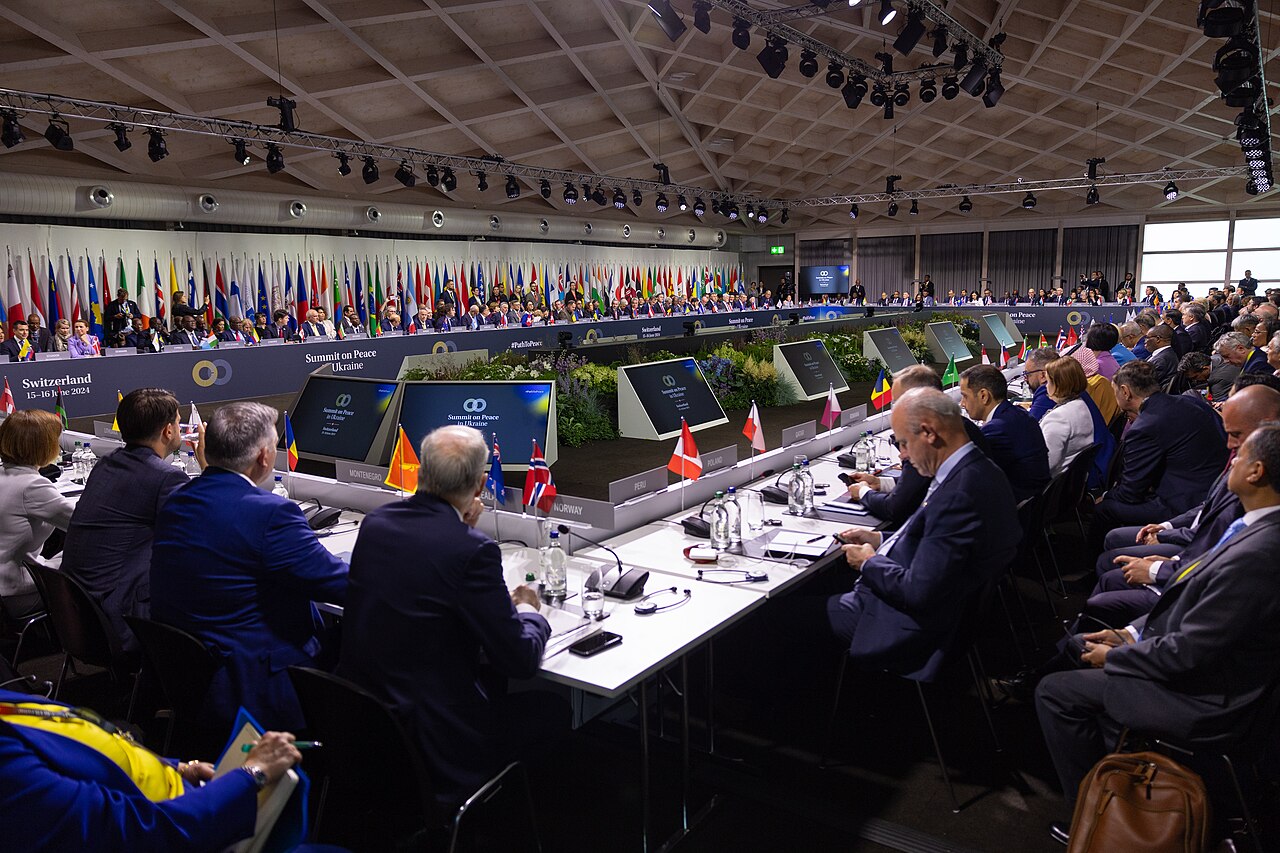
The Western powers held a conference in Switzerland in June in an attempt to gain more international support for Ukraine in its war with Russia.
The vast majority of the world population, in the Global South, rebuked this so-called “Summit on Peace in Ukraine”, to which Russia was not invited.
Only 78 countries, mostly in Europe, endorsed the meeting’s final declaration. Together, these nations represented a small minority of the global population.

At least 160 countries were invited to the conference from June 15 to 16 in Bürgenstock, Switzerland. Just around 90 ended up attending, and most sent low-level officials.
A total of 78 countries signed the “Bürgenstock Declaration”. Major nations chose not to endorse the statement, including Brazil, India, Mexico, Saudi Arabia, South Africa, Thailand, and the United Arab Emirates.
CNBC lamented that the summit “lacks clout”, and was boycotted by China, in protest of the fact that Russia was not invited.
Switzerland’s state media outlet Swissinfo conceded that the “Ukraine peace summit failed to meet ‘fairytale’ expectations”, and that the joint communiqué “was rejected by several key countries”.
One of the reasons that so many Global South nations opposed the Bürgenstock Declaration was because it blamed the war solely on Russia, not acknowledging the role of NATO expansion in fueling the conflict, and not recognizing Moscow’s legitimate security concerns.
In racist rant, Zelensky claims China and Brazil are not “civilized”
Ukraine’s NATO-backed leader Volodymyr Zelensky angrily responded to the Global South’s criticism with racist rhetoric, asserting that China and Brazil are not “civilized” like the West.
“As soon as Brazil and China join the principles that all of us here, civilized countries, have united, we will be happy to hear their opinions, sometimes even if they do not coincide with the majority of the world”, Zelensky said at the summit, according to an official Ukrainian media translation.
Zelensky’s claim that “the majority of the world” is with his government is objectively false. The vote at the conference demonstrated that only a small minority of countries support Ukraine’s NATO-backed war efforts.
China makes numerous peace proposals; West rejects them
China has made numerous peace proposals in an attempt to end the war in Ukraine.
In February 2023, Beijing introduced a 12-point peace plan to try to foster a political settlement. The US and its European allies rejected this initiative.
In May 2024, China and Brazil issued a joint proposal for negotiations, calling for an “international peace conference held at a proper time that is recognized by both Russia and Ukraine, with equal participation of all parties as well as fair discussion of all peace plans”.
While the West rebuked these offers, the Bürgenstock Declaration ironically ended up borrowing several points from China’s proposals, albeit by watering them down and removing the demands for a cessation of hostilities and peace talks.
Although Beijing boycotted the June 2024 Swiss conference in protest of Russia’s absence, it continued to promote its own peace plan.
As the Bürgenstock summit concluded, China’s deputy permanent representative to the United Nations, Geng Shuang, reiterated at the UN Security Council, “China calls on the parties to the conflict to demonstrate political will, come together, and start peace talks as soon as possible to achieve a ceasefire and halt military actions”.
Colombia’s President Petro says Ukraine summit seeks more war, not peace
Colombia’s left-wing President Gustavo Petro criticized the Swiss summit, writing on the day the event began that “it is not a free forum to discuss paths to peace between Russia and Ukraine. Its conclusions are already predetermined”.
Petro insisted that “dialogue between Russia and Ukraine is fundamental”. He also called for “the establishment of a security zone without nuclear weapons that physically separates NATO from Russia”.
The Colombian president revealed that he had been invited to the meeting, but chose not to attend, because “what we have found in the conference is basically an alignment with the side of war, and we do not agree with that; Latin America does not want more war, what it wants is the construction of peace, as soon as possible”.
ZNetwork is funded solely through the generosity of its readers.
Donate




