


Afew miles outside Orient, Iowa, along an unpaved road, sits the farm where Franklin Roosevelt’s second vice president, Henry Wallace, was born in 1888. In a room filled with memorabilia from the days when FDR and Wallace championed an Economic Bill of Rights, Senator Bernie Sanders spoke with me about the need for the Democratic Party to be as bold as it was in Roosevelt and Wallace’s day.
—John Nichols
JN: You have made it a mission of this campaign to renew the Economic Bill of Rights, to take this 75-year-old idea and bring it to the present. Why?
BS: The answer is that we have to rethink politics in America. What Roosevelt said back in 1944 is we have a Bill of Rights, which protects our political freedoms, and that’s important. But we have nothing to guarantee economic freedoms. The question, in essence, that Roosevelt was asking is: If today you’re making $9 an hour, if today you have no health care, if today you can’t afford a higher education, how free are you, really? And that’s the discussion we need. What does freedom mean?
JN: How do you answer that question?
BS: Freedom does not mean that you’re sleeping out on the streets. Freedom does not mean that you’re $100,000 in debt because you went to college. Freedom does not mean that you can’t go to the doctor when you’re sick. We have to redefine what freedom means, and that’s what fighting for an Economic Bill of Rights is about.
All that we are saying—and this is not radical, some of it already exists in other countries—is this: Health care is a human right. The United States has got to join every other major country in guaranteeing that. If you work 40 hours a week and you can’t make it on $10 an hour, then we have to raise that minimum wage to at least $15 an hour and make sure that workers can join a union. All over this country now, we have a housing crisis. It’s not just half a million people sleeping out on the streets. It’s people paying 50 to 55 percent of their incomes on housing. Freedom means that you have decent housing at a cost that you can afford. Freedom means that when you turn on your faucet, the water that comes out is drinkable.
JN: In 1944 and 1945, Wallace was saying that an Economic Bill of Rights had to protect people of all races and backgrounds. That was, at the time when the Democratic Party had a segregationist bloc, considered radical.
BS: They had segregationists leading the party!
JN: In many cases, yes. And I would argue that the Democratic Party compromised its vision. For a long period after Roosevelt and Wallace, the party pulled its punches. It strikes me that when you talk about a political revolution, you are using FDR as a touchstone and saying: Come on, let’s be a party with a bigger vision.
BS: If you want to reach back to Roosevelt, you reach back to 1936, [when FDR said he] welcomed the hatred of the economic royalists. What Roosevelt understood is that you have entrenched economic interests—he called them economic royalists, we call them the billionaire class—who will do anything to protect their wealth and power. You cannot bring about real change unless you are prepared to confront these people.
One of the points of this campaign is to ask questions the corporate media will not. Where is the power in America? Why aren’t things changing? I want to force discussions on those issues because—I’ve said it a million times, and I’ll say it again—no president, not Bernie Sanders or anybody else, can do it alone. We can’t transform this economy, this government, unless millions of people are involved in a grassroots political movement to challenge the power structure of this country.
So this campaign is about two things. It’s certainly about winning here in Iowa and winning the nomination and beating Trump. But it is also about transforming America. The way we do that is through a movement not dissimilar to the civil rights movement, the women’s movement, the gay rights movement, the labor movement. That’s how change takes place.
John Nichols is The Nation’s national-affairs correspondent and host of Next Left, The Nation’s podcast where politics gets personal with rising progressive politicians. He is the author of Horsemen of the Trumpocalypse: A Field Guide to the Most Dangerous People in America, from Nation Books, and co-author, with Robert W. McChesney, of People Get Ready: The Fight Against a Jobless Economy and a Citizenless Democracy.

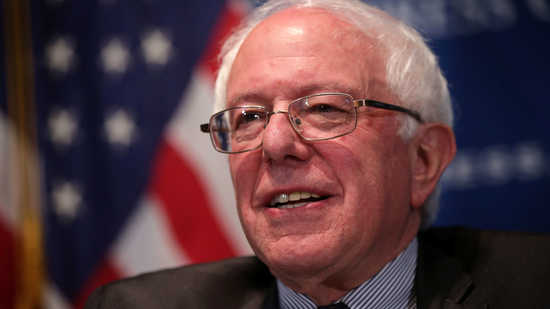
Bernie Sanders (born September 8, 1941) is an American politician, presidential candidate, and activist who has served as a United States senator for Vermont since 2007, and as the state’s congressman from 1991 to 2007. Before his election to Congress, he was mayor of Burlington, Vermont. Sanders is the longest-serving independent in U.S. congressional history. He has a close relationship with the Democratic Party, having caucused with House and Senate Democrats for most of his congressional career. Sanders self-identifies as a democratic socialist and has been credited with influencing a leftward shift in the Democratic Party after his 2016 presidential campaign. An advocate of social democratic and progressive policies, he is known for his opposition to economic inequality and neoliberalism.

ZNetwork is funded solely through the generosity of its readers.
Donate




