

When the Office of the United States Trade Representative recently announced proposed tariffs of 10% to 12.5% on imports from 60 global economies—citing their systemic failure to restrict forced labor within their supply chains—it sent an unequivocal message across the global market. Human rights compliance is no longer merely a regulatory safeguard; it has been elevated into an active, aggressive weapon of American trade diplomacy. Armed with targeted embargoes, Withhold Release Orders, and sweeping trade penalties under Section 301 of the Trade Act of 1974, Washington has long claimed the moral high ground as the world’s preeminent ethics inspector.
By framing labor exploitation abroad as an unfair economic practice that undermines domestic manufacturing, the United States presents its tariff crusade as both a defense of human dignity and a protection of the international economic order. Yet, behind this righteous diplomatic posture lies a glaring structural paradox. Within the borders of the self-appointed global enforcer, forced labor is not merely an illicit shadow economy operated by bad actors or criminal cartels; it remains a constitutionally sanctioned, legally protected, and multi-billion-dollar component of the American domestic economy.
This institutional cognitive dissonance rests upon a century-and-a-half-old anomaly embedded in the fundamental law of the land: the “exception clause” of the Thirteenth Amendment to the U.S. Constitution. While the amendment famously abolished slavery and involuntary servitude in 1865, it explicitly preserved both as “a punishment for crime whereof the party shall have been duly convicted.” What was originally structured as a post-Civil War penal loophole has evolved over generations into a modern industrial apparatus. Across federal and state penitentiaries today, roughly 800,000 incarcerated Americans work under conditions that directly mirror the exact international criteria U.S. trade authorities use to penalize foreign trading partners.
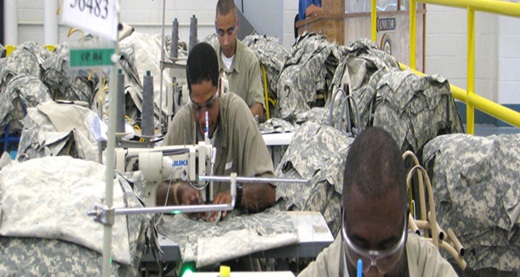
Incarcerated laborers manufacture military hardware, staff emergency call centers, fabricate office furniture, and harvest agricultural crops for state enterprises and private corporate contractors—often for compensation ranging from a few cents an hour to nothing at all. Under International Labour Organization (ILO) standards, prison labor is non-coercive only when performed voluntarily, under conditions approximating a free labor market, and without the threat of penalty. Within the American penal framework, however, “voluntariness” is largely a legal fiction. Incarcerated individuals who refuse work assignments routinely face explicit administrative penalties, including prolonged solitary confinement, the loss of earned good-time credits toward early release, and the revocation of family visitation rights. Stripped of basic legal rights to collective bargaining, minimum wage protections, and federal occupational safety oversight, these workers generate immense value while remaining legally captive.
The hypocrisy deepens when examining global trade flows and supply chain regulations outside the penitentiary wall. While Section 307 of the Tariff Act of 1930 strictly prohibits the importation of goods produced by foreign prison or forced labor into the United States, American federal law contains no parallel prohibition against exporting goods produced by incarcerated American workers to foreign markets. Washington demands total supply-chain transparency and clean labor practices from its international partners, while simultaneously permitting domestic state enterprises to export prison-manufactured commodities into the international marketplace.
Furthermore, domestic reliance on coercive labor practices extends well beyond penal institutions into the agricultural economy. In the fields of the American South and Southwest, hundreds of thousands of migrant farmworkers operating under temporary H-2A guest-worker visas encounter conditions that frequently verge on modern debt bondage. Because these visas lock a worker’s legal residency directly to a single sponsoring employer, the threat of termination functions as an absolute instrument of coercion. Workers who protest systemic wage theft, unsafe exposure to toxic pesticides, or squalid housing facilities face immediate termination and deportation. This structural imbalance of power regularly produces documented instances of human trafficking within the U.S. food supply—the exact sector Washington routinely scrutinizes when inspecting imports from the Global South.
For American foreign policy, this persistent double standard carries severe geopolitical consequences. In an era marked by intense great-power competition, moral authority and credibility function as essential strategic currencies. When American diplomats reprimand developing nations or threaten sweeping tariffs under the banner of anti-coercion, capitals across Asia, Latin America, and Africa increasingly view these measures not as a principled defense of universal human rights, but as an exercise in economic protectionism and strategic leverage. Foreign governments routinely point to America’s penal labor statistics and agricultural visa abuses to blunt Washington’s moral critiques, blunting the effectiveness of U.S. human rights advocacy on the world stage.
Restoring America’s strategic credibility requires a comprehensive, fundamental alignment of its domestic legal realities with its foreign policy rhetoric. This journey must begin at the foundational level through constitutional reform. Lawmakers must pass initiatives like the Abolition Amendment to eliminate the Thirteenth Amendment’s penal exception clause, effectively stripping state and federal penal systems of the constitutional authority to coerce labor under threat of punishment.
Simultaneously, legislative action must extend basic fair wage protections, occupational safety oversight, and voluntary employment guarantees to incarcerated individuals, ensuring that prison labor operates under standards that satisfy international law. In the agricultural sector, reforming the H-2A visa framework by decoupling worker legal status from single employers would empower migrant farmworkers to report systemic abuses without facing immediate expulsion. Finally, federal trade authorities must enforce strict reciprocal standards, ensuring that American prison-made commodities are subjected to the exact same export restrictions that U.S. Customs aggressively applies to foreign imports.
Diplomacy conducted from a house of cards is inherently fragile. Until Washington confronts and dismantles the institutionalized exploitation within its own borders, its global crusade against forced labor will continue to be viewed by the international community not as a beacon of justice, but as a doctrine of geopolitical convenience.
ZNetwork is funded solely through the generosity of its readers.
Donate




