


A clash of two insurgencies is now shaping the west. Progressives on both sides of the Atlantic are on the sidelines, unable to comprehend what they are observing. Donald Trump’s inauguration marks its pinnacle.
One of the two insurgencies shaping our world today has been analysed ad nauseum. Donald Trump, Nigel Farage, Marine Le Pen and the broad Nationalist International that they are loosely connected to have received much attention, as has their success at impressing upon the multitudes that nation-states, borders, citizens and communities matter.
However, the other insurgency that caused the rise of this Nationalist International has remained in the shadows: an insurrection by the global establishment’s technocracy whose purpose is to retain control at all cost. Project Fear in the UK, the troika in continental Europe and the unholy alliance of Wall Street, Silicon Valley and the surveillance apparatus in the United States are its manifestations.
The era of neoliberalism ended in the autumn of 2008 with the bonfire of financialisation’s illusions. The fetishisation of unfettered markets that Margaret Thatcher and Ronald Reagan brought to the fore in the late 1970s had been the necessary ideological cover for the unleashing of financiers to enable the capital flows essential to a new phase of globalisation in which the United States deficits provided the aggregate demand for the world’s factories (whose profits flowed back to Wall Street closing the loop nicely).
Meanwhile, billions of people in the “third” world were pulled out of poverty while hundreds of millions of western workers were slowly sidelined, pushed into more precarious jobs, and forced to financialise themselves either through their pension funds or their homes. And when the bottom fell out of this increasingly unstable feedback loop, neoliberalism’s illusions burned down and the west’s working class ended up too expensive and too indebted to be of interest to a panicking global establishment.
Thatcher’s and Reagan’s neoliberalism had sought to persuade that privatisation of everything would produce a fair and efficient society unimpeded by vested interests or bureaucratic fiat. That narrative, of course, hid from public view what was really happening: a tremendous buildup of super-state bureaucracies, unaccountable supra-state institutions (World Trade Organisation, Nafta, the European Central Bank), behemoth corporations, and a global financial sector heading for the rocks.
After the events of 2008 something remarkable happened. For the first time in modern times the establishment no longer cared to persuade the masses that its way was socially optimal. Overwhelmed by the collapsing financial pyramids, the inexorable buildup of unsustainable debt, a eurozone in an advanced state of disintegration and a China increasingly relying on an impossible credit boom, the establishment’s functionaries set aside the aspiration to persuade or to represent. Instead, they concentrated on clamping down.
In the UK, more than a million benefit applicants faced punitive sanctions. In the Eurozone, the troika ruthlessly sought to reduce the pensions of the poorest of the poor. In the United States, both parties promised drastic cuts to social security spending. During our deflationary times none of these policies helped stabilise capitalism at a national or at a global level. So, why were they pursued?
Their purpose was to impose acquiescence to a clueless establishment that had lost its ambition to maintain its legitimacy. When the UK government forced benefit claimants to declare in writing that “my only limits are the ones I set myself”, or when the troika forced the Greek or Irish governments to write letters “requesting” predatory loans from the European Central Bank that benefited Frankfurt-based bankers at the expense of their people, the idea was to maintain power via calculated humiliation. Similarly, in America the establishment habitually blamed the victims of predatory lending and the failed health system.
It was against this insurgency of a cornered establishment that had given up on persuasion that Donald Trump and his European allies rose up with their own populist insurgency. They proved that it is possible to go against the establishment and win. Alas, theirs will be a pyrrhic victory which will, eventually, harm those whom they inspired. The answer to neoliberalism’s Waterloo cannot be the retreat to a barricaded nation-state and the pitting of “our” people against “others” fenced off by tall walls and electrified fences.
The answer can only be a Progressive Internationalism that works in practice on both sides of the Atlantic. To bring it about we need more than fine principles unblemished by power. We need to aim for power on the basis of a pragmatic narrative imparting hope throughout Europe and America for jobs paying living wages to anyone who wants them, for social housing, for health and education.
Only a third insurgency promoting a New Deal that works equally for Americans and Europeans can restore to a billion people living in the west sovereignty over their lives and communities.

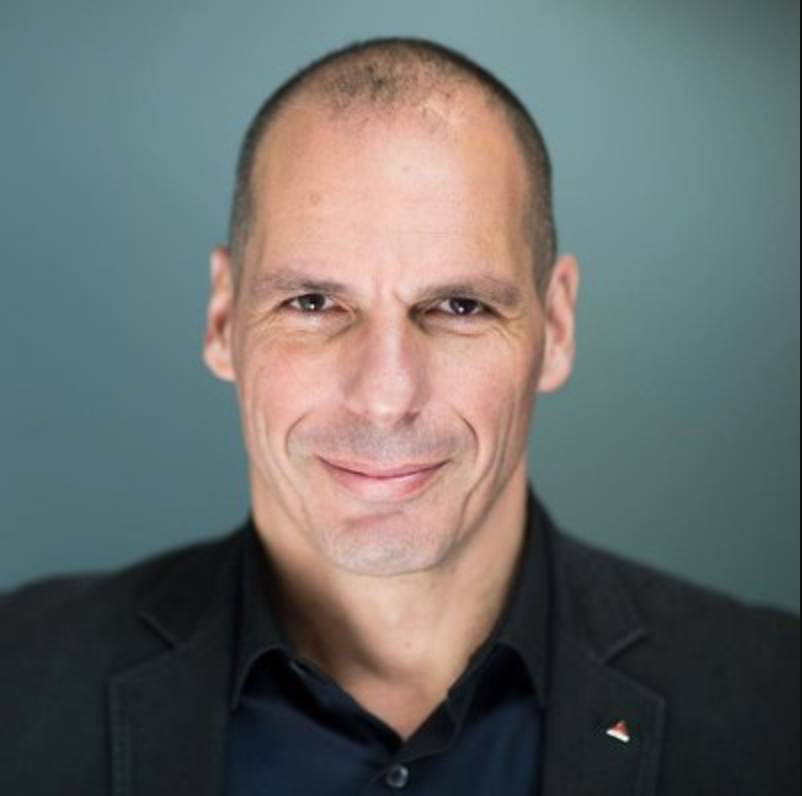
Yanis Varoufakis born 24 March 1961 is a Greek economist, politician, and co-founder of DiEM25. A former academic, he served as the Greek Minister of Finance from January to July 2015. Since 2019, he is again a Member of Greek Parliament and MeRA25 leader. He is the author of several books including, Another Now (2020). Varoufakis is also a professor of Economics – University of Athens, Honorary Professor of Political Economy – University of Sydney, Honoris Causa Professor of Law, Economics and Finance – University of Torino, and Distinguished Visiting Professor of Political Economy, Kings College, University of London.
ZNetwork is funded solely through the generosity of its readers.
Donate





1 Comment
The New Deal scheme is excellent and it applies to the U.S. as well as Europe (with some modifications). However, it leaves out one important factor: the militarization of the global economy and all of the political/economic/ecological issues that go along with militarized neoliberal global imperialism.
Though Europe is much less militarized than the monster across the pond, it is deeply involved in global imperialism. Not only does this result in mass murder, degradation of environments and massive wastes of capital; imperialism defines the political direction of any nation or federation of nations.
It is impossible to separate a domestic political-economy from the voracious demands of empire and it seems the Euro New Dealers need to address this central question – or they will simply become twins of progressives and leftists in the U.S. who fail to see the connections ala Bernie Sanders, et. al.
There cannot be economic justice without peace.