


I turned with interest to Oliver Kamm’s critique (Prospect, November 2005) of the “crude and dishonest arguments” he attributes to me, hoping to learn something. And learn something I did, though not quite what Kamm intended; rather, about the lengths to which some will go to prevent exposure of state crimes and their own complicity in them.
His substantive charges are as follows. To demonstrate “a particularly dishonest handling of source material,” Kamm alleges that, Chomsky “manipulates a self-mocking reference in the memoirs of the then US ambassador to the UN… to yield the conclusion that Moynihan took pride in Nazi-like policies.” The topic is Indonesia’s 1975 invasion of East Timor, condemned by the security council, which ordered Indonesia to withdraw, to no effect. Moynihan explains why: “The US wished things to turn out as they did, and worked to bring this about. The department of state desired that the UN prove utterly ineffective in whatever measures it undertook. This task was given to me, and I carried it forward with no inconsiderable success.” He then refers to reports that within two months 60,000 people had been killed, “10 per cent of the population, almost the proportion of casualties experienced by the Soviet Union during the second world war”—at the hands of Nazi Germany. His comparison, not mine, as Kamm pretends.
Atrocities continued through to the final paroxysm of violence in August-September 1999, until Clinton ordered a halt a few weeks later. Indonesia instantly withdrew, making it clear who bears responsibility for one of the closest approximations to true genocide of the postwar period.
According to Kamm, I “deployed fanciful arithmetic to draw an equivalence” between 9/11 and Clinton’s destruction of the al-Shifa pharmaceutical plant, which produced half of Sudan’s medical supplies. The equivalence is, again, his fanciful construction. Discussing the “horrendous crime” committed on 9/11 with “wickedness and awesome cruelty,” I mentioned that the toll may be comparable to the consequences of Clinton’s bombing of the Sudan, about which I said nothing further. This single phrase was a considerable understatement, judging by the “fanciful arithmetic,” which Kamm ignores. Among other sources I later cited were the German ambassador to Sudan, who wrote in the Harvard International Review that “several tens of thousands” died as a result of the bombing, and a similar estimate in the Boston Globe by the regional director of the Near East Foundation.
Kamm claims that I provided no evidence that the US was bombing Afghanistan with the knowledge that it might lead to the death of millions of people. But I cited extensive evidence from credible sources. Once again, more instructive than the transparent falsification is Kamm’s cold indifference to reports he claims do not exist.
To demonstrate further how my “political judgements have only become more startling over the past decade,” Kamm cites my statement that the situation in Bosnia is “not so simple.” I deteriorated further as a “prophet of the amoral quietism of the Major government,” in Kamm’s rendition, by “depicting Milosevic’s regime as a wronged party” by documenting the fact that Nato “moved at once to violate” the agreements it had signed to end the Kosovo conflict.
To demonstrate my “central” doctrine, Kamm misquotes my statement that, “We have to ask ourselves whether what is needed in the US is dissent—or denazification.” The context, which he omits, is a 1968 report in the New York Times of a protest against an exhibit at the Chicago Museum of Science and Industry where children could “enter a helicopter for simulating firing of a machine gun at targets” in Vietnam, with a light flashing when a hit was scored on a hut. This was a year after the warning by the highly respected military historian and Vietnam specialist Bernard Fall that “Vietnam as a cultural and historic entity… is threatened with extinction… [as]… the countryside literally dies under the blows of the largest military machine ever unleashed on an area of this size.”
Apart from misquoting and omitting the crucial context, Kamm also fails to tell us how one should react to this performance, aside from his own standard tacit acquiescence to horrendous crimes and his dedicated efforts, failing with impressive consistency, to find something to criticise in the efforts to terminate state crimes for which he and I share responsibility, particularly as in a free society, we cannot plead fear as an excuse for silent complicity.

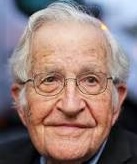
Noam Chomsky (born on December 7, 1928, in Philadelphia, Pennsylvania) is an American linguist, philosopher, cognitive scientist, historical essayist, social critic, and political activist. Sometimes called "the father of modern linguistics", Chomsky is also a major figure in analytic philosophy and one of the founders of the field of cognitive science. He is a Laureate Professor of Linguistics at the University of Arizona and an Institute Professor Emeritus at the Massachusetts Institute of Technology (MIT), and is the author of more than 150 books. He has written and lectured widely on linguistics, philosophy, intellectual history, contemporary issues, and particularly international affairs and U.S. foreign policy. Chomsky has been a writer for Z projects since their earliest inception, and is a tireless supporter of our operations.
ZNetwork is funded solely through the generosity of its readers.
Donate




