

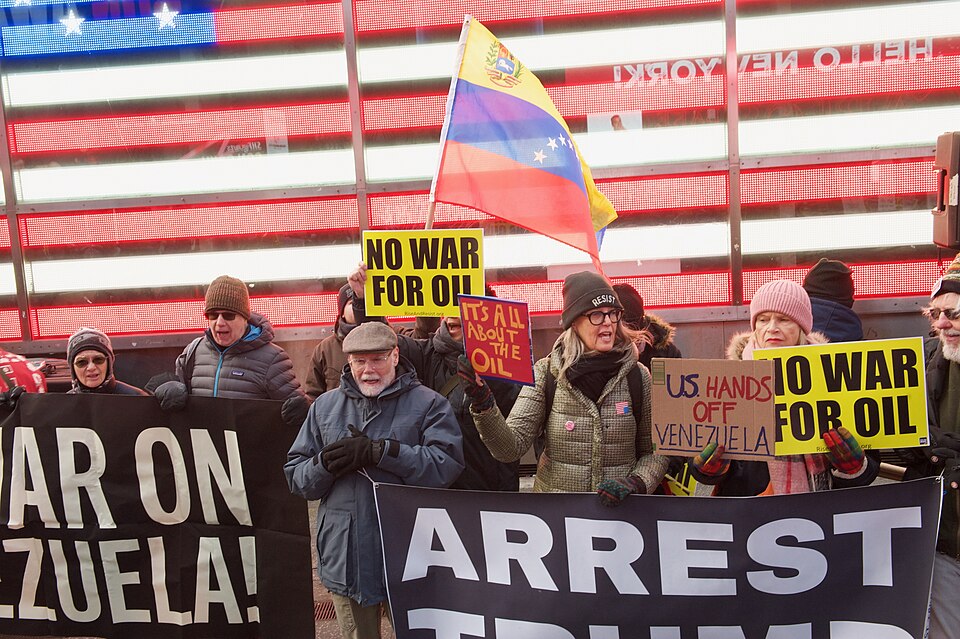
The first photographs of Nicolas Maduro inside an American detention facility surfaced this week as he waits for a trial that will not begin until June 2027. On the same weekend, Venezuela’s interim government confirmed something that got far less attention outside financial pages: the energy arrangement it struck with Washington will run for 25 years and cover more than 65 billion barrels of oil.
Put those two facts next to each other and the last eight months in Venezuela stop looking like a story about democracy promotion. They start looking like a story about grabbing resources.
That is the part missing from most of this week’s commentary. Analysts keep asking whether the January operation that removed Maduro from power was legal, or whether Caracas can survive politically now that it has handed Washington a generation’s claim on the country’s most valuable asset.
Both are fair questions. Neither is the important one. The important question is simpler: how is a pressure campaign against a resource-rich government now designed to end?
Start with what actually happened. In January, U.S. special forces carried out a raid on the presidential compound in Caracas that captured Maduro and flew him to New York. He is held at the Metropolitan Detention Center in Brooklyn and charged with narco-terrorism conspiracy. He has pled not guilty.
Seven months later, Delcy Rodriguez, the interim president that Washington’s operation left in charge, went on state television to describe what comes next: “This 25-year bilateral project envisages the development of 17 strategic oilfields with a production target of more than 1.5 million barrels per day.” By her own government’s math, that adds up to roughly $209 billion in projected revenue at a $65-a-barrel benchmark, of which about $19 a barrel would actually reach Venezuela’s treasury. The 65 billion barrels under new U.S. control amount to roughly a fifth of the country’s entire proven reserves.
Trump announced the arrangement himself, calling it “the biggest oil deal in world history.”
Who saw this coming, and when, is not a small question. A letter Senator Ed Markey (D-MA) sent to the chief executives of Chevron, ExxonMobil, and ConocoPhillips within days of the raid put it directly: the administration, he wrote, “lied about and concealed their plans to attack the territory of, and conduct regime change in, Venezuela,” while “the only outside entities that appear to have known the truth are oil executives.” His letter quoted one of them, anonymously, as saying that “in preparation for regime change, there had been engagement” between the industry and the White House. The same letter notes that ConocoPhillips holds outstanding claims against Venezuela north of 10 billion dollars and ExxonMobil more than a billion, while the oil and gas industry spent 450 million dollars on political influence in 2024 alone. None of that proves a conspiracy. It does establish that the companies with the largest financial stake in a change of government in Caracas had a clearer view of what was coming than did most of the Venezuelan cabinet.
Chevron is now positioned to benefit directly. It is expected to receive an expanded license letting it export more crude and trade state-owned production, on top of a $2 billion sales arrangement already completed between Washington and Caracas. Both things can be true at once: Venezuela’s government gets to say it negotiated rather than surrendered, and Washington gets a fifth of the country’s reserves locked in for a generation while the companies that lobbied hardest get first access to pump it.
This is not really a Venezuela story. It is a preview of what “resolution” looks like whenever Washington leans on a government sitting on resources it wants, and the same test is now being conducted against Iran. Secretary of the Treasury Scott Bessent unveiled what he called the “toughest sanctions in history” against Tehran on August 24, aimed at cutting off what remains of Iran’s oil exports after six months of war. It is not obviously going to work. Sanctions regimes, even harsh ones, have rarely forced a determined government to fold outright, and this one carries its own risk. China buys more than 80 percent of what Iran still exports, and Beijing has already shown—by, for instance, restricting rare-earth exports in 2025 until Western auto plants began idling for lack of magnets—that it knows how to make that kind of pressure expensive for Washington too.
That is a telling difference between the two situations. Venezuela had no Beijing to call when the pressure came. Iran does, which is exactly why the Venezuela outcome matters well beyond Venezuela: it is the version of “success” Washington can now point to when a resource-rich government runs out of options and no major power is willing to absorb the cost of defending it. Success does not look like elections or new institutions. It looks like a long-duration resource concession, negotiated with whoever survives the pressure campaign, structured so it can be described as diplomacy rather than extraction. A quarter century is not a term a government agrees to from a position of strength. It is a term attached to a country that has run out of leverage and knows it.
None of this requires believing Maduro’s government was worth defending. It was not short on abuses of its own, and plenty of Venezuelans who despised him are watching their country’s oil signed away for a generation with no illusions about what just happened either. The point is not to relitigate January. The point is to notice what came after, because that is the part every other government now under American pressure is watching most closely, from Tehran to resource-rich states in Africa and the Pacific that Washington has started discussing in the same language of national security it once reserved for oil.
The lesson those governments are drawing is not subtle. A pressure campaign that removes a hostile government does not end with a handshake and a return to normal trade. It ends with a bill, sized to the resource in question and written to last decades, presented to whoever is left standing and willing to sign. Caracas signed. The open question is which government gets handed the bill next, and whether it will have any more room to say no than Venezuela did.
ZNetwork is funded solely through the generosity of its readers.
Donate




