


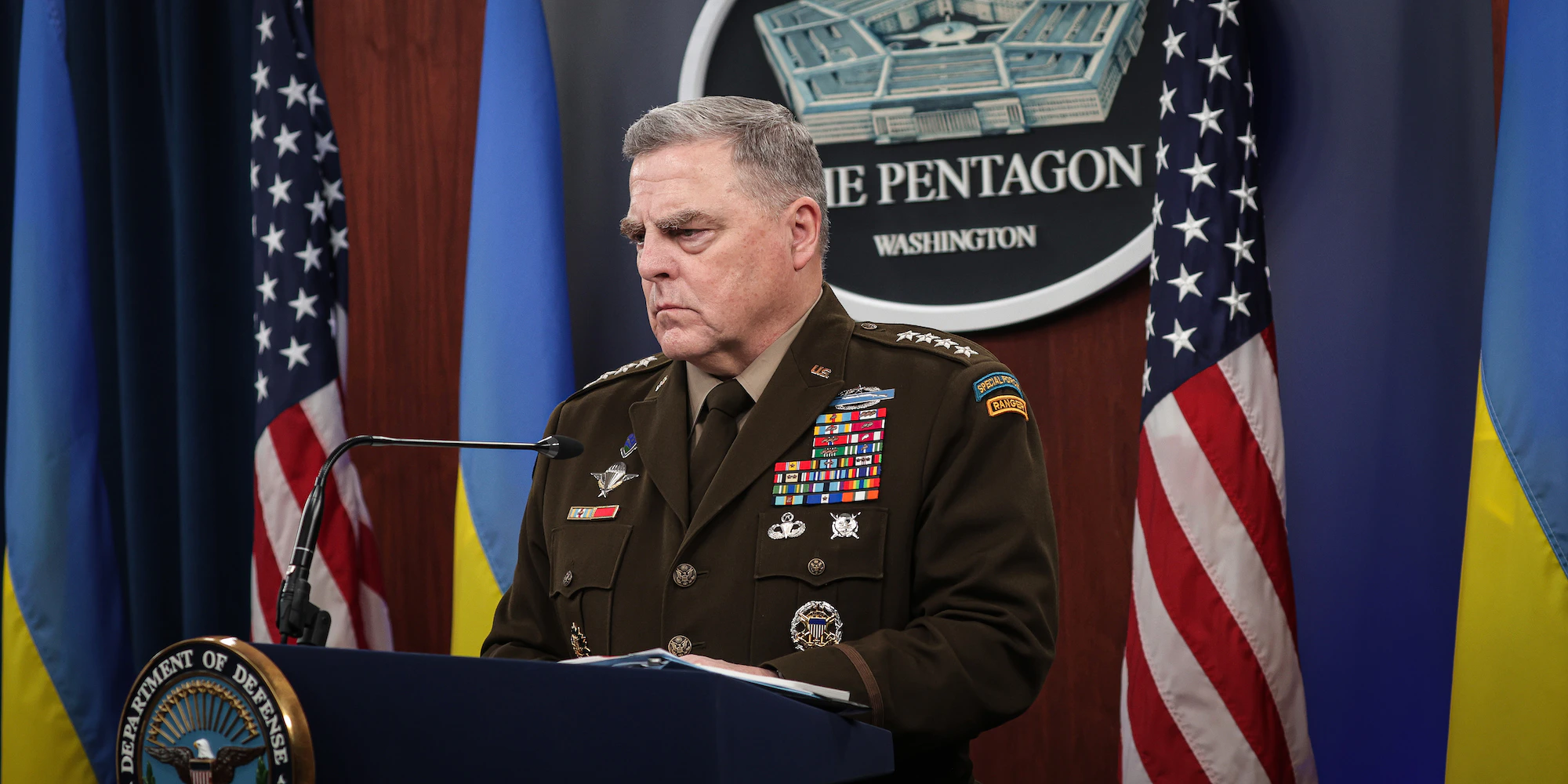
Gen. Mark Milley, chair of the Joint Chiefs of Staff, recently offered some matter-of-fact observations about the immense human suffering and death caused by Russia’s invasion of Ukraine and placed the responsibility for ending the war squarely on Moscow’s shoulders. “There’s one guy that can stop it — and his name is Vladimir Putin,” Milley said. “He needs to stop it.”
But then Milley crossed what he most certainly never imagined to be a tripwire when he said, “And they need to get to the negotiating table.”
The general cited the multiyear death toll of 20 million during World War I — caused, he said, by the failure to negotiate an earlier end to the war — and went on to suggest that it would be better for the war in Ukraine to end soon in negotiation rather than continue on indefinitely.
“There has to be a mutual recognition that military victory is probably — in the true sense of the word — is maybe not achievable through military means, and therefore you have to turn to other means,” Milley said during the November 9 event at the Economic Club of New York. Referring to recent Russian setbacks at the hands of Ukrainian forces and the coming winter, Milley went on: “When there’s an opportunity to negotiate, when peace can be achieved, seize it. Seize the moment.”
Milley clearly did not think he had said anything controversial. A day later, he was making similar points during an interview on CNBC. “We’ve seen the Ukrainian military fight the Russian military to a standstill,” Milley said. “What the future holds is not known with any degree of certainty, but we think there are some possibilities here for some diplomatic solutions.”
But as snippets of Milley’s remarks in New York started to spread, the White House began fielding angry calls from Ukrainian officials protesting Milley’s comments and asking if they indicated that the U.S. might be getting soft in its support for Ukraine’s stated goal of militarily expelling Russia from its territory. Or if the White House did not believe that Ukraine could win the war.
As the Biden administration “scrambled” to “clean up Milley remarks” and “handle Ukraine’s feelings,” Milley defended his assessment in a press briefing at the Pentagon alongside Defense Secretary Lloyd Austin. “The probability of a Ukrainian military victory defined as kicking the Russians out of all of Ukraine to include what they define or what the claim is Crimea, the probability of that happening anytime soon is not high, militarily,” Milley said in response to a reporter’s question on November 16. “There may be a political solution where, politically, the Russians withdraw, that’s possible.” He added: “You want to negotiate from a position of strength. Russia right now is on its back.”
This made some Russia hawks apoplectic. In an essay for The Atlantic titled, “Cut the Baloney Realism: Russia’s war on Ukraine need not end in negotiation,” Eliot A. Cohen, a former adviser to Secretary of State Condoleezza Rice, asserted that “the argument for diplomacy now is wrongheaded,” writing: “The calls for negotiations, like the strategically inane revelations of our fears of escalation — inane because they practically invite the Russians to get inside our head and rattle us — are dangerous.” Instead, Cohen declared, it is “time to pass the ammunition and to stop talking about talking,” suggesting that Ukraine should be given top-tier U.S. drones and advanced fighter aircraft like F-16s as well as “a tank fleet superior to that of Russia.”
In a column for the Wall Street Journal, former Pentagon official Seth Cropsey suggested that Milley should be replaced and said his comments on Ukraine were part of a track record of being soft on China and “apparently resisting then-President Trump’s desire to strike the [Iranian] regime in the final months of his term.” Like Cohen, Cropsey — who served under Presidents Ronald Reagan, George H.W. Bush, and George W. Bush — also argued for increasing weapons shipments to Ukraine. “U.S. interests would be better served by providing Ukraine with support to retake more territory from Russia and declaring Ukrainian victory the aim of U.S. policy,” he wrote. “At some point there might be negotiations in which Russia gains something. Yet these talks should be undertaken only when Ukraine has a superior position.”
Lt. Gen. Ben Hodges, former commander of U.S. Army Europe, told Politico that he believed Ukraine would expel Russian forces from the country by summer. “People should get their heads around the idea that Ukraine is going to defeat Russia on the battlefield, the old fashioned way. They have irreversible momentum,” he said. “Now is the time to put the pedal to the metal.”
Conceding the massive, unprecedented U.S. military shipments and other support to Ukraine, it is undeniable that President Joe Biden has at key points treaded cautiously in his stance toward Moscow. He and other U.S. officials have consistently said they do not want to risk direct military conflict with Russia. The president recently won some praise from the Kremlin for the “measured and more professional response” to his handling of the missile that landed in Poland killing two people on November 15. While major news organizations reported that it was a Russian attack, Biden urged caution and refuted the claims, which turned out to be false. The White House has also stopped several weapons transfers to Ukraine — in some cases on grounds that misuse of the weapons against Russia could lead to further escalation. At times, the White House has sought assurances from Ukraine that it would not use long-range U.S. weapons “to attack Russian territory.” Biden has also slow-walked a decision on whether to give Gray Eagle weaponized drones to Ukraine, despite mounting pressure from the industry, a bipartisan group of lawmakers, and Kyiv.
Biden isn’t dovish on Russia. But the administration has its own calculus for how it wants this war to proceed, and frequently games out how it might end.
None of that indicates that Biden is dovish on Russia — he isn’t. But the administration has its own calculus for how it wants this war to proceed, and frequently games out how it might end. Some news reports have described “a broad sense” within the Pentagon that winter will provide an opportunity to reach a political settlement, while senior national security officials, including national security adviser Jake Sullivan and Secretary of State Anthony Blinken have opposed pushing Ukraine to negotiate. “One official explained that the State Department is on the opposite side of the pole from Milley,” according to CNN. “That dynamic has led to a unique situation where military brass are more fervently pushing for diplomacy than U.S. diplomats.” Milley’s public remarks offered a glimpse into the informed analysis of one powerful camp within the administration. “Milley is much more willing to just say what he thinks,” one U.S. official said. “I’m sure they sometimes wish he wouldn’t always say the quiet part out loud.”
Despite some moments of narrow strategic restraint from the White House, Biden and virtually the entirety of established political power across the U.S. government is unified in the project of flooding Ukraine with weapons and other military support. Milley, it must be noted, has been a major proponent of heavily arming Ukraine and has advocated continuing to do so indefinitely. Biden currently has a request before Congress for nearly $40 billion in new aid to Ukraine, and the military component of his proposal would, with the swipe of a pen, more than double the entire U.S. expenditure since the invasion began in February.
There is legislation pending in Congress that indicates that the U.S. government believes the Ukraine war may continue for years. On October 11, the Senate Armed Services Committee submitted its amended draft of the National Defense Authorization Act for 2023. Nestled within the draft is a provision that would establish an “emergency” multiyear plan to award massive defense contracts to Lockheed Martin, Raytheon, BAE Systems, and other war corporations to produce weapons for Ukraine and to “replenish” U.S. stockpiles as well as those of “foreign allies and partners.” An amendment, spearheaded by New Hampshire Democratic Sen. Jeanne Shaheen and co-sponsored by Texas Republican Sen. John Cornyn, would allow the Pentagon to award noncompetitive no-bid contracts to arms manufacturers under the plan.
Congress is “supportive of this. They’re going to give us multiyear authority, and they’re going to give us funding to really put into the industrial base — and I’m talking billions of dollars into the industrial base — to fund these production lines,” said the Pentagon’s chief weapons buyer, Bill LaPlante, in remarks reported by Defense News. “That, I predict, is going to happen, and it’s happening now. And then people will have to say: ‘I guess they were serious about it.’ But we have not done that since the Cold War.”
Among the weapons that would be preauthorized for procurement by the Pentagon, according to the legislation, are: 100,000 Guided Multiple Launch Rocket Systems, 30,000 Hellfire missiles, 36,000 Joint Air-to-Ground missiles, and 700 High Mobility Artillery Rocket Systems — all manufactured by Lockheed Martin. The list also includes a staggering stream of other missiles, rockets, and ammunition.
It is often said that in war there are no winners. But that has never really been true, certainly not in modern U.S. wars. From Vietnam to Korea, and Iraq to Afghanistan, the winner has always been the same. That victor also prevailed in the Cold War and will most certainly do so again throughout this new cold war that is being rapidly ushered into existence. The winner is the war industry.
That a powerful U.S. general would suggest that it might be better for the war to end through negotiation rather than prolonging the bloodbath, with Ukrainian civilians paying the highest price, is not an earth-shattering development. But the response to Milley’s expression of that sentiment, combined with the ever-intensifying preparations for a protracted war in which the U.S. is the premiere arms dealer, should spur a discussion over whose interests are being served right now.
Perhaps more significant than Milley’s comments about negotiations was his assessment that a victory for Ukraine is likely unachievable on a purely military level. Already, some European officials are warning that the appetite in their countries to continue the war in Ukraine is waning and that “the double hit of trade disruption from U.S. subsidies and high energy prices risks turning public opinion against both the war effort and the transatlantic alliance.” As one senior European Union official told Politico, “The fact is, if you look at it soberly, the country that is most profiting from this war is the U.S. because they are selling more gas and at higher prices, and because they are selling more weapons.”
The NDAA now before Congress is a reminder of the prescience exhibited by President Dwight Eisenhower in his January 1961 farewell address. “This conjunction of an immense military establishment and a large arms industry is new in the American experience,” Eisenhower said. “We recognize the imperative need for this development. Yet we must not fail to comprehend its grave implications.” Eisenhower warned that “we must guard against the acquisition of unwarranted influence, whether sought or unsought, by the military-industrial complex.”


Jeremy Scahill has reported from Afghanistan, Iraq, Somalia, Yemen, Nigeria, the former Yugoslavia, and elsewhere across the globe. Scahill has served as the national security correspondent for The Nation and Democracy Now!. Scahill's work has sparked several congressional investigations and won some of journalism’s highest honors. He was twice awarded the prestigious George Polk Award, in 1998 for foreign reporting and in 2008 for “Blackwater.” Scahill is a producer and writer of the award-winning film “Dirty Wars,” which premiered at the 2013 Sundance Film Festival and was nominated for an Academy Award.
ZNetwork is funded solely through the generosity of its readers.
Donate




