


A still-life image: a building covered with Jerusalem stone, a large memorial poster hanging high up on one of the floors, and below, a sign in broken English over the “Paradise Cafe.” Second image: a makeshift soccer field, empty, on which a huge puddle formed on Sunday of this week. Across the road a barbed-wire fence encircles the abandoned airfield of Atarot, once touted as “Jerusalem’s international airport.” Along the fence runs a ditch – into which the boy fell and, according to witnesses, bled for a long time until he died. He was struck by a bullet in the leg and lay there, dying in agony.
Was he only playing soccer? Did he just run to get the ball, which had fallen into the ditch along the fence, as his friends say? Or did he sabotage the fence and try to take the metal for his family’s livelihood, as the Israel Defense Forces (IDF) said the next day?
What difference does it make? What does make a difference is the appalling question of what prompted a soldier, or a Border Policeman, to open fire from a long way off at the boy and then to leave him bleeding on the ground until he died. What goes through the mind of the shooter, in the moments before and after he takes the life of an adolescent, who was in no way putting anyone at risk – even if he touched a fence that must not be touched? Three fences surround the abandoned airport, and last Sunday we saw no hole in any of them, three days after the unnecessary, criminal shooting.
In this terrible place the children of Qalandiyah and its surroundings are killed like flies. At least eight have been killed here in the past few years, along the death fence. In this space we wrote about 11-year-old Yasser and his brother, Samar, 15, the two children of Sami Kosba, who were killed at the fence a month apart, in February, 2002; about Omar Matar, 14, killed in April, 2003; and about Ahmed Abu Latifi, 13, in September, 2003. And there was Fares Abed al-Kader, 14, killed in December, 2003. Now there is also Taha Aljawi, February, 2007.
It’s said that he was a good boy, the kind of boy who goes with his father to pray in the morning and evening. And he was Jerusalem-born, the bearer of a blue ID card, like us. Taha Aljawi, a nice kid from Jerusalem, not yet 17 at his death.
The Hamas memorial poster shows dripping blood. In the Fatah poster the photograph is more recent: Taha looks a little older and has the shadow of a mustache. The Al-Aqsa Mosque appears in both posters – a rare instance of Palestinian national unity these days, in the paradisical cafe in Kafr Aqab, a Jerusalem neighborhood whose residents carry blue ID cards and pay municipal taxes, but which has nevertheless been fated to be on the other side of the separation fence, north of the capital, on the way to Ramallah.
The men sit in the big space of the cafe, which has been transformed into a mourning room, and eat lamb with rice in yogurt, as is the custom. Two weeks ago we were offered the same fare in nearby Anata, on the occasion of the killing of an 11-year-old girl, Abir Aramin, by the Border Police.
Taha’s bereaved father, Mahmoud Aljawi, worked for the Jerusalem Municipality part-time for 11 years as a school janitor, until he was forced to take early retirement a few months ago. He is 48 and the father of six children, including the dead Taha, who was the second child. To supplement his income, Mahmoud also made leather garments in the Old City, and had a kiosk that sold sweets at the Qalandiyah checkpoint. He learned basic Hebrew at a beginners’ course at the Gerard Behar cultural center on Bezalel Street in Jerusalem. Until three years ago the family lived in the Old City, but because of the overcrowding moved to Kafr Aqab. Their rented apartment is above the Paradise Cafe.
Last Thursday, Mahmoud went to the offices of the National Insurance Institute (NII) in Jerusalem, to arrange for his unemployment insurance. Taha had a free morning: In the past few weeks the authorities lengthened the school hours on the first four days of the week and canceled classes on Thursdays. He was a 10th-grader at the school for orphans in the Old City, opposite Al-Aqsa, an educational institution for the children of poor families. He got up at 5 every morning and went with his father and his two brothers, Mohammed, 18, and Suleiman, 8, to the adjacent mosque to pray, and then at about 7:30 left for school via the checkpoints. It was 40 minutes each way, if there were no problems.
Taha wanted to learn the printing profession. He was weak in English and also got into problems with the teacher. Not long ago his father had a talk with him and explained that if he wanted to work in the print industry, he would have to be articulate in both English and Hebrew. Taha was thinking about enrolling in Hebrew lessons at a center near the Rockefeller Museum in East Jerusalem.
Last Thursday Taha returned from the mosque at 7 A.M., after his last prayer, as it turned out. Mahmoud made breakfast for his son and at 7:30 his friends came by and asked him to play soccer with them on the field on the other side of the Ramallah road. The word “road” is a bit misleading: It’s actually an intercity route peppered with potholes and puddles, flanked by garbage on both sides, on which traffic moves slowly.
According to the testimonies of Taha’s friends, as related to the grieving father, shortly after the game started, the ball flew over another road that abuts the improvised playing field. Taha ran to retrieve the ball and then the kids heard a few shots. They say they ran in panic, but saw Taha slump into the ditch. No one knows for sure what happened after that. The children told Mahmoud that the shots had come from the direction of the skeleton of a tall building, which is under construction next to the soccer field. They say that the soldiers hid high up in the building and that they opened fire at Taha. Usually, they said, there are no soldiers in that building – only on that particular day.
The bullet slammed into Taha’s left leg, above the knee. At the time, his father was near the government compound in East Jerusalem, on the way to the NII. Mahmoud’s brother, Kamal, phoned him to say that Taha had been wounded. The two brothers rushed to Kafr Aqab. They tried to call Taha on his mobile phone – Mahmoud says he got his son a phone so he would always know where he was – but the boy didn’t answer. Next to the house, people had already gathered; they related that Taha had been taken to the hospital in Ramallah. Kamal set out for Ramallah, while the distraught Mahmoud said he felt he had to stay with the mother and other children to calm them.
At the hospital, Kamal was told that Taha had been dead on arrival. He saw his nephew’s body – with one bullet hole above the knee. In most cases, a bullet in the leg will kill you only if it causes a massive loss of blood. Taha apparently lay in the ditch for a long time: The children told Mahmoud that at least an hour went by before the soldiers arrived to collect their victim and take him to the Qalandiyah checkpoint. From there a Palestinian ambulance was summoned – even though Taha was Israeli – to take him to Ramallah. Kamal called his brother and told him to come to the hospital to identity his son’s body. Taha was buried that evening in the cemetery on Saladin Street in East Jerusalem, next to the post office.
“I always made sure that my children were with me. I watched over them, like over my eyes,” Mahmoud says. “On Fridays I would walk with them to pray at Al-Aqsa, go by the grandparents’ place, have a bite to eat, always staying close together. Everyone who knows me knows how I watched over them. I hear a lot from people: You have good children – they pray, they are getting a good education, they have no problems, quiet children. Sometimes people would ask: Who is Taha’s father? Good for you, having a well-educated boy like that. In the winter he went to play computer games, in the summer he went to the Casablanca Pool in Ramallah, and other than that he was with me. Maybe 18 hours a day with me. We are a family that respects its children and the children respect their father.
“How can we know what he was doing there, next to the fence? It’s not important. A boy of that age, he didn’t endanger the soldiers – a shy boy, not violent, quiet. I didn’t see what he was doing next to the fence. I didn’t see, but what if he even cut the fence? And why should he cut the fence? He has a blue ID card. I always taught him to keep away from things like that.”
The response of the IDF Spokesperson’s Office: “On February 1 during the morning an IDF force spotted four suspicious youths next to the Qalandiyah refugee camp south of Ramallah, while they were still engaged in sabotaging the security fence and trying to breach it. The force fired at the lower body of one of the youths and hit his leg. Minutes later an IDF medical team arrived, which worked to stabilize the wounded person’s condition, but without success.”
We go out to the killing field. Mahmoud hasn’t been there since his son fell by the fence. It’s empty, even though people live all around it. We stop at the road, looking at the fence from a distance and at the ditch where Taha bled to death. Within seconds a Border Police Jeep barrels out of the abandoned airport terminal – a long way from us – and we scatter, in panic.

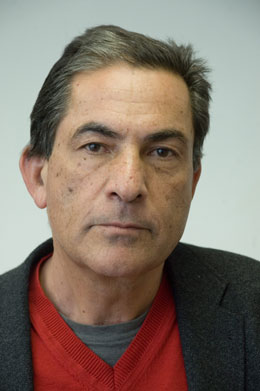
Gideon Levy is a Haaretz columnist and a member of the newspaper's editorial board. Levy joined Haaretz in 1982, and spent four years as the newspaper's deputy editor. He is the author of the weekly Twilight Zone feature, which covers the Israeli occupation in the West Bank and Gaza over the last 25 years, as well as the writer of political editorials for the newspaper. Levy was the recipient of the Euro-Med Journalist Prize for 2008; the Leipzig Freedom Prize in 2001; the Israeli Journalists’ Union Prize in 1997; and The Association of Human Rights in Israel Award for 1996. His new book, The Punishment of Gaza, has just been published by Verso Publishing House in London and New York.
ZNetwork is funded solely through the generosity of its readers.
Donate




