


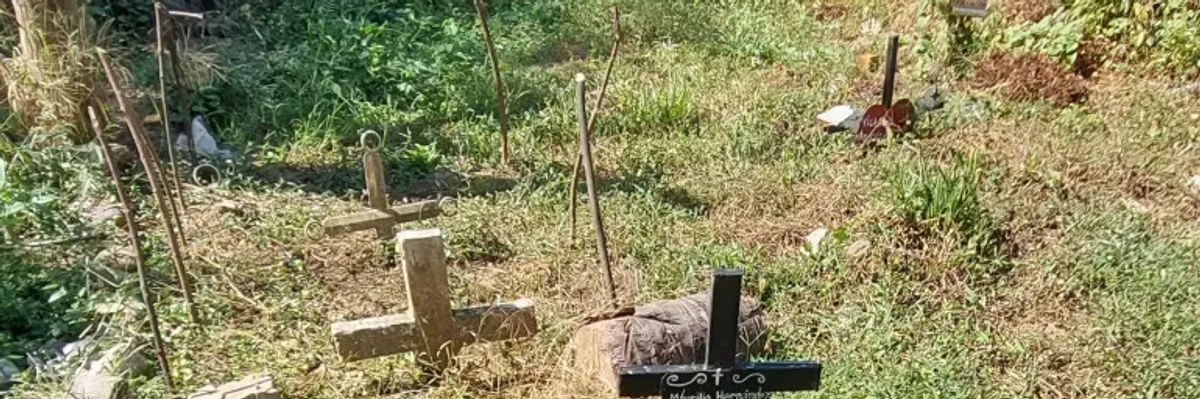
The municipal cemetery of Tapachula in the Mexican state of Chiapas is a sprawling expanse overflowing with graves in colorful disrepair. Tombstones from centuries past crack and crumble, and the clutter is so extreme that, to reach certain parts of the graveyard, you must resign yourself to stepping on the dead.
Some of the newer graves still host the remains of the Day of the Dead celebration in November—death being far more, well, lively in Mexico than in most other places on the planet. The country becomes awash in the cempasúchil flower—or Mexican marigold—and mariachis descend upon cemeteries for all-night festivities with music, food, and libations.
Lying close to the Mexican border with Guatemala, Tapachula has achieved notoriety as a “jail-city” for refugees from Central America, Haiti, Africa, and beyond who are effectively trapped there by the Mexican government—which is continuously bullied by the United States into curbing northbound “migrant flows.” And inevitably, some of these refugees perish in limbo.
Here in Mexico, we are also witnessing a U.S.-backed war—and a pretty “dirty” one at that.
When I arrived at the Tapachula cemetery for a visit on January 18, the three young men reclining on dilapidated benches near the entrance were perplexed at my request to be directed to the “migrant section.” Following a bit more awkward explanation on my part, something clicked: “You mean the mass grave.”
This was located in the very farthest corner of the graveyard, the men told me, and, if I just walked straight for as long as I could and then went down a little slope to the right, I would see it there by the wall.
Off I went through the kaleidoscope of colors, apologizing all the while to the souls I was trampling and noting the occasional gravesite bearing a Chinese name—a testament to an earlier era of migration. I descended the slope as instructed to reach the corner of the cemetery, where I found dirt, grass, some scattered wooden crosses, and assorted rubbish—a far and desolate cry from the comparatively animated landscape above.
Mass graves are, of course, often associated with war—or with the sort of “dirty war” perpetrated by the U.S.-backed right-wing dictatorship of Argentina, which murdered or disappeared some 30,000 suspected leftists in the late 1970s and early 1980s.
But here in Mexico, we are also witnessing a U.S.-backed war—and a pretty “dirty” one at that. In this war, the unmarked bones in the corner of the Tapachula municipal cemetery are but a tiny fraction of the casualties.
Back in 2021, I encountered other victims of the U.S. war on asylum-seekers when I was imprisoned for 24 hours in Tapachula in Siglo XXI, which means “21st century” and is Mexico’s largest immigration detention center. Inside this jail-within-a-jail-city, I spoke with numerous women who, having fled U.S.-inflicted political and economic calamity in their home countries, had arrived at the final stretch of their northbound journey only to find themselves categorically criminalized.
On top of the psychological and physical torment these women had already endured as vulnerable people on the move, some now faced potential deportation back to places where their lives were at risk. Many had traversed the Darién Gap between Colombia and Panama—another 21st-century battlefield and mass migrant grave in its own right, where plenty of asylum-seekers go in one side and never come out.
And there is something about the municipal cemetery of Tapachula that encapsulates the profound inhumanity of a system that denies refugees dignity even in death, forcing them to die undocumented and unidentified, with no sign that they ever existed at all. The mass grave also signifies untold emotional trauma for family members of the persons buried therein, who have no way of knowing that their loved ones have ended up in the far back corner of a Mexican graveyard.
I had returned to Tapachula a year and a half after the Siglo XXI ordeal to see how the 21st-century jail-city was holding up, and the cemetery visit was at the top of my to-do list. I was still unsure, however, whether I had actually seen the mass grave—such being the nature of mass graves, I suppose. Ascending the slope once more, I picked my way across more souls until I found two workers refurbishing a blue-colored tomb.
I explained that I simply wanted to confirm the grave’s exact location. It was right there in the corner, the older man said—and he was sure of it because he had helped inter the first batch of 17 unidentified bodies that had arrived in bags. This had been several years ago, he said, but more anonymous bodies were subsequently added, and he now had no idea how many deceased persons comprised the subterranean congregation.
He himself had worked at the cemetery for 35 years, during which time he had never felt scared, because “it’s the living you have to fear, not the dead.” To be sure, there is much to fear in a world where the U.S. is allowed to violate international borders at will while fueling a ludicrously lucrative “border security” industry that effectively sentences poor people to death.
And as the Tapachula municipal cemetery’s 17-plus nameless victims of a nameless war attest, the whole arrangement is failing both the living and the dead.


Belén Fernández is the author of The Imperial Messenger: Thomas Friedman at Work and Martyrs Never Die: Travels through South Lebanon.
ZNetwork is funded solely through the generosity of its readers.
Donate




