
Source: Common Dreams

“The total bonus pool for 190,800 New York City-based Wall Street employees in 2022 was $33.7 billion—enough to pay for 771,520 jobs that pay $15 per hour with benefits for a year.”

The federal minimum wage in the United States would be more than $42 an hour today if it rose at the same rate as the average Wall Street bonus over the past four decades, according to an analysis released Thursday by the Institute for Policy Studies.

Citing newly released data from the New York State Comptroller, IPS noted that the average Wall Street bonus has increased by 1,165% since 1985, not adjusted for inflation.

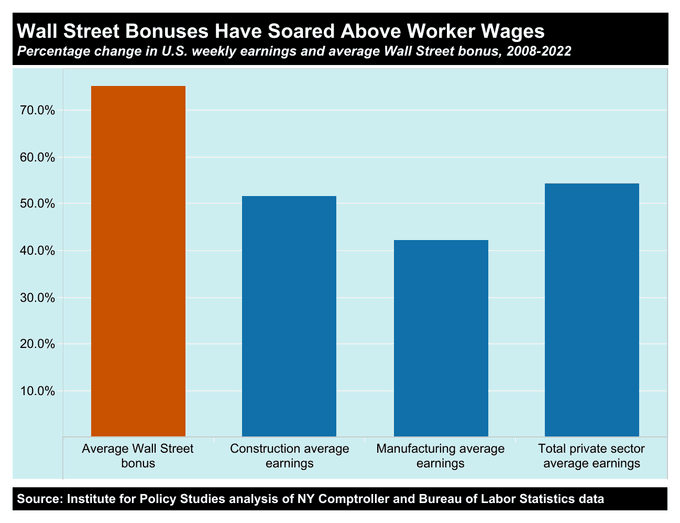
Last year, the average cash bonus paid to Wall Street employees was $176,700—75% higher than in 2008 but slightly lower than the 2021 level of $240,400.

The federal minimum wage, meanwhile, has been completely stagnant since 2009, when it was bumped up to $7.25 from $5.15. While many states and localities have approved substantial pay increases in recent years, 20 states have kept their hourly wage floors at the federal minimum.

Sarah Anderson, director of the Global Economy Project at IPS and the author of the new analysis, wrote Thursday that “average weekly earnings for all U.S. private sector workers increased by only 54.4%” between 2008 and 2022—a significantly slower pace than inequality-fueling Wall Street bonuses.

“The total bonus pool for 190,800 New York City-based Wall Street employees in 2022 was $33.7 billion—enough to pay for 771,520 jobs that pay $15 per hour with benefits for a year,” Anderson observed. “Wall Street bonuses come on top of base salaries, which averaged $516,560 for New York securities industry employees in 2021.”

Anderson argued that there are a number of straightforward steps lawmakers and regulators can take to curb exorbitant Wall Street compensation and bonuses.

In the wake of the 2008 financial crisis, Congress passed several provisions aimed at reining in bankers’ compensation as part of the Dodd-Frank Wall Street Reform and Consumer Protection Act.

But as The American Prospect‘s David Dayen pointed out last week, “bank regulators hip-pocketed one of those rules that Congress mandated in 2010—the one that would prohibit banker compensation that is specifically tied to taking inappropriate risks.”

“The last time there was even a proposed rule on this was nearly seven years ago,” Dayen continued. “And in 2018, when Federal Reserve Chair Jerome Powell was asked whether he would abide by Congress’ wishes and finish the rule, he blandly replied, ‘We tried for many years’ and ‘we were not able to achieve consensus’—just thumbing his nose at a congressional mandate.”

Anderson urged the Biden administration’s financial regulators to stop deferring to Wall Street lobbyists and “swiftly—and rigorously—enact the Dodd-Frank Wall Street pay restrictions that were supposed to have been enacted by May 2011.”

Any new regulation, Anderson wrote, can and should include “a ban on stock options at Wall Street banks” and mandates requiring Wall Street executives to “set aside significant compensation for 10 years to pay potential misconduct fines.”

“If such a regulation had been in place before the [Silicon Valley Bank] collapse,” Anderson noted, “top executives would’ve automatically forfeited this deferred pay to help cover the cost of their recklessness.”


This article was originally published by Common Dreams; please consider supporting the original publication, and read the original version at the link above.

Jake Johnson is a staff writer for Common Dreams.


ZNetwork is funded solely through the generosity of its readers.

Donate
Donate
Leave A Reply

Subscribe

All the latest from Z, directly to your inbox.

Institute for Social and Cultural Communications, Inc. is a 501(c)3 non-profit.

Our EIN# is #22-2959506. Your donation is tax-deductible to the extent allowable by law.

We do not accept funding from advertising or corporate sponsors.  We rely on donors like you to do our work.

ZNetwork: Left News, Analysis, Vision & Strategy

Subscribe

All the latest from Z, directly to your inbox.

THE WIND CRIES FREEDOM

The Wind Cries Freedom, the new book from Z co-founder Michael Albert, is a sweeping oral history of a future American revolution.

Through thirty interconnected chapters, it draws out the strategies, failures, turning points, and hard-won wisdom of a movement that called itself the Revolutionary Participatory Society. These are not the polished memoirs of politicians: they are the unfiltered accounts of people who organized in neighborhoods, hospitals, universities, stadiums, courthouses, and places of worship, and kept a shared vision alive through cynicism and exhaustion.

The result is speculative political fiction that reads like history: messy, human, and quietly hopeful in the way that only real experience and long thought can produce.

Get your copy and peruse more features on the book’s website below.

“Read it, argue with it, but don’t look away. The future it recalls is one we must still fight to deserve.”

Yanis Varoufakis

“The most unusual and intriguing combination of prophecy, manifesto, and movement building manual that I have ever encountered.”

Bill Fletcher Junior

“This work fills a huge gap in our social movement literature.”

Cynthia Peters

This is your article this month.

We’re glad you keep coming back. If Z’s work has informed, challenged, or inspired you, that’s no accident: there are no paywalls, no ads, and no billionaire owners here, and there never will be. Independent media survives because readers choose to support it.

Billionaires fund their own media. We fund ours. Help us reach 1,000 sustaining donors:

Number of donors689
Our goal1,000

Sustainers at $9/month or more receive the digital Z Magazine.

Already a sustainer? Click here and we won’t ask again. Thank you!

Your reading count is stored only in your browser and is never sent to us.

Sound is muted by default.  Tap 🔊 for the full experience

CRITICAL ACTION

Critical Action is a longtime friend of Z and a music and storytelling project grounded in liberation, solidarity, and resistance to authoritarian power. Through music, narrative, and multimedia, the project engages the same political realities and movement traditions that guide and motivate Z’s work.

If this project resonates with you, you can learn more about it and find ways to support the work using the link below.

Independent media is not disappearing because the ideas are weak.

It is disappearing because platforms reward speed, outrage, and algorithmic visibility over thoughtful analysis.

More than 100,000 people read Z every month, free of paywalls, ads, and billionaire owners. It takes fewer than 1 in 100 of them to fund all of it: 1,000 donors who keep Z independent, for everyone, and build what comes next.

Number of donors689
Our goal1,000

Sustainers at $9/month or more receive the digital Z Magazine.

Subscribe

Join the Z Community – receive event invites, announcements, a Weekly Digest, and opportunities to engage.

Exit mobile version

