



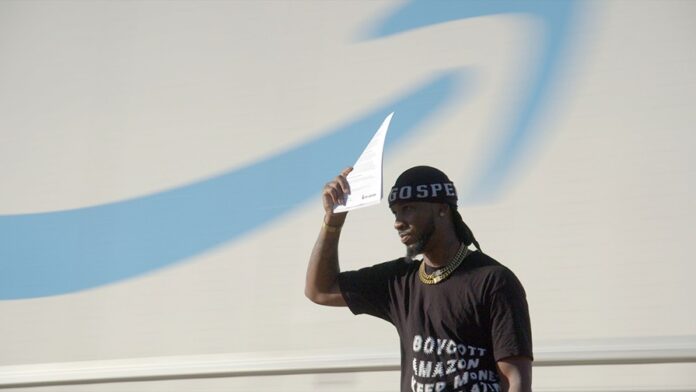
In 2022, a group of Amazon workers stunned the world by winning a union election at the huge JFK8 warehouse in Staten Island, New York. Many had wondered if Amazon workers in the United States could ever win a union election at the corporate giant, which transformed from a small online bookseller in the 1990s to a behemoth with 1.5 million employees.
These Staten Island workers showed that it could be done. But how did they do it? A new documentary, Union, offers a close look at what happened, following the organizing campaign for over a year. The film focuses a lot, necessarily, on Christian Smalls, the founder and leader of the Amazon Labor Union (ALU). After he was fired early in the pandemic in 2020 for leading a walkout to protest Amazon’s COVID-19 policies, he started talking to other workers at JFK8 about the need for a union. The campaign soon attracted other key leaders and supporters shown in the film, including Angelika Maldonado, Connor Spence, Derrick Palmer, and Madeline Wesley.
The Organizing Process
The film captures a lot of compelling scenes of union members in action and does a nice job of showing the nuts and bolts of union organizing, which started at JFK8 in the spring of 2021. Union depicts a seemingly endless number of Zoom and phone calls, discussions with workers, handing out flyers, and collecting union authorization cards.
Some new workers got jobs as “salts” to help organize. A principal strategy was to have activists stationed at a food tent near the bus stop at the warehouse; the film shows workers doing this at all hours of the day for a year, making themselves available to talk with coworkers as they started and ended their shift, often when it was dark out.
The film’s depiction of the Amazon workers’ plight and organizers’ dogged efforts is often moving. One featured worker was homeless and sleeping in her car; another had a sister who worked at the warehouse who died of COVID-19. In one scene, several organizers sit in the tent late at night, silent and tired, with a fire going for warmth, waiting for more workers to talk with. This is the real work of organizing, often unglamorous and exhausting for months on end; in moments like that, doubt often creeps in that this will ever work out.
Union also contains some fantastic scenes of the company running captive-audience misinformation sessions, which it called “trainings,” to encourage workers to vote against forming a union. Workers in those meetings took videos of the discussions, where ALU supporters would interrupt with their own questions.
It’s remarkable how ham-fisted these anti-union efforts can seem to those of us on the Left, recycling as they do the same tired talking points: The union is just a business that wants your dues. The union is lying and making false promises they can’t deliver on. The union is an outside third party that will get in the way of our special, direct employer-employee relationship.
Yet employers spend hundreds of millions of dollars a year on union-busting consultants. That’s no doubt because these anti-union campaigns are unfortunately often effective. So it was inspiring to see the workers fighting back in those meetings.
After months of work collecting over 1,700 union cards, the ALU filed for an election. The union faces a setback, however, when it discovers it didn’t have enough cards because of the 150 percent annual worker turnover at the warehouse. This curse of a high-turnover workplace meant the ALU had to spend several more months signing up new workers.
The union refiled more cards and got its election scheduled for March 2022. The film presents the growing drama and some tense moments during the two-month election campaign: We see yet more captive-audience meetings and write-ups of union supporters, and workers discover that Amazon is paying union-busting consultants $2,000 a day. We hear more about the issues motivating workers — low pay, the grueling pace of work, inadequate breaks, unfair disciplinary policies. Organizers become tired and are arguing. One chaotic scene shows Smalls and several other workers being arrested in front of the facility.
But ultimately the union prevailed, in a 2,654–2,131 win. The ALU press conference and celebration afterward is another moving scene. That’s when Smalls made his famous joke about company founder Jeff Bezos: “We want to thank Jeff Bezos for going to space, because when he was up there, we were signing people up.”
Union concludes with the company stalling on contract negotiations, which it is still doing today. Amazon is fighting to overturn the election win and has now joined several other employers in taking the extraordinary step of arguing that the National Labor Relations Board is unconstitutional. Given the current right-wing-dominated Supreme Court, there is a decent chance that the nearly ninety-year-old labor relations system, in place since the National Labor Relations Act was passed in 1935, could soon be discarded.
The Dominance of Smalls
ALU president Christian Smalls is undoubtedly Union’s central character. We get to know Smalls over the course of the film, as it essentially follows him around. But other organizers are given less attention — mostly in passing during meetings and discussions with Smalls. Giving more time to other ALU leaders — their backgrounds, perspectives, and motivations — may have given the viewer a better understanding of the union and its organizing process. That said, the documentary’s focus on Smalls in fact reflects his central position in the union effort.
Smalls’s dominance ends up leading to trouble. The film shows that some members find him unwilling to listen and make space for other ideas. One worker quits the union, calling it a “boys’ club” controlled by Smalls; she wants another union to come in. At one union meeting shown in the film, another member becomes agitated, claiming that decision-making is being monopolized by Smalls and a few others.
The film suggests that, despite his dedication to the union, Smalls was perhaps unable to appreciate the need for more leadership from others and more space for collective deliberation. Grievances with Smalls eventually led a faction of the members to form a Democratic Reform Caucus to protest the ALU’s strategy and what they decried as its lack of democracy.
This kind of debate about union democracy is usually healthy and necessary, and thankfully for the ALU both sides eventually reached a settlement. On March 4, the Democratic Reform Caucus announced that the union had voted “yes” on a referendum calling for the election of new union officers.
A New Organizing Paradigm?
When ALU won its election, there was a lot of discussion in the labor movement about whether their campaign suggested a new paradigm for organizing. For example, the union drive was public from the start, they filed for an election with a low 30 percent of union-authorization cards, and organizers didn’t do any worker house visits — all departures from standard union best practices.
The unconventional victory was exciting and surprising to many observers. But then the ALU lost two subsequent elections, one at another warehouse in Staten Island and one in Albany, New York. Other union efforts at Amazon have had difficulty breaking through as well — the Retail, Wholesale, and Department Store Union (RWDSU) has lost two elections at the company’s Bessemer, Alabama, warehouse.
I tend to think that organizing Amazon at scale will require the contributions of many unions and experimentation with different strategies. The winning ALU campaign at JFK8 suggested to me not that we need dramatically new organizing methods, but that the traditional techniques of constant conversations and relationship building with other workers, shown so well in the film, are still key.
Importantly, the ALU had a strong rank-and-file worker led campaign, reinforcing the important idea that the union is the workers, not a third party. The ALU was also able to organize workers inside the warehouse break rooms, a tactic that was likely crucial in allowing it to reach more workers.
The fight to unionize Amazon continues. Aside from the ALU and RWDSU actively organizing, the Teamsters have started an Amazon division and have organized one of the many Amazon delivery contractors (though the delivery company’s contract with Amazon was canceled soon after). Some Amazon workers are members of the independent Amazonians United across a number of warehouses, which has organized for improvements in the workplace, winning more water stations, reinstatement of unjustly fired workers, and the right to wear earbuds at work. The end of the film shows workers organizing at an Amazon facility in California.
Union does a great job capturing the organizing of a bold and unconventional independent union, facing off against a powerful, intransigent employer. Union campaigns often get attention only in dramatic moments like an election win or a strike. But Union presents the grind and glory of organizing before and after the election, taking the time to show us the tough and painstaking process of building solidarity.

ZNetwork is funded solely through the generosity of its readers.
Donate




