


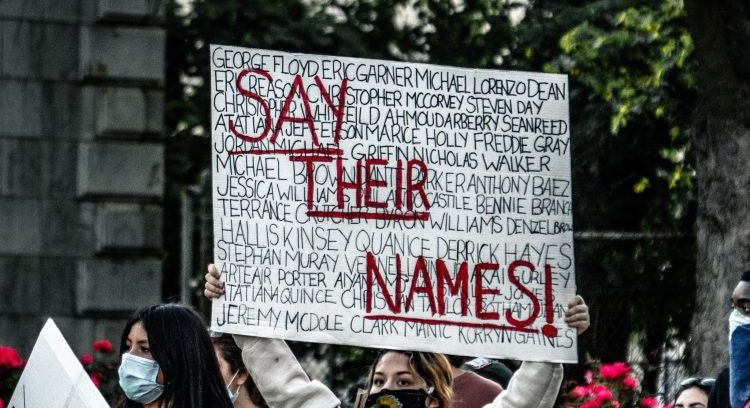
America, America . . . God kicks thee in the head.
The twisted irony here — the irony of the brutal murder of Tyre Nichols in Memphis, Tennessee last month — is that his killers were the ones hired and trained to keep the city safe. Instead, they created half an hour of hell for the young man, kicking and beating and tasing him to death a short distance away from his mother’s house, after a random, and perhaps unjustified, traffic stop.
One of the last words he uttered, as recorded on a pole-mounted Police Surveillance Video of the incident, was a desperate cry: “Mom-m-m-m-m!”
Should we outlaw hell? Or maybe at least defund it?
My words of outrage right now are hardly the first such words expressed over the murder of 29-year-old Tyre Nichols, a beloved man, father of a 4-year-old son, aspiring photographer — and victim of the phenomenon of police violence in a community of color, where the role of law enforcement isn’t so much protector as occupying army. And the primary role of an occupying army is to protect itself, not the inhabitants of the occupied territory.
Here‘s what we need to defund: the nation’s us-vs.-them mentality, which accomplishes virtually nothing except the maintenance of a status quo of fear. And the death of Tyre Nichols — hardly the first such incident, hardly the last — is simply one more manifestation of the country’s flawed social infrastructure.
The five officers who were the initial perpetrators of Nichols’ gang-beating were members of a Memphis special police unit, now disbanded, called SCORPION, an ironic acronym (you might say) for: Street Crimes Operation to Restore Peace in Our Neighborhoods. The unit’s mission wasn’t to issue traffic tickets, but to confront serious matters: gangs, drugs, etc. They were, indeed, at war with a perceived enemy, and the point of traffic stops was to find possible gangbangers and such. The five have been arrested and charged with, among other things, second-degree murder.
As David Kirkpatrick, writing for the New Yorker, explained: “Convinced that they risk their life each time they stop such a driver, many officers approach each encounter prepared for a life-or-death struggle. Few may be as hyperaggressive as the officers who killed Nichols, but their fear and belligerence can still evoke a reciprocal urge in a driver to talk back or flee, sparking a deadly cycle.”
Kirkpatrick’s article also makes this telling point: Embedded in what he calls the “folklore” of American policing is the belief that an officer with a “warrior mindset” is safer than Officer Friendly. Friendliness, not to mention empathy, are forms of weakness, and a display of weakness can kill you. Thus, the cycle of violence is destined to continue — until there is a consciousness shift, both within and beyond American police departments. Is it possible?
Let’s be clear. Such a shift in awareness, followed by a change in attitude and procedures at the American street level, would not be simple, though perhaps it may, to a certain extent, seem that way.
For instance, a former New York City police officer, Quoted By CNN, in response to the video of Nichols’ killing, noted: “It’s clearly excessive force. What’s even more troubling is, no officer was willing to intervene and say, ‘Stop.’”
The larger context, beyond those words, is that order and safety are not us-vs.-them in nature, and therefore official maintenance of public safety cannot and must not be limited to dominance, force and (when “necessary”) violence. What about a two-way relationship — respect and empathy that flow in both directions? What about . . . ?
Warning. The following question — perhaps the largest question of all — is seldom addressed in a public context and is virtually taboo politically: What about disarming the police and completely rethinking the nature of public safety?
Time Magazine, in the wake of the killing of George Floyd by Minneapolis police in 2020, did address this issue, noting that 19 countries worldwide have primarily unarmed police departments, and share this common thread: “officers will police by consent rather than with the threat of force.” The article, by Mélissa Godin, focuses primarily on Norway, but notes that there can’t be a simple, one-to-one comparison between Norway and the U.S., which is far more beset with the social turmoil created by such issues as poverty, gun prevalence and historic racism.
Nonetheless, there are things the U.S. can (must) learn, given that, in 2020 a total of 1,090 people were killed by police here, compared to zero in Norway (and in 2022, the U.S. total of police killings was 1,183).
Perhaps the primary difference between policing in the two countries, according to the article, is training. In Norway, the training process is a truly big deal: “Norwegian student officers must complete a three-year bachelor’s degree,” Godwin writes, “where they spend one year studying society and ethics, another shadowing officers, and a final year focusing on investigations and completing a thesis.” In contrast, she points out, average officer training in the U.S. is 21 weeks, “modelled on military bootcamps.”
She also notes that police officers in Norway and other Scandinavian countries work “in tandem with medical professionals, particularly psychiatric specialists that accompany officers when dealing with people who are exhibiting signs of mental illness.”
Hmmm . . .
You mean it turns out that policing is complex — that boot camp isn’t enough? Perhaps the takeaway here is this: What if we envisioned policing not as the maintenance of order at the barrel of a gun (or the toe of a boot, the tip of a baton) but, rather, as something like social psychology — medical work at the social level? She quotes an Icelandic sociology professor at one point, who says he thinks the greatest skill a police officer can have is (are you ready?) . . . “critical reflection.”
In contrast, Here’s A Quote from one of the officers in the midst of the Tyre Nichols killing, caught on surveillance video: “Bitch, put your (hands) behind your back before I break them.”
What if we weren’t at war with so many enemies, including ourselves?


Robert Koehler is an award-winning, Chicago-based journalist and nationally syndicated writer. Koehler has been the recipient of multiple awards for writing and journalism from organizations including the National Newspaper Association, Suburban Newspapers of America, and the Chicago Headline Club.
ZNetwork is funded solely through the generosity of its readers.
Donate




