

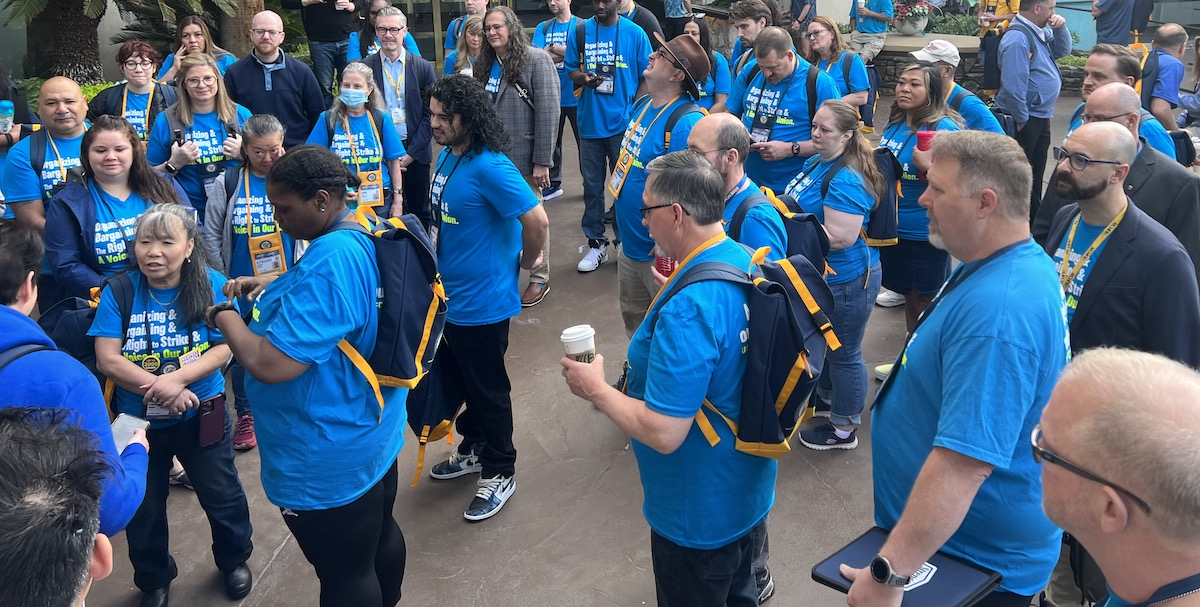
(Image: Delegates from United Food and Commercial Workers Local 3000 (Washington, Oregon and Idaho) get ready to head into union’s convention in Las Vegas and hand out literature in support of a slate of constitutional amendments to increase bargaining power and democracy in the union. Their shirts bear the slogan “Organizing & Bargaining & the Right to Strike & A Voice in Our Union.”)
The United Food and Commercial Workers is one of the country’s largest unions, with 1.2 million members in the U.S. and Canada, two-thirds of whom work in grocery stores. Like other unions, it has lost membership over the last decade, but it has managed to double its assets.
Reformers in the union are asking why. The UFCW caucus Essential Workers for Democracy has proposed a slate of amendments to expand rank and file power in the union and put resources into organizing and strike action. The proposals will be considered at the union’s convention starting today in Las Vegas. The convention is held every five years.
The caucus plans to fight for one-member, one-vote elections by mail for the union’s top officer positions, which would replace the current system where delegates elect officers. A similar change in the Auto Workers led a reform slate to win top offices in the union recently.
Essential Workers for Democracy’s proposals also include strike pay from day one and caps on officer salaries. Another amendment would curb the international’s power to trustee a local, requiring an arbitrator to decide.
A Look at The Numbers
What does an analysis of the international union’s net assets, membership, revenues and spending tell us?
The union’s divisions are Retail, which is 800,000 grocery workers but also includes 118,000 workers in other types of stores; Food Processing, Packing and Manufacturing, which includes 250,000 workers in meatpacking and food processing plants; Distillery, Wine and Allied Workers, with 5,000 workers; and the newest division, Cannabis, with 10,000 workers. Reformers hope to start a Health Care Division for strategy and planning for the union’s 55,000 healthcare workers.
Since 2014, when Marc Perrone assumed the top position in the union, UFCW’s net assets have risen from $199 million to $521 million in 2022. Over that same time, membership has declined by 8 percent, for a loss of 106,000 members.
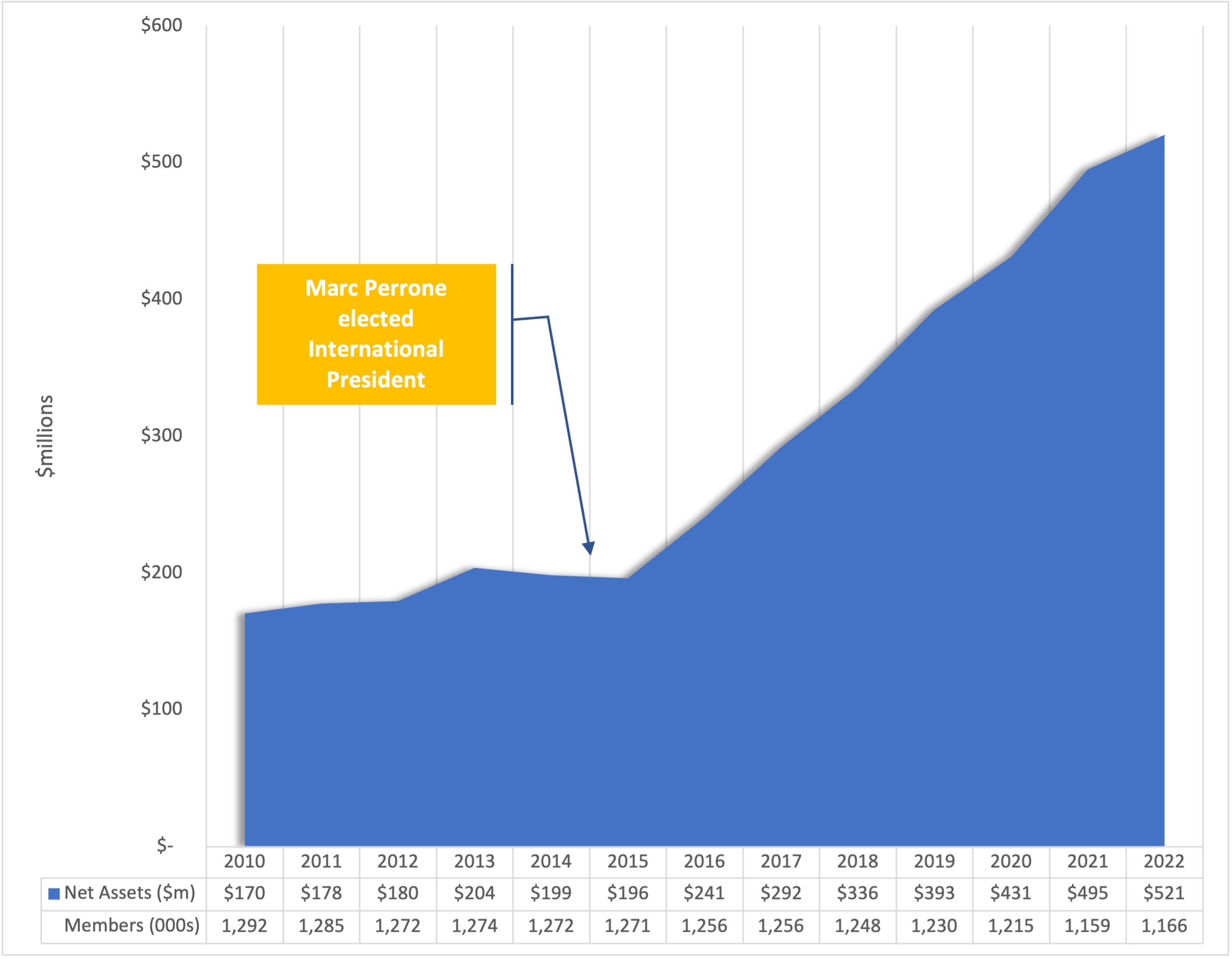
Data from the Department of Labor Office of Labor-Management Standards. Data methods here.

The growth of UFCW’s assets since 2014 is not due to shrewd investment strategies. Rather the UFCW runs large budget surpluses every year, spending far less than the union receives in member dues and other revenue streams.
Since 2014, the UFCW has booked average annual surpluses of $44 million. But spending on union activities is down 25 percent since 2014. Leaving aside officers, the number of employees at the international has declined from 444 employees in 2014 to 366 employees in 2022.
The UFCW leadership has clearly embraced “finance unionism,” where the accumulation of financial assets from the existing membership is the primary route to growth, rather than the mass organizing of new workers into unions.
Strikes Not Encouraged
While the UFCW on the international level has amassed over half a billion in net assets, these resources have not been deployed to encourage or support strike activities. From 2015 to 2022, the union spent a total of $5.3 million on strike benefits, or $666,000 on average annually.
That $5.3 million represents just 0.3 percent of total union spending from 2015 to 2022. In comparison, UFCW spent $67 million on political activities in the same period. And in 2022 alone, the union spent $7.2 million on consultants and media companies.
Currently, a two-thirds vote of affected members is required to call a strike or continue a strike. In addition to strike pay from the start of a strike, Essential Workers for Democracy is backing an amendment to change that to a majority vote.
Under the current union rules, a majority could reject a contract and still be forced back to work, as happened after a six-week strike in 2021 at Heaven Hill Distillery in Kentucky. Workers voted 54 percent to reject the contract offer, but had to go back to work anyway.
Comparisons to other unions underscore how the strike weapon is dormant at the UFCW. UNITE HERE, the much smaller 262,000-member hotel and restaurant union that also was deeply impacted by the pandemic, spent $12 million from 2015 to 2022, more than twice what UFCW spent on strike benefits.
UFCW has 900,000 more members than UNITE HERE. Similarly, the Communications Workers of America, with half the membership base of the UFCW, spent over $46 million on strike benefits since 2015.
Amendments proposed by Essential Workers for Democracy would require that 20 percent of the union’s budget be spent on organizing, and that of any increase in funds collected from locals, 50 percent would go to local organizing campaigns. They also propose that strike pay start on the first day of the strike, rather than the eighth, and that the international president no longer have a veto over strikes. In addition, workers striking for a first contract could receive strike benefits.
High Top Pay
In 2022, International President Marc Perrone was paid $298,177 in salary, not including benefits. Other top earners include local president John Niccolli from New Jersey’s Local 464 with a total compensation package of $700,941. Local presidents earning more than $400,000 in total compensation include Steve Lomax of Local 1996 ($592,496), Jean Bruny of Local 888 ($505,588), Brian String of Local 152 ($473,374), Harvey Whille of Local 1262 ($426,343), and William Hopkins of Local 455 ($415,522). Workers at grocery stores earned only $32,820 on average in 2021.
The caucus proposes capping local staff salaries at $250,000 and that the top three salaries at a local not exceed $650,000. The full slate of amendments can be found here.
ZNetwork is funded solely through the generosity of its readers.
Donate




