


The major parties on Capitol Hill like to boast about how much more “representative” their Congressional delegations have become in recent years. But that’s only in the most-discussed categories of diversity—race, age, gender, ethnicity, and sexual orientation. Working-class Americans rarely end up in the halls of Congress. Fewer than 2 percent of Congress members had working-class jobs at the time they were elected.
Two working-class candidates hope to improve those numbers next year, by winning U.S. Senate seats in Nebraska and West Virginia, states currently represented by anti-labor politicians, but which were once bastions of a more populist, pro-worker politics.
In Nebraska, former Bakery Workers (BCTGM) leader Dan Osborn is challenging two-term Republican Deb Fischer, and he leads in a poll commissioned by Nebraska Railroaders for Public Safety. Osborn is a steamfitter from Omaha who helped lead a successful strike by 1,500 Kellogg’s workers. They shut down plants in four states for 11 weeks in 2021.
In West Virginia, Zach Shrewsbury is also running for U.S. Senate. He’s a military veteran (as is Osborn), a community organizer, and the grandson of a coal miner. Shrewsbury hopes to replace multi-millionaire Joe Manchin by preventing governor Jim Justice, a billionaire coal baron, from claiming the seat that the corporate Democrat is vacating.
Populist Voices
In their respective campaign launches last fall, both candidates sounded themes once familiar to voters in their home states in the heyday of progressive populism, but not heard much lately.
At a campaign kickoff event in late September, Osborn denounced “the monopolistic corporations… that actually run this country” and pledged to “bring together workers, farmers, ranchers and small business owners across Nebraska around bread-and-butter issues that appeal across party lines.”

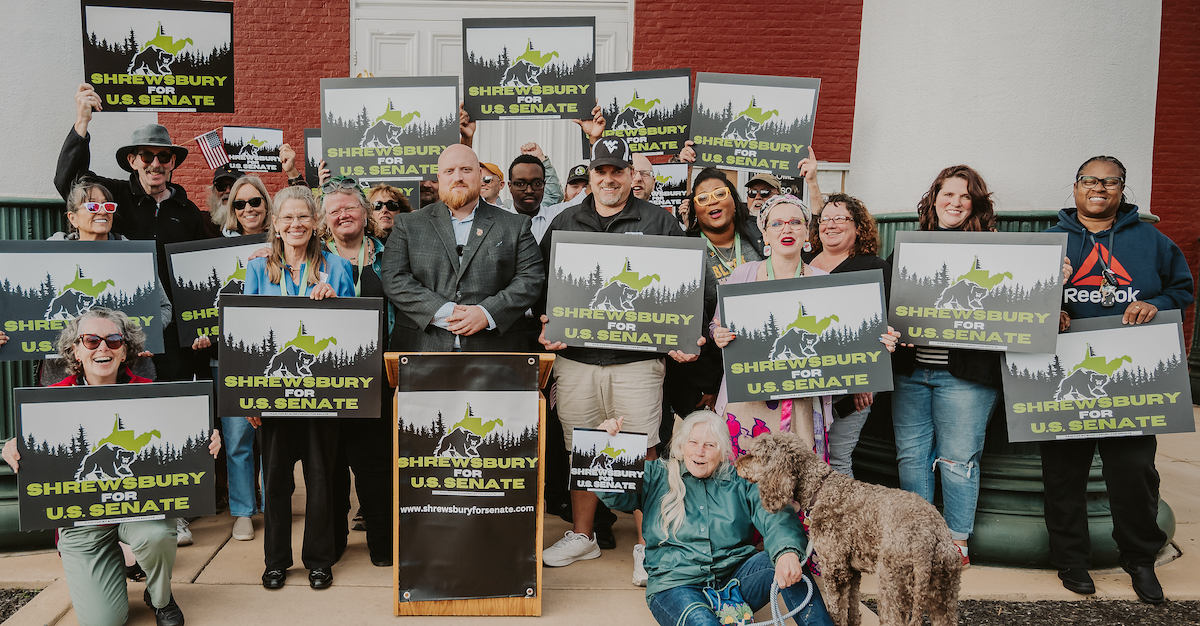
While picketing with striking General Motors workers in Martinsburg in October, Shrewsbury explained that he’s “running to win and show that working class people can run for office, even high office. We can’t be ruled by the wealthy elite who don’t understand everyday American life.”
Shrewsbury plans to compete in next year’s Democratic primary, but Osborn is currently collecting the 4,000 signatures necessary to get on Nebraska’s November 2024 ballot as an independent. He hopes to avoid an unhelpful association with the national Democratic Party in a state which chose Donald Trump over Joe Biden by 19 points in 2020.
Osborn supporters in Nebraska unions, and even the state Democratic Party, believe his non-partisan stance may be helpful. According to Jeff Cooley, a railroad union official who leads the Midwest Nebraska Central Labor Council, Osborn’s focus on rail safety and the Protecting the Right to Organize (PRO) Act, paid leave time, minimum wage increases, and misclassification of workers as independent contractors “offers hope to all workers in Nebraska regardless of political party.”
Osborn’s platform also highlights the need to curb corporate misbehavior ranging from routine consumer rip-offs to Big Pharma price gouging and monopolistic practices in the meatpacking industry which favor big agriculture over small family farmers and ranchers.
A Troubled Brand
Jane Kleeb, a past Bernie Sanders delegate who chairs the Nebraska Democratic Party and serves as an Our Revolution board member, told the local media “it would be very interesting for Democrats, Libertarians, and Independents to all come together with the one goal of breaking up the one-party rule at the top of the tickets in our state.
Kleeb acknowledged to Labor Notes that, at the moment, “the brand of the Democrats is not the best when it comes to working class and communities of color voters.” Meanwhile, in rural communities like her own, “people think Democrats are wimpy, just want to tax us, and take away our guns.”
Neither Osborn nor Shrewsbury look or sound wimpy. Before going to work for Kellogg’s as an industrial mechanic and becoming president of BCTGM Local 50G, Osborn served in the Navy and two state national guard units. Shrewsbury was in the Marine Corps for five years. After his discharge, he joined Common Defense to rally fellow veterans against what that group calls “Trump’s corrupt agenda of hate” and “the entrenched power of greedy billionaires who have rigged our economy.”
Shrewsbury has been an organizer for Citizen Action and the New Jobs Coalition, where he met retired AFL-CIO organizing director Stewart Acuff, now a resident of West Virginia. Acuff hopes to enlist national union backing for Shrewsbury’s campaign. The two of them bonded while canvassing to build grassroots support for federally-funded green jobs, environmental clean-ups, and infrastructure projects employing union labor. Acuff believes that Shrewsbury is uniquely equipped to challenge the “corporate colonialism that is still robbing a people and their state of much-needed resources.”
Shrewsbury wants to use his campaign “to help revitalize labor here and everywhere, like Bernie did.” Like Sanders, who won West Virginia’s Democratic presidential primary in 2016, Shrewsbury isn’t afraid of being red-baited. “If caring about working-class people, caring about people having bodily autonomy, water rights, workers’ rights, makes you a socialist, then call me whatever you want. Doesn’t bother me,” he told The Guardian recently.
Attack on Schools
In addition to voting for a senator next November, Nebraska voters will consider a ballot measure backed by teachers in the Nebraska State Education Association. It would repeal a Republican-backed tax scheme that aids private schools instead of financing public education.
Osborn sides with the teachers, showing what Kleeb calls “a real contrast” between Osborn and Fischer, who has built a $2.7 million re-election campaign war-chest. Fischer’s top donors include construction bosses, defense contractors, her Senate Republican colleagues, and AIPAC (the American Israel Public Affairs Committee).
Osborn has raised more than $100,000 in small donations so far. He believes that his Senate race could be “the most viable independent campaign in America” next year, particularly if Nebraska’s Democratic primary produces no serious competition for Fischer’s seat. Meanwhile, he is spending 40 hours a week doing boiler maintenance and repair work at Boys Town in Omaha, as a member of Steamfitters and Plumbers Local 464.
Osborn hopes to take more time off from his day job soon to campaign around the state, with backers like Nebraska Railroaders for Public Safety. This advocacy group just conducted a favorable poll and then endorsed him.
Their survey of 1,048 likely voters revealed considerable discontent with Fischer, who promised to serve only two terms but is now seeking a third. Despite Osborn’s lack of name recognition, their poll showed he had a slight lead over Fischer, which grew larger when survey participants were informed about the biographies and positions of both candidates.
The Nebraska Railroaders are taking that as an encouraging sign that their state still has an independent streak that could help “elect a next-generation representative of the working class instead of continuing to send out-of-touch millionaires back to Washington to fail us.”


Steve Early has worked as a journalist, lawyer, labor organizer, or union representative since 1972. For nearly three decades, Early was a Boston-based national staff member of the Communications Workers of America who assisted organizing, bargaining and strikes in both the private and public sector. Early's free-lance writing about labor relations and workplace issues has appeared in The Boston Globe, Los Angeles Times, USA Today, Wall Street Journal, New York Times, Washington Post, Philadelphia Inquirer, The Nation, The Progressive, and many other publications. Early's latest book is called Our Veterans: Winners, Losers, Friends and Enemies on the New Terrain of Veterans Affairs (Duke University Press, 2022). He is also the author of Refinery Town: Big Oil, Big Money, and the Remaking of An American City (Beacon Press, 2018); Save Our Unions: Dispatches from a Movement in Distress (Monthly Review Press, 2013); The Civil Wars in U.S. Labor: Birth of a New Workers’ Movement or Death Throes of the Old? (Haymarket Books, 2011); and Embedded With Organized Labor: Journalistic Reflections on the Class War at Home (Monthly Review Press, 2009). Early is a member of the NewsGuild/CWA, the Richmond Progressive Alliance (in his new home town, Richmond, CA.) East Bay DSA, Solidarity, and the Committees of Correspondence for Democracy and Socialism. He is a current or past editorial advisory board member of New Labor Forum, Working USA, Labor Notes, and Social Policy. He can be reached at Lsupport@aol.com and via steveearly.org or ourvetsbook.com.
ZNetwork is funded solely through the generosity of its readers.
Donate




