


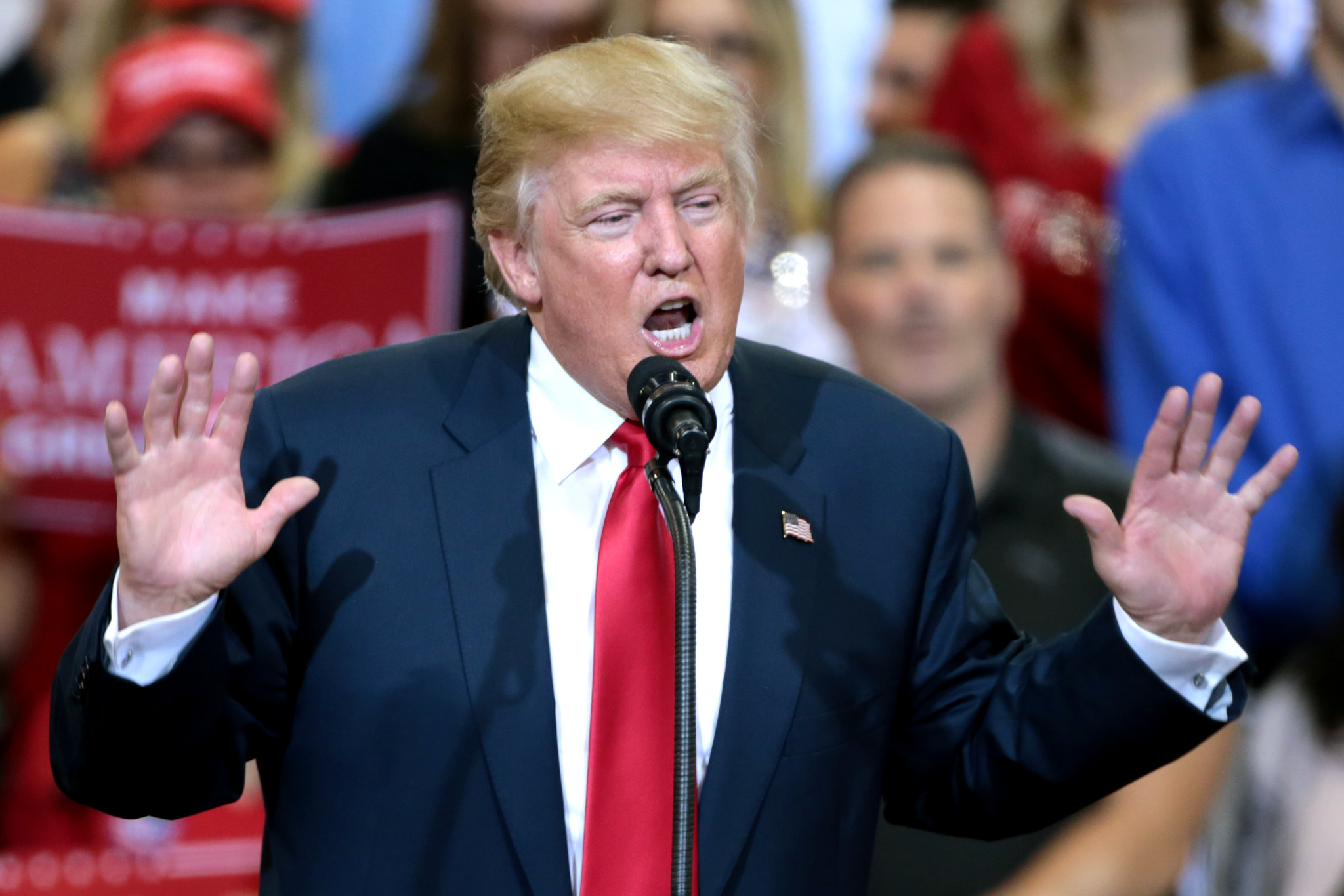
Even if I have to say so as co-author with Mark Green of “WRECKING AMERICA: How Trump’s Lawbreaking and Lies Betray All,” I know of no book on Trump to be as practically useful for the 2024 presidential election. Useful, that is, for those Americans who are appalled at how this egomaniacal delusionary man has gotten tens of millions of voters wanting him back in the White House.
The fervent Trumpsters may believe all politicians are delusionary. Trump, however, is proudly open about his assertions proving it. He is a bombastic blowhard who rants and raves in all directions.
Trump is too unstable, too unreliable, too dangerous—especially to exercise lawfully the enormous power held by a President of the U.S.
In our book, we assembled Trump’s own words to define his “delusionary” state of mind. He made these boasts without a smile and in all seriousness:
“Nobody knows more about taxes than I do, and income than I do.”
“Nobody knows more about construction than I do.”
“Nobody knows more about campaign finance than I do.”
“I know more about drones than anybody.”
“Nobody knows much more about technology … than I do.”
“Nobody in the history of this country has ever known so much about infrastructure as Donald Trump.”
“I know that H-1B [visa], I know the H-2B. Nobody knows it better than me.”
“I know more about ISIS than the generals do, believe me.”
“Nobody knows more about environmental impact statements than me.”
“I understand the power of Facebook maybe better than almost anybody.”
“I know more about renewables than any human being on earth.”
“Nobody knows more about polls than me.”
“I know more about courts than any human being on earth.”
“I know more about steelworkers than anybody that’s ever run for office.”
“Nobody knows more about banks than I do.”
“Nobody knows more about trade than me.”
“I know more about nuclear weapons than he’ll ever know.”
“I understand the tax laws better than almost anyone.”
“I know more about offense and defense than they will ever understand.”
“Nobody even understands it but me. It’s called devaluation.”
“I understand money better than anybody.”
“I understand the system better than anybody.”
“Nobody knows more about debt than I do.”
“Nobody knows the game better than me.”
“And who knows more about the word ‘apprentice’ than Donald Trump?”
“I understand politicians better than anybody.”
“Who knows the other side better than me?”
“I was the fair-haired boy. Nobody knows more about it than me.”
“I know a lot. I know more than I’m ever gonna tell you.”
For a mass media that concentrates so heavily on the politics of personalismo, it is remarkable that journalists have not more forcefully taken account of this braggadocio on steroids. Imagine any other candidate – Democratic or Republican – bellowing two or three such grandiosities without being taken to task. This is what happens when politicians like Reagan and Trump succeed in constantly lowering the bar of expectations by the reporters. Trump gets away with saying things for which other candidates would be excoriated or harshly ridiculed.
“WRECKING AMERICA” is replete with clearly written narratives on what damage Trump and his administration did to many aspects of life, laws, social norms, justice, health, safety, trust and truth in our country. During his business and political careers, he has gotten away with serial lawlessness. He bragged publicly in 2019: “I have an Article II, where I have the right to do whatever I want as President.” And he proved this dictatorial license regularly.
Last June by a vote of 6 to 3 the U.S. Supreme Court went very far in saying that Trump could do what he wants to do, should the Electoral College select him again as President in November.
On page 251 we devoted a few pages to speaking to wannabe Trump voters, elaborating how they and anti-Trump voters suffer the same under the impact of Trumpist policies and practices. That is if you are not part of either the Plutocracy and the Oligarchy.
Such hubris or arrogance is not just rhetoric. It led directly to him saying about Covid that “It’s going to disappear. One day, it’s like a miracle, it will disappear.” Trump also suggested that using a “powerful light” might be used to fight Covid.
He even wanted to explore injecting a disinfectant. The Michigan Poison Center reported, “Popular disinfectant companies like The Clorox Company and Reckitt Benckiser, the parent company of both Lysol and Dettol, quickly released statements emphasizing that their products should not be consumed. Despite warnings from healthcare providers and other officials, [some] people acted on Trump’s advice and ingested chemicals, including bleach, across the country. In at least five states, poison centers reported they had an increase in calls within 18 hours of Trump’s broadcasted stupidity.”
This “know-it-all” delayed mobilizing the Executive Branch for weeks and his actions caused tens of thousands of Covid-related deaths.
Moreover, through Trump’s own carelessness, he exposed himself and White House aides to Covid, sending him to Walter Reed National Military Medical Center. Tragically, before he left the White House in January 2021, 400,000 people died from Covid.
Trump’s delusional campaign promises know no bounds. In his first run for the presidency, The Guardian newspaper reported Trump’s “Promises to save US manufacturing and prevent American jobs moving abroad were a key part of Donald Trump’s 2016 campaign. But since Trump took office in January 2017, nearly 200,000 jobs have been moved overseas, based on Trade Adjustment Assistance certified petitions.”
Trump also promised clean air and water. But he pushed to weaken the Clean Air Act and clean water protections. Making empty promises is nothing new for Donald Trump. Expect more of the same between now and election day.
Presently, assailing Kamala Harris, Trump is going off the rails into very vulgar territory where no presidential candidate has ever dared to dwell. His advisors are frantic, trying to have him read their talking points and wondering how they are going to focus erratic Donald during his September 10th ABC network debate with Harris.
They are unlikely to succeed. Trump will sweep aside most reporters’ questions and launch into the same diatribes, falsehoods and bloated assurances to fix everything immediately which he repeatedly delivers at his rallies.
His delusions by definition are here to stay.


Nader is opposed to big insurance companies, "corporate welfare," and the "dangerous convergence of corporate and government power." While consumer advocate/environmentalist Ralph Nader has virtually no chance of winning the White House, he has been taken quite seriously on the campaign trail.Indeed, he poses the greatest threat to Sen. John Kerry. Democrats fear that Nader will be a spoiler, as he was in the 2000 election, when he took more than 97,000 votes in Florida. Bush won Florida by just 537 votes. The win gave Bush the election. Nader, an independent candidate, who also ran in 1992 and 1996, is on the ballot in 33 states, including Florida, Ohio, Wisconsin, and New Mexico—tough battleground states. Kerry stands a chance of losing those vital states if Nader siphons away the votes of Democrats. President Bush and Kerry have been in a statistical dead heat in nationwide polls, and votes for Nader could well tip the balance in favor of Bush.Many Kerry supporters contend that a vote for Nader is in reality a vote for Bush and have made concerted efforts to persuade Nader to throw his support behind the Democratic candidate. Nader, however, has held fast to his convictions that the two candidates are nearly indistinguishable and are pawns of big business.Designing Cars for Everything but SafetyNader was born in Winsted, Connecticut, on Feb. 27, 1934 to Lebanese immigrants Nathra and Rose Nader. Nathra ran a bakery and restaurant. As a child, Ralph played with David Halberstam, who\'s now a highly regarded journalist.Nader with Democratic nominee Jimmy Carter outside of Jimmy Carter\'s home on August 7, 1976, discussing Consumer Protection. (Source/AP) Nader graduated magna cum laude from Princeton in 1955 and from Harvard Law School in 1958. As a student at Harvard, Nader first researched the design of automobiles. In an article titled "The Safe Car You Can\'t Buy," which appeared in the Nation in 1959, he concluded, "It is clear Detroit today is designing automobiles for style, cost, performance, and calculated obsolescence, but not—despite the 5,000,000 reported accidents, nearly 40,000 fatalities, 110,000 permanent disabilities, and 1,500,000 injuries yearly—for safety."Early Years as a Consumer AdvocateAfter a stint working as a lawyer in Hartford, Connecticut, Nader headed for Washington, where he began his career as a consumer advocate. He worked for Daniel Patrick Moynihan in the Department of Labor and volunteered as an adviser to a Senate subcommittee that was studying automobile safety.In 1965, he published Unsafe at Any Speed, a best-selling indictment of the auto industry and its poor safety standards. He specifically targeted General Motors\' Corvair. Largely because of his influence, Congress passed the 1966 National Traffic and Motor Vehicle Safety Act. Nader was also influential in the passage of 1967\'s Wholesome Meat Act, which called for federal inspections of beef and poultry and imposed standards on slaughterhouses, as well as the Clean Air Act and the Freedom of Information Act."Nader\'s Raiders" and Modern Consumer MovementNader\'s crusade caught on, and swarms of activists, called "Nader\'s Raiders," joined his modern consumer movement. They pressed for protections for workers, taxpayers, and the environment and fought to stem the power of large corporations.In 1969 Nader established the Center for the Study of Responsive Law, which exposed corporate irresponsibility and the federal government\'s failure to enforce regulation of business. He founded Public Citizen and U.S. Public Interest Research Group in 1971, an umbrella for many other such groups.A prolific writer, Nader\'s books include Corporate Power in America (1973), Who\'s Poisoning America (1981), and Winning the Insurance Game (1990).
ZNetwork is funded solely through the generosity of its readers.
Donate




