

In 1809, Thomas Jefferson wrote to James Madison suggesting Madison annex Florida, Canada, and Cuba, noting, “we should have such an empire for liberty as she has never surveyed since the creation.” Each president since then, whether engaging in genocidal westward expansion, the colonization of the Philippines, or executing a global drone assignation campaign, has contributed to the building and development of that Empire. Trump is no different. In fact, he has been looking for a war since his first term when he threatened to reign down “fire and fury” on North Korea, struck Syrian government targets, and assassinated Qasem Soleimani. This term, he has overseen Israel’s genocide in Gaza and bombed Iranian nuclear facilities. But with the recent escalations with Venezuela, it seems all out warfare may be on the horizon.
Early US planners saw the whole of the Western Hemisphere as fated for US conquest. As Hamilton urged, “we ought certainly to look to the possession of the Floridas and Louisiana, and we ought to squint at South America.” In 1786, Jefferson voiced fear that Spain’s hold over its territory would not last, “till our population [was] sufficiently advanced to gain it from them piece by piece.” John Quincy Adams noted of one of those pieces, Cuba, that it would fall into the hands of the US in the same way “an apple, severed by the tempest from its native tree, cannot choose but fall to the ground.” Adams was the mastermind behind James Monroe’s Monroe Doctrine which declared, “We owe it…to candor and to the amicable relations existing between the United States and [the European] powers to declare that we should consider any attempts on their part to extend their system to any portion of this hemisphere as dangerous to our peace and safety.”
In 1895, Grover Cleveland invoked the Monroe Doctrine when entering negotiations with the British over the Anglo-Venezuelan Boundary Dispute. It was then that Cleveland’s secretary of state, Richard Olney, added his own corollary to the doctrine: “Today the United States is practically sovereign on this continent and its fiat is law upon the subjects to which it confines its interposition.” Echoing Olney, during WWII, the Western Hemisphere was identified by Council on Foreign Relations and State Department planners as a place where the US should “achieve military and economic supremacy”. In 1948, a coup in Venezuela replaced civilian rule with a military regime. One State Department policy paper from 1950 identified, among other things, as “specific objectives in Venezuela” the assurance of “an adequate supply of petroleum” and the promotion of Venezuela as “an aid in defending the strategic Caribbean-Canal Zone area”. That the military government fulfilled those objectives was enough for the US to maintain relations despite thousands of political dissidents being disappeared.
For most of the twentieth century, Venezuela was the world’s leading oil exporter, its oil reserves largely dominated by US corporations. For that reason, when Hugo Chávez was elected in 1998 and warmed relations with Cuba, expanded social services for Venezuelans, and nationalized a series of Venezuelan industries, he was seen as a hindrance to US military and economic supremacy in the region. And while Chávez’ successor Nicholás Maduro has been credibly accused of human rights abuses, were Richard Olney alive today, it is certain that he would most object to Maduro challenging the US as the primary “sovereign on this continent”. In fact, in March 2019, Trump’s then National Security Advisor John Bolton told Jake Tapper about tensions between the US and Venezuela, “In this administration we’re not afraid to use the phrase Monroe Doctrine. This is a country in our hemisphere.”
Trump knows that if he chose to escalate with Venezuela, he would likely receive broad support from the political and media establishment. This is what took place during his first term. According to former acting FBI director Andrew McCabe, as he wrote in his book of a 2017 conversation, Trump said, “That’s the country we should be going to war with. They have all that oil and they’re right on our back door.” That year, Trump imposed sanctions to prevent Venezuela from borrowing or selling assets in the financial system of the US. As economist Mark Weisbrot noted in The Nation at the time, Venezuela was previously in a position “to recover fairly quickly” from financial turmoil they were in as they had already cut imports, necessary to balance external accounts. Weisbrot wrote, “The new embargo will exacerbate shortages of food, medicine, and other essential goods, while severely limiting the policy options available to pull the country out of a deep depression”. In April 2019, the Center for Economic and Policy Research issued a study that found sanctions imposed in 2017 and 2018 led to some 40,000 deaths.
Still, the New York Times Editorial Board published a piece endorsing sanctions on August 3, 2017: “European and Latin American nations should join in the quarantine of Mr. Maduro and his cronies.” On January 23, 2019, the Trump administration acknowledged Juan Guaidó, the thirty-five-year-old Venezuelan president of the National Assembly, as the interim president of Venezuela after he swore himself in and called, effectively, for a military coup. When Guiadó was acknowledged at Trump’s 2020 State of the Union which he was present for, Democrats and Republicans alike gave him a standing ovation. Days later, Nancy Pelosi gave a press conference with Guiadó, which she opened saying, “It is a great honor to welcome to the capitol…who we consider to be the president of Venezuela.”
In January 2019, days after then Secretary of State Mike Pompeo pledged $20 million of aid to Venezuela, a sum that falls short of even a few days’ worth of oil revenue US sanctions were preventing, US military aircraft began arriving in neighboring Colombia. Ready-to-use meals used to fight malnutrition in children were sent despite malnutrition not being an affliction of Venezuela’s, while USAID contracted right-wing organizations within Venezuela for distribution despite many of them lacking proper facilities to do so. Years later, the inspector general at USAID would give his opinion that the decision to send aid “was not driven by technical expertise or fully aligned with the humanitarian principles of neutrality, independence and being based on needs assessments.” Early the next month, a photo surfaced that showed a bridge blocked between Colombia and Venezuela, cited by news organizations from CNN to Bloomberg as evidence of the Venezuelan government preventing aid from entering the country. The picture was tweeted by Pompeo who added, “The Maduro regime must LET THE AID REACH THE STARVING PEOPLE.” The CBC, would later issue a retraction after they reported on the picture noting “what Pompeo didn’t say in his tweet—and what many news organizations, including CBC News, didn’t report—was that the bridge in the tweet has never been open to traffic.”
Later that month, images of burning trucks of humanitarian aid at the border between Colombia and Venezuela surfaced. Bolton Tweeted, “Masked thugs, civilians killed by live rounds, and the burning of trucks carrying badly-needed food and medicine. This has been Maduro’s response to peaceful efforts to help Venezuelans.” CNN reported the claim, even including in their article that “a CNN team saw incendiary devices from police on the Venezuelan side of the border ignite the trucks.” By early March, however, it became undeniable the claim was false. The New York Times would publish an article on March 10 where they pointed out, “The opposition itself, not Mr. Maduro’s men, appears to have set the cargo alight accidentally.”
However, between his first and second terms, his rhetoric surrounding war shifted as he and other far right politicians criticized Joe Biden for his Ukraine policy. This has limited how populist he might be able to market a regime change war. When Trump struck Iranian nuclear facilities, public opinion was not on his side. At the time, one survey found only 19% of Trump voters supported the US bombardment against 60% who opposed. Still, Trump has the propensity for war, made clear by the fact that the US military budget under Trump will exceed $1 trillion yearly and while Trump’s Director of National Intelligence Tulsi Gabbard had asserted that US intelligence suggested Iran was not building a nuclear weapon, Trump openly contradicted her to justify subsequent air strikes.
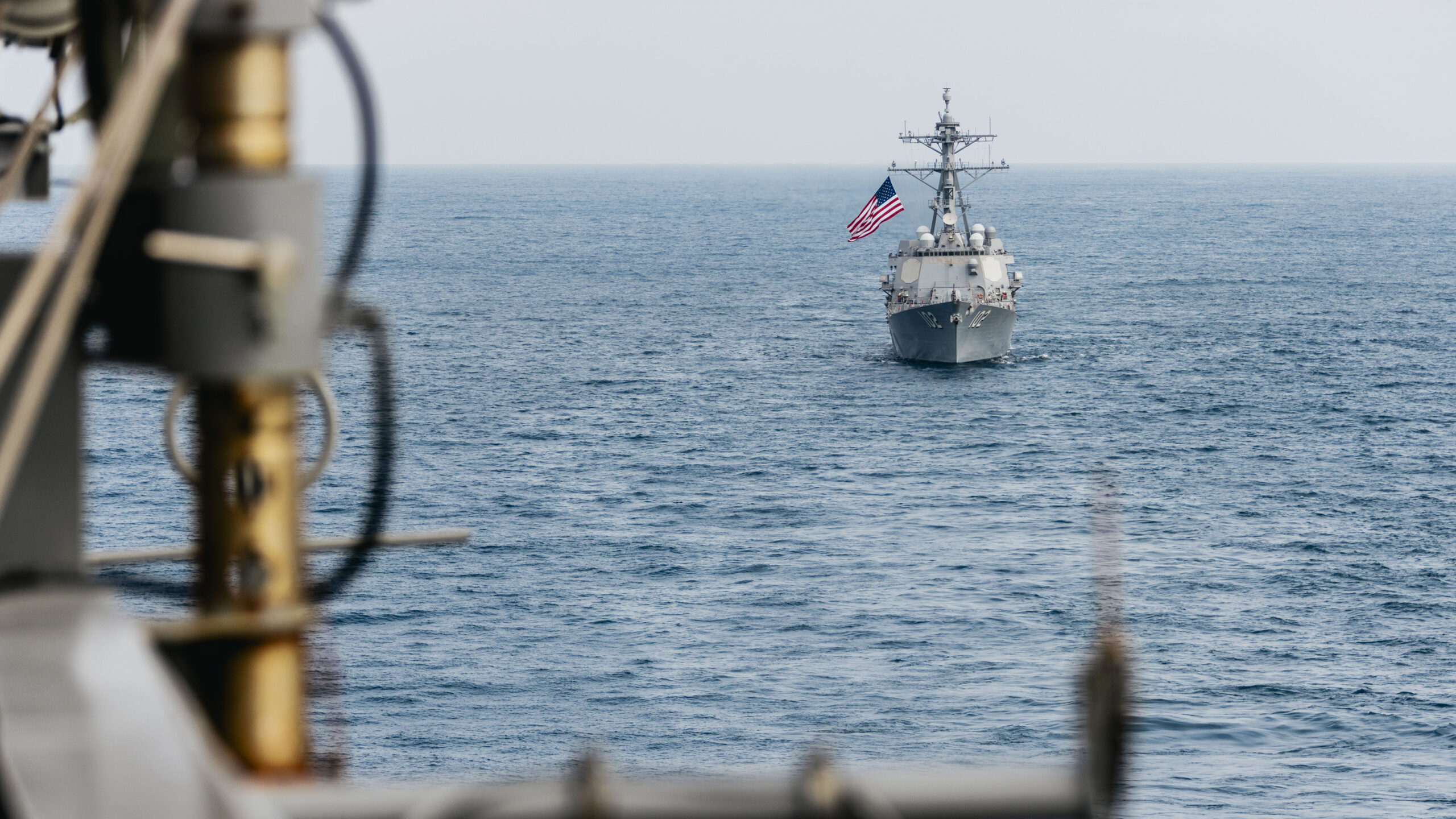
To address the problem of public opinion, Trump has tried to tie US intervention to the opioid crisis which has afflicted much of his base in the de-industrialized parts of the US. One month ago, US destroyers entered the Caribbean as Trump authorized military force against Latin American drug cartels, designating them as foreign terrorist organizations, leading to thousands of marines and service members entering Venezuelan waters. On August 7, Maduro was accused of being “one of the largest narco-traffickers in the world” by the US Justice Department and State Department who doubled their bounty on his head. Early this month, Trump authorized a US strike on an alleged Tren de Aragua vessel that had left from Venezuela killing, according to Trump, eleven people.
Much of the rhetoric surrounding the gang Tren de Aragua stems back to the dubious reporting around a year ago, that was seized on by the far right, that members of Tren de Aragua had commandeered entire apartment complexes in Aurora, Colorado. In a deteriorating, de-industrial, society afflicted by gun violence, drug addiction, and economic anxiety, scapegoating a now designated foreign terrorist organizations as the source of the problems that come with capitalism in decline is straight out of the fascist playbook. As we have seen, much of the internal cleansing via ICE raids has been rationalized as targeting MS-13 and Tren de Aragua. It seems, Trump has refined his imperial apologetics and figured out a way to rationalize a regime change war while still marketing himself as a populist. This time around, Trump is not letting tensions diffuse. Gabbard, seeming to fall in line, has just retracted a National Security Agency report from intelligence official Richard Grenell, believed to advocate for a less hardline approach than the one Trump is pursuing. The result will undoubtedly resemble the sort of misery wrought by the US in the region since Richard Olney declared the US the sovereign in 1895.
ZNetwork is funded solely through the generosity of its readers.
Donate





1 Comment
It is Manufacturing Consent. That is his evil genius.