The Federal Reserve has been under intense pressure in recent months to sharply raise interest rates in the name of taming inflation. The voices calling for these rate increases often explicitly say that they are worth doing even if they greatly increase the risk of recession. At their last open market committee meeting, the Fed heeded these voices and raised rates by 0.75%—the largest single increase in 28 years—and indicated commitment to continuing to raise rates until inflation normalized, even if this increased the risk of recession.
A recession directly reduces economy-wide incomes while inflation does not.
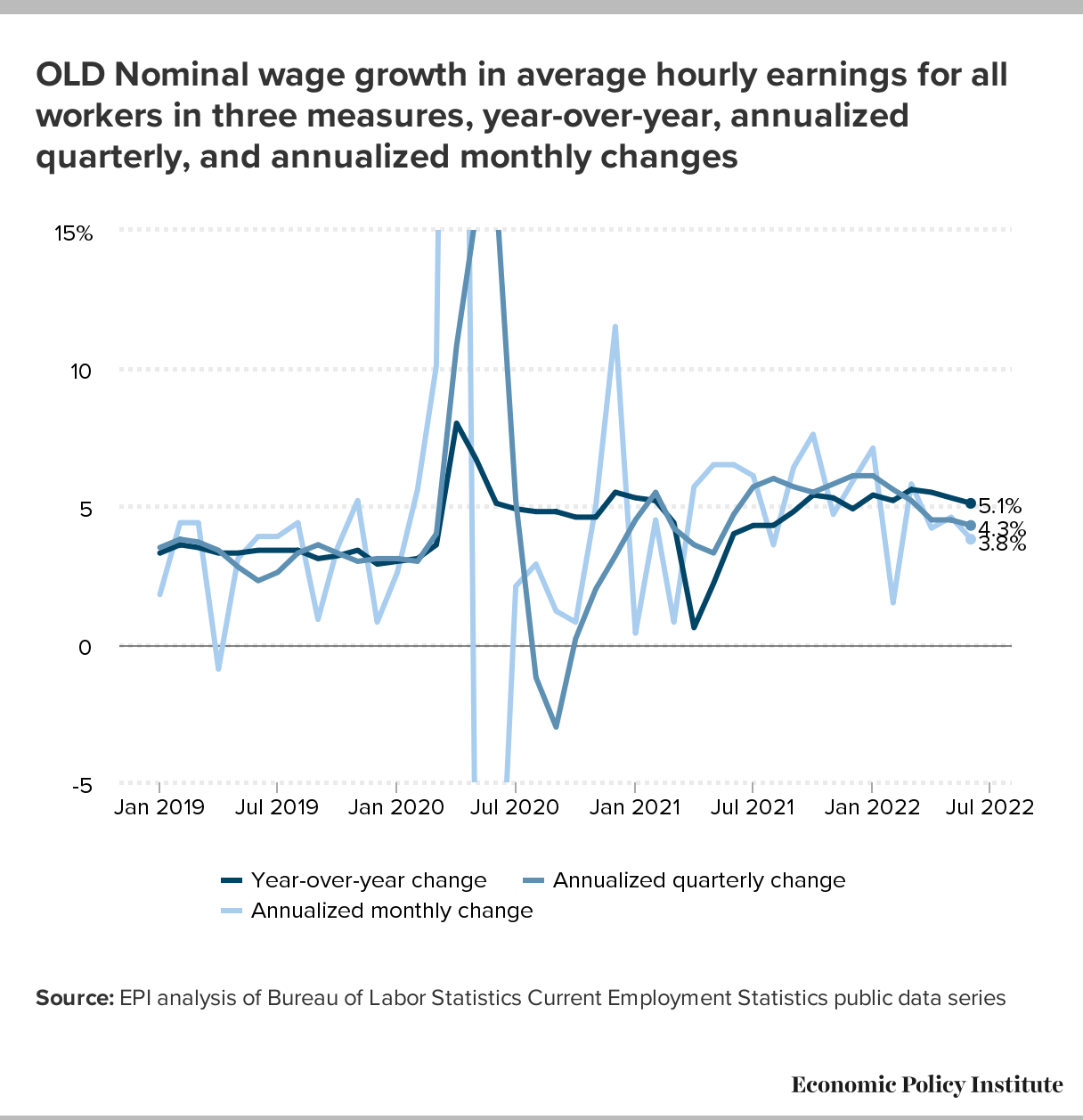
The Fed’s actions to date do not guarantee a recession, but they have already made one more likely. Moreover, if they continue on a hawkish path much longer, a recession is quite probable. This would be a huge and avoidable policy mistake. Inflation is not being driven by large macroeconomic imbalances between aggregate demand and supply. Wage growth is already decelerating noticeably. In short, the point of rate hikes—bringing demand and supply into balance and restraining wage growth—has already been accomplished.
Besides failing to recognize these points, many voices in this debate have implicitly or explicitly argued that recession and inflation cause equivalent damage, or that inflation actually causes worse damage than recession. This view is clearly wrong—the economic damage wrought by recessions is far greater than that by single-digit inflation rates.
A common argument runs that inflation harms everybody in the economy, but only those who lose their job are harmed by recession. This is the opposite of truth. A recession directly reduces economy-wide incomes while inflation does not.
A recession results from potential productive resources (labor, most importantly) being underutilized (a rise in unemployment, for example). In short, it represents pure waste in the sense that the economy produces less than it could have with full utilization of potential resources. Over the course of the Great Recession and the long recovery following it, this waste amounted to roughly $20 trillion, or more than a year’s worth of economic output.
Inflation, on the other hand, is pure redistribution in the short run, but does not directly reduce incomes in the aggregate. One person’s cost is another person’s income. As prices rise, this leads directly to higher incomes for somebody in the economy. The inflation of 2021–2022 has admittedly been regressive, leading to lower real (inflation-adjusted) wages for (most) workers but substantially higher profits for corporations and for foreign exporters to the United States But as much as we may not like the redistribution caused by recent inflation, there’s no evidence that it has led to lower incomes overall (including non-U.S. global income). Additionally, if we wanted to hold income distribution harmless against the effects of recent inflation, there are a number of policy instruments like fiscal redistributions and labor standards that could do this.
Some might make the mistake of looking at the current pace of wage growth for workers (roughly 4.5% at an annualized rate) and the current rate of inflation (8.6% over the past year) and think that a recession could pull down inflation but leave nominal wage growth unscathed. If this was true, workers (at least those who remained employed) could in theory benefit from an aggressive campaign against inflation. But, this is wrong. Higher unemployment lowers wage growth much more reliably and by larger amounts than it lowers inflation. The evidence for this is simple—in regressions that identify the correlation between inflation-adjusted wages and unemployment (or other measures of labor market tightness), the evidence is overwhelming that tighter labor markets (lower unemployment) are associated with faster real wage growth. The boost that tighter labor markets give real wage growth is also highly progressive. Low-wage workers see greater gains as labor markets tighten and Black workers see faster gains than white workers. In short, the benefits of high-pressure labor markets are large in the aggregate and distributionally progressive. Conversely, the costs of recession are large and regressive.
People hoping that any effort to contain inflation will just restrain price growth without slowing the pace of wage growth will hence be disappointed if this effort is wholly driven by a weaker labor market stemming from the Fed’s interest rate hikes. Put simply, if the Fed does engineer a recession (or even a significant slowdown in the rate of economic growth), workers’ inflation-adjusted wages will be lower than they would be without that recession.
This wage growth angle is, by far, the most important reason why just looking at the rise of unemployment in a recession is a radical understatement of how many workers are adversely affected by recessions. Other issues include higher rates of underemployment and fewer hours worked over the course of a year. In short, the costs of recession are not simply limited to those workers who lose a job— they’re incredibly widespread across the workforce.
While it’s generally understood that inflation may not directly reduce economy-wide income directly, some point to theories indicating that if inflation was sustained for a long time (several years) it could eventually prove detrimental to aggregate economic growth. But the main channels through which sustained high inflation leads to lower growth run through its potential interaction with the income tax code—whose features historically were not well-indexed to keep economic incentives neutral in the face of inflation. But most features of the U.S. tax code are largely indexed for inflation today. Further, those features that are not perfectly indexed to avoid distortionary interactions with inflation could be fixed in ways that do not require draconian inflation control.
Of course, a sustained recession or period of weak growth would also have large effects on long-run growth. Extended periods where workers’ wages are kept low by damaged labor markets are periods where firms’ incentive to make productivity-enhancing investments are blunted—these firms can instead post high rates of profitability simply due to suppressed wages. These “scarring” effects of recessions on long-run potential growth are very large, and they almost surely dwarf any long-run effect from inflation over the coming years. Obviously, if U.S. inflation rose to 50% for a number of years, the growth-stunting effects of that would exceed the effect of recession scars, but nobody seriously believes scenarios like that are plausible.
Some arguing for a more-rapid pace of Fed tightening have claimed that even if you think recession is worse than inflation, it is essentially impossible to ever pull inflation back to more-normal rates without raising interest rates high enough to at least risk a recession. This thinking essentially argues that inflation is a one-way ratchet, only ever moving up until recession pulls it back down. This isn’t true. The most obvious way this is not true is when much of overall inflation is driven by certain commodities like energy and food. These commodities’ prices whipsaw up and down a lot and put substantial upward and then downward pressure on inflation without a recession necessarily intervening.
This claim of a one-way ratchet in non-recessionary times is also not true more generally. The key variable for determining whether or not a softer labor market is needed to rein in inflation in coming months is generally the pace of wage growth. If wage growth is consistently running more slowly than inflation, then wages are dampening inflation from both the cost side (labor costs are growing more slowly than other costs) and by generating lower real incomes for households, thus depressing demand. So long as wage growth decelerates, then inflation will be reeled back in without causing a recession once economic shocks relent. Currently, wage growth is decelerating. This means there is no genuine need for a recession to pull wage growth down to sustainable levels.
One could certainly argue that the reason why wage growth is currently moderating is the recent hikes undertaken by the Fed, and their success in tamping down inflationary expectations. My own view is that’s a pretty incomplete argument. But, even if one believed this, it seems clear that going forward, the imperative to continue pushing interest rates up is gone. The risk of recession is much larger now than it was a few months ago, and interest rate hikes—both in the recent past and in the anticipated near future—are a key reason why. The cost of a recession would be far higher than any benefit to piling on more contractionary policy to rein in already-fading inflation.
ZNetwork is funded solely through the generosity of its readers.
Donate