


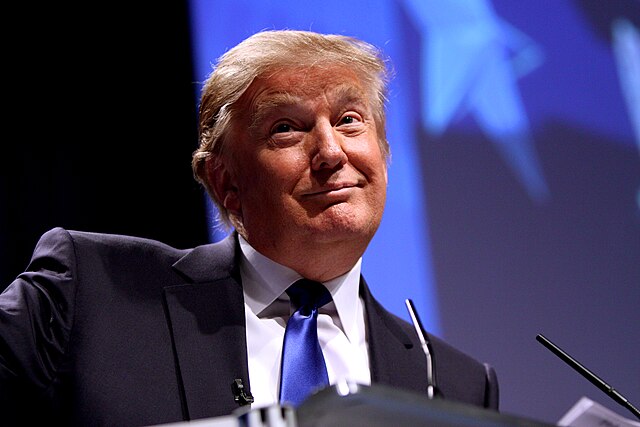
Many Americans are celebrating the news of Donald Trump’s conviction on 34 felony charges in a hush-money incident that took place ahead of the 2016 presidential election. Newspaper headlines screamed “TRUMP GUILTY ON ALL COUNTS” and media reports relied on superlatives such as “historic” and “unprecedented” to label the unanimous jury verdict. Given that Trump has been unusually adept at avoiding accountability for a staggering number of alleged crimes, the verdict felt like a long-overdue comeuppance.
It was even more shocking than the news of Derek Chauvin’s conviction in the murder of George Floyd four years ago—but not by much. The United States criminal justice system was not designed to be applied equally across race and class. It was designed to protect men like Trump and Chauvin—powerful elites who bend laws to suit their purpose and the henchmen who serve them.
This is why the fact that Trump is now officially a “felon” feels so earth-shattering. For years people convicted of felonies were unable to vote in elections in many states. Felony disenfranchisement disproportionately impacts Black voters. According to Dyjuan Tatro, an alumnus of the Bard Prison Initiative, as of 2016 “Black Americans [were] disenfranchised for felony conviction histories at rates more than four times those of all other races combined.” It is highly unlikely that the U.S. would tolerate the disproportionate (or even proportional) disenfranchisement of wealthy whites.
Although many states are slowly overturning the loss of voting rights for people who have finished serving their sentences, in the vast majority of U.S. states people still cannot vote while incarcerated. Republicans tend to back felony disenfranchisement, perhaps because of the assumption that those marginalized populations that our criminal justice system targets tend not to favor them.
Florida, the state where Trump officially resides, has been ground zero for the battle over felony disenfranchisement. When Floridians in 2018 voted to restore the voting rights of those convicted of felonies, the state’s Republican governor, Ron DeSantis, effectively overturned the measure by forcing it to apply only to those who have paid off their debts. It was a clearly classist move, one that prison reform advocates dubbed “pay-to-vote.” Given the preservation of felony disenfranchisement in Florida, some have speculated that Trump may not be able to vote for himself in November depending on the sentence he is handed. But given that he was convicted in New York, he may ironically be able to cast a ballot in Florida thanks to New York’s ban against felony disenfranchisement laws.
Incredibly he can still run for president in spite of being labeled a “felon,” and could even be elected from within prison walls. But if he was a low-income person of color merely looking to rent an apartment or apply for a job as a janitor or schoolteacher, he would have likely been barred from doing so freely.
States have generally enabled legalized discrimination against people convicted of felonies. Aside from the loss of voting rights, it is acceptable to engage in housing and employment discrimination against them. It’s no wonder that the label “felon,” has been considered by human rights advocates in recent years as deeply dehumanizing. The same is true for terms such as “inmate,” “parolee,” “offender,” “prisoner,” and “convict.”
This is why Trump’s conviction is so astonishing. And this is why abolitionists—those who want to dismantle the entire criminal justice system and replace it with a system based on equity and the sharing of collective resources as a means of promoting public safety—are watching with bated breath if the former president will actually be ensnared by a system intended to reward people like him and instead serve prison time. In general, we live in a system where “the rich get richer and the poor get prison.” It is a rare exception for someone of elite status to be criminalized.
Each felony count against Trump carries a maximum sentence of four years which could be served concurrently. He could also be sentenced to house arrest or be put on probation. The minimum sentence is zero. The Associated Press is reporting that “Manhattan District Attorney Alvin Bragg declined to say whether prosecutors would seek prison time.” In other words, in spite of Trump’s clear guilt, it is possible he could face no punishment whatsoever. His fate lies in the hands of Judge Juan Merchan who will hold a sentencing hearing on July 11.
“Without law and order, you have a problem,” said Trump in 2016 months before he won enough electoral college votes to be deemed president. “And we need strong, swift, and very fair law and order,” he added. Such rhetoric remains common among Republicans (as well as centrist Democrats such as current president Joe Biden). It is the sort of language that marginalized people understand is aimed at them. But in rare instances when the system functions in the way it was never meant to—when it ensnares powerful elites or law enforcement—the “tough-on-crime” crowd shows its hand in myriad ways.
Those who are emotionally invested in the notion that we live in a society with equal justice under the law see it as proof that the system works, even if it can benefit from some reforms. Trump’s verdict is apparently “a triumph for the rule of law.” But, it has been eight years since the Wall Street Journal first reported that Trump arranged to pay off Stormy Daniels in exchange for her silence over their affair. Since then, he has remained free, even as low-income people of color are jailed before trial at the drop of a hat for far lesser alleged crimes.
Others, such as Republican supporters of the former president, see Trump’s verdict as a “shameful” exception that proves the system is “corrupt and rigged”—against the wealthy and powerful, not the untold numbers of wrongfully convicted Black and Brown people.
Meanwhile, Trump has engaged in ethical breaches and criminal acts faster than the system can respond. Just weeks before his conviction, Trump was reported to have overtly demanded a $1 billion bribe from oil and gas executives at a fundraiser. Barely did Senate Democrats have time to launch an investigation into the apparent quid-pro-quo when he did it again. His hubris stems from an implicit belief that the system was never designed to hold people like him accountable. He’s right, it wasn’t.
Erica Bryant at the Vera Institute of Justice pointed out that the U.S. would be “one of the safest nations in the world” if mass incarceration was an effective way to protect us from crime. “[W]hy do we have higher rates of crime than many countries that arrest and incarcerate far fewer people?” she asked. A Vera Institute poll found that a majority of U.S. voters prefer a “crime prevention” approach to safety rather than a system based on punishment, one that prioritizes fully funding social programs rather than traditional “tough-on-crime” policies like increased policing and mass incarceration.
Those of us who understand that Trump’s conviction is neither welcome proof that a “tough-on-crime” approach works, nor evidence that it’s rigged against elites are nonetheless celebrating the headlines. It is akin to watching an overzealous and greedy hunter step into one of his own traps. The ultimate goal is to end the hunt even as it feels incredibly satisfying to see Trump cut down to size.
Trump’s emergence in the U.S. political system and his (nearly) successful avoidance of accountability for so long is clear evidence that our democracy and its criminal justice system are rigged against us in favor of wealthy elites. The fact that there is still no guarantee that he will be punished or even disqualified from the presidency in a nation that zealously criminalizes marginalized communities ought to be all the proof we need that our criminal justice system does not deserve our faith.
This article was produced by Economy for All, a project of the Independent Media Institute.


Sonali Kolhatkar is an award-winning multimedia journalist. She is the founder, host, and executive producer of “Rising Up With Sonali,” a weekly television and radio show that airs on Free Speech TV and Pacifica stations. Her most recent book is Rising Up: The Power of Narrative in Pursuing Racial Justice (City Lights Books, 2023). She is a writing fellow for the Economy for All project at the Independent Media Institute and the racial justice and civil liberties editor at Yes! Magazine. She serves as the co-director of the nonprofit solidarity organization the Afghan Women’s Mission and is a co-author of Bleeding Afghanistan. She also sits on the board of directors of Justice Action Center, an immigrant rights organization.
ZNetwork is funded solely through the generosity of its readers.
Donate




