

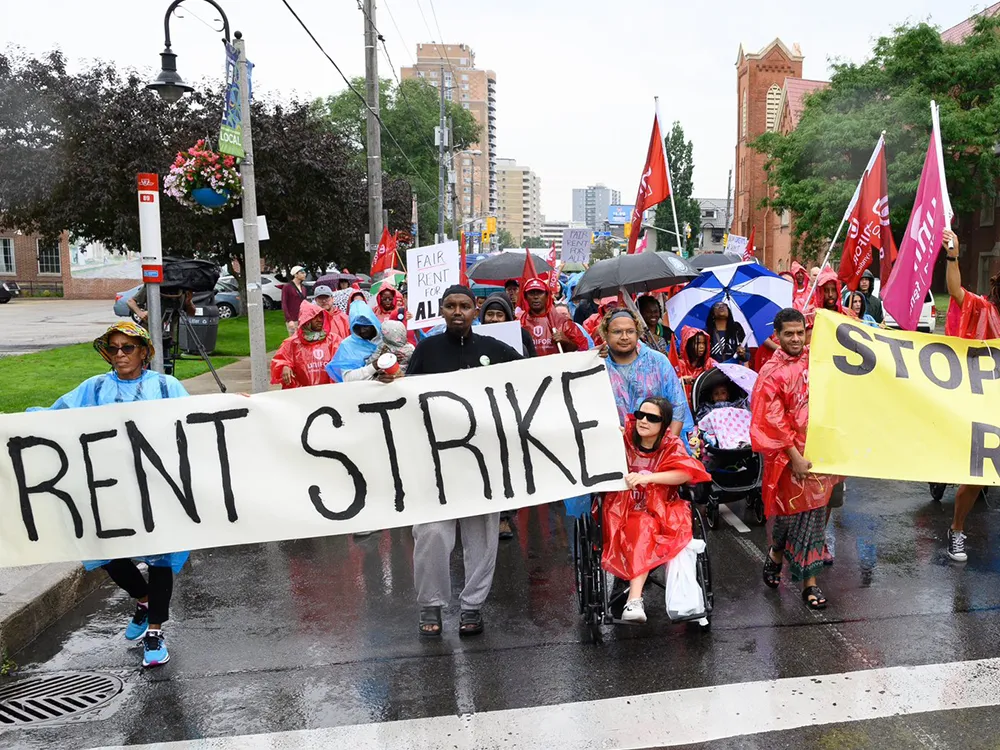
Rent strikes are good. When tenants organize to withhold payment from landlords, they are resisting exploitation, fighting for fairness, raising class consciousness, and building solidarity. When more renters join the cause, it becomes even more powerful, serving as a force multiplier. And that is exactly what’s happening in Toronto right now.
Last Sunday, more than one hundred tenants at two Lawrence Avenue West buildings joined strikers at several other buildings in the city. Tenants at buildings on King and John Streets, and Thorncliffe Park, have been striking for months. Some residents at Thorncliffe are now facing eviction.
In June, Mitchell Thompson ran down the list of tenant grievances in Toronto at several properties. He also put the strikes in broader context. Toronto is facing a housing crisis, like much of Canada. In the wildly unaffordable city, poor and lower middle-class people are getting squeezed hard. They are desperate and tired through no fault of their own. At the same time, building owners are exploiting them, raising rents and providing subpar living conditions. This is class war, pure and simple.
Building owners at King and John refuse to negotiate with the tenants, despite the efforts of Toronto mayor Olivia Chow to bring the parties together. This refusal to parley isn’t surprising. Owners recognize that strikers are doing more than withholding their rent; they are taking a stand against above-guideline rent increases and addressing the shabby condition of buildings, which are in desperate need of maintenance and care. These striking renters are not just asserting their rights — they’re laying the groundwork for a broader movement. Their courage will likely set an important precedent.
On their own, tenants are disconnected and vulnerable to building owners who have all the power. United, tenants are much stronger, coordinated, and empowered with the leverage that comes from unity. If a single tenant decides not to pay rent, landlords can readily initiate eviction and collection-agency procedures at a relatively low cost. Conversely, when hundreds upon hundreds of tenants collectively withhold their rent, the financial burden on property owners escalates — much like the rent in a roach-infested building that a slumlord refuses to care for.
Naturally, building owners are betting that they can outlast tenants. They are counting on their usual bag of tricks — putting the screws to tenants, threatening to evict, as well as reporting tenants to credit agencies, thereby making future rentals much more difficult to attain. They are used to having all the power and exploiting tenants. Moreover, they’re now desperate because they’re not stupid. They know what’s at risk.
Owners are all-in on outlasting tenants because they are worried that if tenants win, it will not only cost them profit — in the form of maintenance, repairs, higher standards, and lower rents — but it will also cost them power, which, in time, will cost them even more money, undermining their capacity to gouge tenants and to resist necessary maintenance and repairs.
The greater the legitimacy and success achieved by tenant unions, the more likely they are to become widespread, recognized (in law and otherwise), and accepted by the public as legitimate organizations that are due consideration. Tenant solidarity and power will grow in tandem with the number of tenant unions. If dozens of tenant organizations came together, they could establish uniform expectations and demands, and pool resources to support tenants, whether they are currently striking or not, on a large scale. This would improve the chances for striking or would-be striking tenants, thus rebalancing the historically skewed power dynamics in favor of landlords over tenants.
Chiara Padovani is a social worker, the founder of the York South-Weston Tenant Union, and a leader in the tenants’ rights movement. She recently told Abby O’Brien at CTV that with the Lawrence Avenue tenants joining in tenant action, the current count of striking renters is nearly 500. It may not sound like much. But it’s the most in the history of the city. It is a big deal. And, as the saying goes, momentum creates its own opportunities. The strike could still be in its infancy — as could the movement.
Rent strikes aren’t new. Documented instances of rent strikes, often involving large-scale actions, can be traced back to the nineteenth and early twentieth centuries in both Europe and North America. During times marked by heightened exploitation and increasing class awareness, workers and tenants, frequently overlapping groups, have shown remarkable resistance and willingness to organize. The 1960s and 70s saw a rise in tenant strikes in the United States, for instance. As Livia Gershon pointed out for JSTOR Daily, the pandemic saw its own jump in tenant strikes. She notes that in the wake of New York’s mid-century rent strikes, the practice was legalized.
The pandemic, and the affordability crisis that arrived in its wake, led to a renewal of rent striking. In 2020, the United States saw the revival of rent strikes, including the largest coordinated strike in decades. Faced with the challenges of a rising cost of living, escalating rents, employment pressures, and subpar building conditions, tenants collectively declared that enough is enough. In Toronto, tenants are saying the same thing in the context of a similar situation.
The immediate goals of each strike may vary at the margins, but they tend to be familiar and similar in substance — fair rent, reasonable rates of rent increase, better building maintenance, and regular repairs and upgrades. In sum, an expectation that owners respect the dignity of renters.
Beyond immediate demands to meet basic needs, however, there is a chance to consolidate unions, normalize tenant strikes, and entrench a movement for renters’ rights. Doing so will not only help deliver the goods now for striking tenants, but will also protect them and other renters in the future. In this moment, there is an opportunity to permanently rebalance power between owners and renters — and help secure a fairer and safer future for tenants. And Toronto rent strikers are at the vanguard of that movement. The striking Toronto tenants deserve much more than plaudits — more renters should join them.
ZNetwork is funded solely through the generosity of its readers.
Donate




