

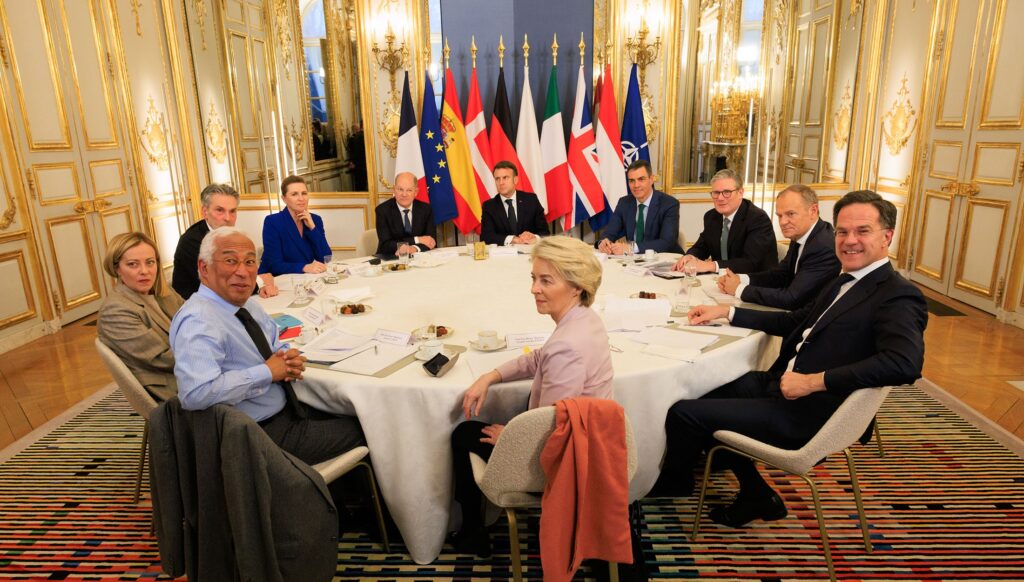
In February of this year, NATO Secretary General Mark Rutte remarked at the Munich Security Conference that, due to the current situation in Europe, “we will have to prioritize defense over other stuff”. More recently, Rutte declared that he would propose a new defense spending target of 5 % of GDP at NATO’s upcoming summit in the Hague. This would constitute a dramatic increase from the alliance’s current 2 % of GDP spending target for its member states. Rutte also stated that there is “broad support” for this move. Such a spending hike, however, would almost certainly be detrimental to social and welfare spending (or “other stuff”, as Rutte dismissively characterized it), for which there has been very strong opposition in Europe. Spanish Defense Minister Margarita Robles, for instance, has already announced that Spain is unwilling to accept the new spending target, while several political groups in Germany have opposed reprioritizing the budget in a manner that would undermine social welfare.
Strong social safety nets have long been a defining feature of European societies. After the Cold War ended, several European countries increased their social spending, while scaling back military expenditures. In general, European countries have tended to spend much more on social expenditures than defense. France and Italy, for instance, spend nearly a third of their GDP on social expenditures, while other industrial countries, such as the US and South Korea, have emphasized military spending over social expenditures. If European NATO members commit to achieving Rutte’s 5 % spending target, these trends could be reversed, with ominous implications for the strength of European countries’ social safety nets.
The issue of whether to prioritize social or military spending has been at the forefront of discussion since Russia invaded Ukraine in February 2022. In September 2024, for instance, the Wall Street Journal published an article titled “Europe Has a Painful Choice: War vs. Welfare”. In a similar article in Foreign Affairs this March, the author states that Europe should increase military spending “at the expense of its welfare states”. There is one crucial component missing from this discussion, though, which is the notion that a reduction of tensions would diminish the need to boost military spending. The drive to massively increase military spending is fueled by the concern over Russia’s intentions and a desire to placate US President Donald Trump, who has demanded that European NATO countries contribute more to the alliance’s funding.
We could, however, choose to create a world in which co-operation is favored over confrontation. In an interview with the Canadian journalist Aaron Maté, former US diplomat Chas Freeman accurately pointed out that Europe “historically has been at peace only when all the great powers who could overthrow the peace have been co opted into it”. Freeman went on to describe how the Congress of Vienna in 1814-1815 had the “good sense to reincorporate France into the governing councils of Europe” after the Napoleonic wars, which was followed by a century of peace in Europe. Freeman also points out that the exclusion of Germany from European affairs after the First World War contributed to the outbreak of World War II a few decades later. Russia’s invasion of Ukraine was a criminal act, but if we want to live in a peaceful and prosperous Europe, we might want to keep these lessons of history in mind.
The prospect of co-operation, though, is undermined by the rearmament of Europe and the attitude of many of its leaders. Ursula von der Leyen, President of the European Commission, recently ruled out the resumption of commercial ties with Russia after the end of the war, claiming that doing so would be a “mistake of historic dimensions for Europe”. The graver mistake, however, would be to choose confrontation over co operation. The latter option would be highly beneficial for Europe and the entire world. We cannot address truly existential threats, such as the possibility of a nuclear war, unless all the great powers are willing to work together.
The opponents of this thesis would assert that Russia is an implacable and evil force, determined to conquer all of Europe, and that it cannot be negotiated or reasoned with. Therefore, undertaking a massive rearmament program is the only wise course of action. Even if one believes this claim, it is unlikely, to put it mildly, that a country that is so militarily weak or incompetent that it cannot even conquer Ukraine could invade an entire continent. We may recall that the Soviet invasion of Afghanistan in the 1980’s was followed by stern warnings that it was a precursor to the Soviet Union conquering all of Asia. There is no need to comment on the accuracy of those predictions, but it is curious to observe how history often repeats itself.
At a deeper level, the prospect of co-operation would have been greatly enhanced if NATO, instead of expanding eastward, had disappeared after the fall of the Berlin Wall in 1989. During that time, there were several different proposals as to how to organize Europe’s security structures. One of the proposals was that of the last leader of the Soviet Union, Mikhail Gorbachev, who unveiled his vision of a common European home with no military alliances. In this pan-European security structure, both NATO and the Warsaw Pact would have disappeared in favor of co-operation and integration between the West and the East. That idea, though, was thoroughly undermined by the George H.W. Bush administration’s attitude towards NATO and Europe (“pan-European security is a dream”, as Bush’s Secretary of State, James Baker, informed Gorbachev) and NATO’s subsequent eastward expansion. Russia’s invasion of Ukraine dealt a further blow to these hopes, resulting in the current rearmament of Europe. Since the expansion of NATO has probably been an irreversible process, Gorbachev’s conception of a common European home seems unattainable now. However, if we want to preserve the European social welfare model and reduce tensions, we should be resisting the plans Rutte has put forth.
ZNetwork is funded solely through the generosity of its readers.
Donate
