



I’ve lived in or near Burlington, Vermont for most of the last thirty-five years. In 1999 I wrote a piece for a local Burlington agitational monthly called the Old North End Rag (or The Rag) that discussed the various permutations of the encroaching police state then being developed in the United States. One of the topics I covered was the fairly recent expansion of a database operating in the Burlington suburb of Williston, a town that is a mix of big box stores, old farms, nice trailer parks, condos and McMansions. The database was then known as the Immigration and Naturalization Services Law Enforcement Support Center (INSLESC). The database, which was originally built for use by the Drug Enforcement Agency (DEA), had its budget increased and its duties expanded after the 1996 Immigration Reform and Immigration Responsibility Act. That law, which was passed overwhelmingly by both chambers (Senate 87-3, House 333-87), is the basis for the laws currently determining the nature of immigration enforcement in the United States. Obviously, the current regime of enforcement is considerably more widespread and vicious than previous administrations over the past thirty years, but it is this law which provides the basis for Stephen Miller, Kristi Noem and Donald Trump’s increasingly murderous rampage we see today.
At that time, the database was voluntary on the part of local police forces and the laws regarding detention and deportation applied only to convictions for felonies. As anyone who has been paying attention knows, immigrants and those profiled as immigrants are now being picked up and detained just because they “look” like immigrants. In what is quickly becoming known as a Kavanaugh stop—named after Supreme Court Justice Kavanaugh who wrote the order—immigration enforcers can stop and detain someone for the color of their skin, their clothing and/or their accent. The database is now used by virtually every police department in the United States. Despite the fact that certain states and municipalities are forbidden by local laws to turn people they stop over to immigration enforcers, there are plenty of other local police agencies that have no such restrictions. Furthermore, with the vast increase in the number of immigration enforcers now employed thanks to the Trumpist expansion of that infrastructure, local police are often ignored when a federal roundup is taking place; their role usually being reduced to harassing and arresting citizens protesting the immigration agencies actions.
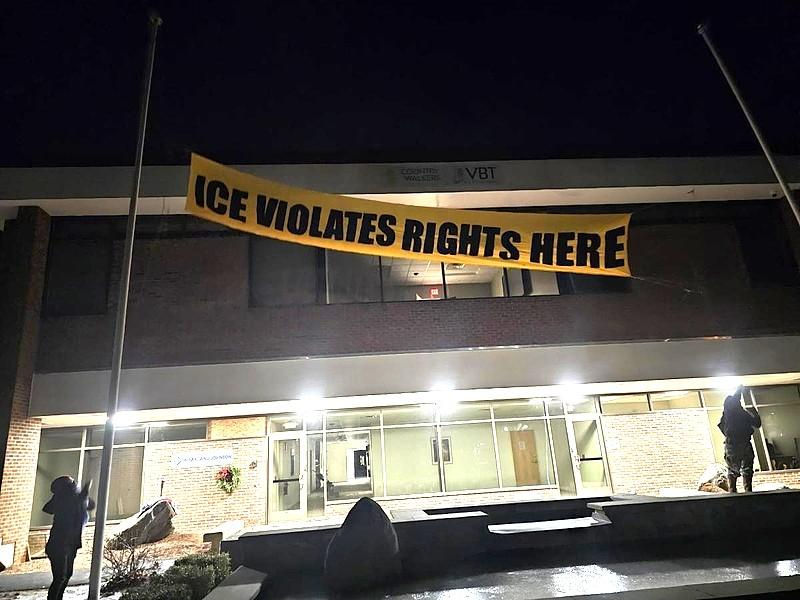
In recent weeks, especially as the Department of Homeland Security (DHS) has stepped up its attacks on immigrants and those who support them in Minneapolis and elsewhere, the buildings housing the aforementioned database in Williston, VT. has become a focus of the protests. Since I wrote that article in 1999, the INS was reconfigured as part of the Department of Homeland Security; a reconfiguration that resulted in it becoming Immigration and Customs Enforcement (ICE). This is how the ICE website describes the transition:
In March 2003, the Homeland Security Act set into motion what would be the single-largest government reorganization since the creation of the Department of Defense. One of the agencies in the new Department of Homeland Security was the Bureau of Immigration and Customs Enforcement, now known as U.S. Immigration and Customs Enforcement, or ICE.
For those who weren’t around, don’t remember or weren’t paying attention, DHS exists as part of the US government’s massive attempt to reorganize along more authoritarian lines than previously existed. The reason (or excuse, if you prefer) for this rebuild were the attacks that took place on September 11, 2001. Another element of this shift was the so-called PATRIOT Act—a law that redefined the rights of US residents by further restricting them while enhancing the repressive role of law enforcement, intelligence agencies and the military. As many folks noted after DHS was announced as a fact, the agency’s name implied an authoritarian future. Over time, the department has made many of those fears real; so real in fact that many US residents don’t recall a time when they weren’t subjected to DHS intrusiveness, surveillance and repression. Given this, the role played by the servers inside that building in Williston now called the Law Enforcement Support Center (LESC) is greater than ever before. Together with ICE and other DHS departments, like Customs and Border Protection (CBP), it helps maintain surveillance across the United States on citizens and non-citizens alike. Another location less than two miles away known as the National Criminal Analysis and Targeting Center (NCATC) monitors US residents—citizens and non-citizens alike—via their social media and other online transactions. Like the files kept by the office of Nazi war criminal Adolf Eichmann, the files maintained in this database serve an expansive machine of repression which reaches beyond US borders and into the lives of millions, destroying families, childhoods, and human psyches while diminishing whatever freedoms remain in the land of the free.
Regarding the ICE website: the regimen it describes in its pages cannot help but remind those who know about the Nazi’s method of removing Jewish residents. For example, where the Nazis had the Reich Security Main Office (RSHA), the United States has the Department of Homeland Security. One of the agencies run by Eichmann was called the Reichszentrale für jüdische Auswanderung (Reich Central Office for Jewish Emigration). His department within the RSHA was titled Referat IV B4 (Sub-Department IV, Section B4) and its purpose was organizing the logistics of the mass deportation of Jews. Other agencies in the Nazi government worked in a similar manner to rid the Reich of others it considered undesirable. The organization of the programs, the offices involved and the bureaucracy that was established is mirrored in the description of what ICE calls its Enforcement and Removal Operations. One click on those words on the ICE website reveals a bureaucratic network that includes a listing of detention facilities, a brief history of ICE, and a place to snitch on your neighbors. In other words, a website describing a bureaucracy of repression with an invitation for the reader to join in.
It’s necessary to remark here that the current regime of repression operating under the auspices of immigration control in the United States is not the same as the regime operated during the Nazi reign in Germany. It’s not killing people by the millions; it’s not even detaining or deporting those numbers, yet the mechanism for such an endeavor exists. I was told by some who read my article written in 1999 that I was being unnecessarily alarmist; the US had too many checks and balances for the LESC as I described it then to become a tool of repression like I was suggesting. Yet, here we are.
In recent weeks, people protesting ICE and CBP actions against immigrants and their supporters in Vermont have focused more of their work on the LESC center described above. A large protest in the street in front of the building on January 20, 2026 was followed by civil disobedience at the location that monitors social media the next day. A description posted on Reddit describes the action: “On Thursday, Jan 22 at approximately 1pm, a group of about a dozen Vermont community elders with whistles entered the atrium of White Cap Office Park in Williston VT, home of ICE’s National Criminal Analysis and Targeting Center. They refused to leave when ordered by Williston Police, the property manager, and federal agents, demanding instead that the landlord renegotiate and cancel the facility’s lease. For the next 3.5 hours, they sat together in silence, pausing every 90 seconds to read the name of someone killed in ICE custody, followed by a loud whistle blast. Williston Police arrived at around 1:30pm, and asked protesters to leave and stop making noise. A group of 5 elders refused and remained in the atrium accompanied by a medic and physical therapist. Around 2pm, property manager and landlord Normand Stanislas arrived and began screaming at supporters gathered outside that he would have them arrested.” (t/reddit/vt.)
There are a few websites that describe the connections between the repressive apparatus of the DHS and your hometown. The lists are by no means complete, but they’re worth a look if only to understand how complicit the private sector is in the police state revealing itself via ICE and CBP. The site I find the most comprehensive is ICE Boycott List.
ZNetwork is funded solely through the generosity of its readers.
Donate


3 Comments
https://www.dhs.gov/science-and-technology/centers-excellence
Also, are some U.S. universities (like Northeastern University in Boston, MA) still cooperating with DHS? From DHS website, for example: “Each DHS Center of Excellence (COE) is led by a U.S. college or university in partnership with other academic institutions; industry; national laboratories; federally funded research and development centers; state, local, tribal and territorial homeland security agencies; and first responder groups. By leveraging extensive public and private networks, COEs can conduct groundbreaking research resulting in rigorous, objective knowledge products and timely solutions for DHS Components.
Each COE works under a cooperative agreement that provides annual management and research funding over the duration of the award.”
The photo is attributed to activists at an action in Williston, VT