


In Lebanon, a little-honored truce remains in effect – yet another in a decades-long series of ceasefires between Israel and its adversaries in a cycle that, as if inevitably, returns to warfare, carnage and human misery. Let’s describe the current crisis for what it is: a US-Israeli invasion of Lebanon, with only a cynical pretense to legitimacy. Amid all the charges and counter-charges, the most immediate factor behind the assault is the Israeli-Palestinian conflict.
This is hardly the first time that Israel has invaded Lebanon to eliminate an alleged threat. The most important of the US-backed Israeli invasions of Lebanon, in 1982, was widely described in Israel as a war for the West Bank.
It was undertaken to end the Palestinian Liberation Organisation’s annoying calls for a diplomatic settlement. Despite many different circumstances, the July invasion falls into the same pattern.
What would break the cycle? The basic outlines of a solution to the Israel-Palestine conflict have been supported by a broad international consensus for 30 years: a two-state settlement on the international border, perhaps with minor and mutual adjustments.
The Arab states formally accepted this proposal in 2002, as the Palestinians had long before. Hizbullah leader Sayyed Hassan Nasrallah has made it clear that though this solution is not Hizbullah’s preference, they will not disrupt it. Iran’s “supreme leader” Ayatollah Khamenei recently reaffirmed that Iran too supports this settlement. Hamas has indicated clearly that it is prepared to negotiate for a settlement in these terms as well.
The US and Israel continue to block this political settlement, as they have done for 30 years, with brief and inconsequential exceptions. Denial may be preferred at home, but the victims do not enjoy that luxury.
US-Israeli rejectionism is not only in words but, more importantly, in actions. With decisive US backing, Israel has been formalizing its program of annexation, dismemberment of shrinking Palestinian territories and imprisonment of what remains by taking over the Jordan valley – the “convergence” program that is, astonishingly, called “courageous withdrawal” in the US.
In consequence, the Palestinians are facing national destruction. The most meaningful support for Palestine is from Hizbullah, which was formed in reaction to the 1982 invasion. It won considerable prestige by leading the effort to force Israel to withdraw from Lebanon in 2000. Also, like other Islamic movements including Hamas, Hizbullah has gained popular support by providing social services to the poor.
To US and Israeli planners it therefore follows that Hizbullah must be severely weakened or destroyed, just as the PLO had to be evicted from Lebanon in 1982. But Hizbullah is so deeply embedded in society that it cannot be eradicated without destroying much of Lebanon as well. Hence the scale of the attack on the country’s population and infrastructure.
In keeping with a familiar pattern, the aggression is sharply increasing the support for Hizbullah, not only in the Arab and Muslim worlds beyond, but also in Lebanon itself. Late last month, polls revealed that 87% of Lebanese support Hizbullah’s resistance against the invasion, including 80% of Christians and Druze. Even the Maronite Catholic patriarch, the spiritual leader of the most pro-western sector in Lebanon, joined Sunni and Shia religious leaders in a statement condemning the “aggression” and hailing “the resistance, mainly led by Hizbullah”. The poll also found that 90% of Lebanese regard the US as “complicit in Israel’s war crimes against the Lebanese people”.
Amal Saad-Ghorayeb, Lebanon’s leading academic scholar on Hizbullah, observes that “these findings are all the more significant when compared to the results of a similar survey conducted just five months ago, which showed that only 58% of all Lebanese believed Hizbullah had the right to remain armed, and hence continue its resistance activity”.
The dynamics are familiar. Rami Khouri, an editor of Lebanon’s Daily Star, writes that “the Lebanese and Palestinians have responded to Israel’s persistent and increasingly savage attacks against entire civilian populations by creating parallel or alternative leaderships that can protect them and deliver essential services”.
Such popular forces will only gain in power and become more extremist if the US and Israel persist in demolishing any hope of Palestinian national rights, and in destroying Lebanon.
Even King Abdullah of Saudi Arabia, Washington’s oldest ally in the region, was compelled to say: “If the peace option is rejected due to the Israeli arrogance, then only the war option remains, and no one knows the repercussions befalling the region, including wars and conflict that will spare no one, including those whose military power is now tempting them to play with fire.”
It is no secret that Israel has helped to destroy secular Arab nationalism and to create Hizbullah and Hamas, just as US violence has expedited the rise of extremist Islamic fundamentalism and jihadi terror. The latest adventure is likely to create new generations of bitter and angry jihadis, just as the invasion of Iraq did.
Israeli writer Uri Avnery observed that the Israeli chief of staff Dan Halutz, a former air force commander, “views the world below through a bombsight”. Much the same is true of Rumsfeld, Cheney, Rice and other top Bush administration planners. As history reveals, that view of the world is not uncommon among those who wield most of the means of violence.
Saad-Ghorayeb describes the current violence in “apocalyptic terms”, warning that possibly “all hell would be let loose” if the outcome of the US-Israel campaign leaves a situation in which “the Shia community is seething with resentment at Israel, the US and the government that it perceives as its betrayer”.
The core issue – the Israel-Palestine conflict – can be settled by diplomacy, if the US and Israel abandon their rejectionist commitments. Other outstanding problems in the region are also susceptible to negotiation and diplomacy. Their success can never be guaranteed. But we can be reasonably confident that viewing the world through a bombsight will bring further misery and suffering, perhaps even in “apocalyptic terms”.
Noam Chomsky’s most recent book is Failed States: The Abuse of Power and the Assault on Democracy; he is emeritus professor of linguistics and philosophy at the Massachusetts Institute of Technology www.chomsky.info

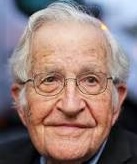
Noam Chomsky (born on December 7, 1928, in Philadelphia, Pennsylvania) is an American linguist, philosopher, cognitive scientist, historical essayist, social critic, and political activist. Sometimes called "the father of modern linguistics", Chomsky is also a major figure in analytic philosophy and one of the founders of the field of cognitive science. He is a Laureate Professor of Linguistics at the University of Arizona and an Institute Professor Emeritus at the Massachusetts Institute of Technology (MIT), and is the author of more than 150 books. He has written and lectured widely on linguistics, philosophy, intellectual history, contemporary issues, and particularly international affairs and U.S. foreign policy. Chomsky has been a writer for Z projects since their earliest inception, and is a tireless supporter of our operations.
ZNetwork is funded solely through the generosity of its readers.
Donate




