


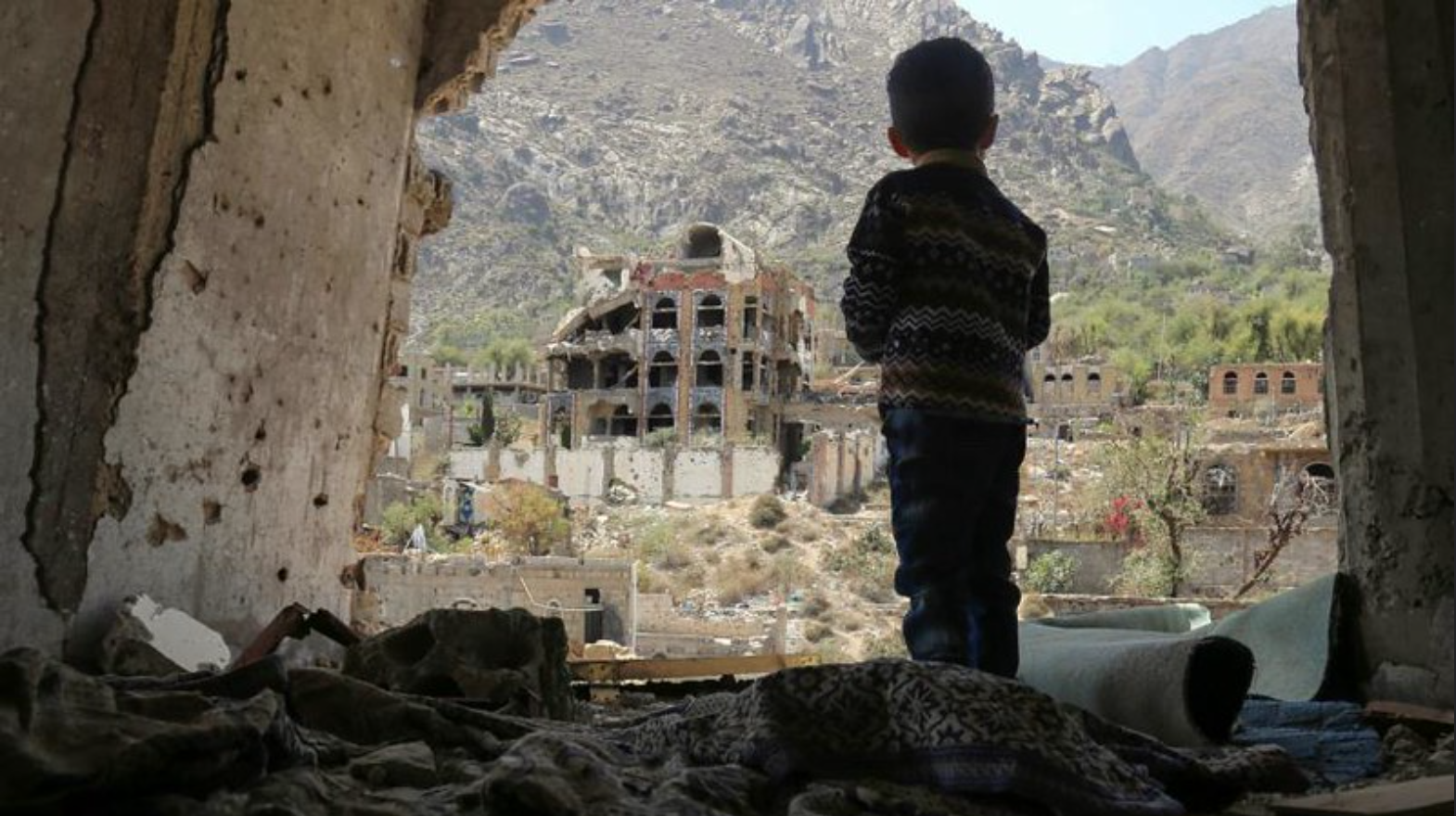
I’ve always thought of the famous John Lennon refrain, “War is over, if you want it,” as mostly a thought experiment meant to shake us out of the learned helplessness that can lead to forever wars. But in the case of the war in Yemen, the war really is over if we want.
Everybody else directly or indirectly involved — Saudi Arabia, the United Arab Emirates, the Houthis, China, Oman, Qatar, Jordan, etc. — appears to want to put the war behind them. A ceasefire has held for more than a year, and peace talks are advancing with real momentum, including prisoner exchanges and other positive expressions of diplomacy. Yet the U.S. appears very much not to want the war to end; our proxies have been thumped on the battlefield and are in a poor negotiating position as a result.
Reading between the lines, the U.S. seems to be attempting to slow-walk and blow up the peace talks. Triggering a resumption of hostilities would unleash yet another Saudi-led bombing campaign that could win U.S. proxies better terms when it comes to control of the strategically positioned Yemeni coastline. (The Red Sea and the Gulf of Aden link the Indian Ocean to the Mediterranean at the southwestern corner of Yemen, an area so geopolitically important to the flow of oil and international traffic that the U.S. has one of its largest bases, in Djibouti, across the strait.)
Tim Lenderking, the U.S. special envoy for Yemen, has been offering up particularly pessimistic comments on negotiations. “I don’t expect a durable resolution — and we should not — to the nearly eight-year conflict in Yemen to happen overnight,” he said recently in the region. “A political process will take time and likely face numerous setbacks, but I continue to be optimistic that we have a real opportunity ahead of us for peace.” That sounds nice, but decoding the diplomacy, the most important remark there is the prediction of “numerous setbacks” and the confidence that we “should not” expect “a durable resolution.”
“I don’t think we’re near the finish line yet,” Lenderking went on. “I think there is great challenges ahead. I think there is still a considerable amount of distrust among the parties, and there’s considerable division within Yemen’s society itself.”
In fact, Lenderking is attempting to wish “considerable division” back into Yemeni society. Much of that considerable division has been resolved by the Houthis winning the war. But acknowledging that would give the U.S. and Saudi-backed proxies, which operated largely out of luxury hotel rooms in Riyadh, no real position in the new Yemeni government. That’s why the U.S. keeps pressing for an “inclusive government” — the same phrase the U.S. has used with Afghanistan, demanding that in order for us to release the country’s foreign currency reserves, the Taliban must empower our proxies there (the warlords the Taliban already paid off to hand the country over to them).
In mid-April, as news of the Saudi-Iran-Houthi peace deal emerged, U.S. diplomats rushed to Saudi Arabia to tap the brakes. Axios reported at the time that the Brett McGurk, a top envoy to the region, and Lenderking “underscored the U.S. support for Saudi Arabia’s defense against threats from Yemen or elsewhere and emphasized the need for forging broader regional integration and stability through a combination of diplomacy, deterrence, and new investment and infrastructure.” This saber rattling and talk of new security guarantees came just as hundreds of prisoners were being exchanged, and the world was celebrating the steps toward peace.
A State Department spokesperson, Vedant Patel, said that I was reading too much into the U.S. insistence on transitioning the talks over to the United Nations and making sure the deal is “comprehensive” and inclusive” before peace is reached. “I reject your premise that we’re hostile to these peace talks,” Patel said. “In fact, Tim reiterated our commitment to not just strengthening the UN brokered truce but also how we remain focused on helping the parties secure a new, more comprehensive agreement.”
The U.S. knows that time is not on the Houthis’ side.
But the U.S. knows that time is not on the Houthis’ side. Saudi Arabia is still inflicting a blockade on Yemen, preventing food, medical supplies, and energy from entering the country at anywhere near the capacity needed for basic survival. In Sanaa, the capital of Yemen, a charitable offering worth roughly $9 recently drew a crowd of hundreds to a local school. Houthi security forces, in a failed effort at crowd control, fired weapons in the air; a bullet reportedly hit an electrical box, sparking an explosion and a panicked stampede that left at least 78 people dead.
The Houthis, for their own political and literal survival, need the blockade lifted. If the talks drag on for too long, the Houthis are likely to resume cross-border strikes. Everybody on all sides knows that, which is why the Saudis appear eager to get to a final deal, while the U.S. keeps throwing up new conditions.
Hassan El-Tayyab, legislative director for Middle East policy for the Friends Committee on National Legislation, who has lobbied for an end to the war, said the U.S. rhetoric makes him nervous. “I’m very concerned that the administration is adding all these conditions to a full U.S. military exit and a Saudi-Houthi deal. I’m worried that they’d use the idea that we need to have a perfect inclusive peace as a precondition to lifting the blockade,” he said, adding that he is completely supportive of an inclusive peace — but the U.S. has no business dictating terms of what peace should look like. “Yemenis should be allowed to chart their own future. It increasingly seems like the Biden administration would rather slow down diplomatic progress instead of finally just ending the Saudi-Houthi conflict.”
“Lenderking has made clear that his primary goal is not ending the war but advancing the U.S. and Israeli anti-Iran crusade in the region.”
Erik Sperling, executive director of Just Foreign Policy, was even more blunt. “It’s surreal to think that the Biden administration is more hawkish on Yemen than the brutal regime of Mohammed bin Salman, but that’s the current reality,” said Sperling. “Lenderking has made clear that his primary goal is not ending the war but advancing the U.S. and Israeli anti-Iran crusade in the region. He would prefer the Saudis continue their brutal war and blockade against Yemen, even if it means endangering Saudi security, to a deal that legitimizes Yemen’s de facto authorities. The blood of Yemenis will once again be on U.S. hands if he succeeds in his goal of scuttling the Saudi-Houthi deal and the war escalates.”
Even if the State Department earnestly believes longer talks will produce a more durable peace, the longer the talks are delayed while the blockade remains in effect, the more likely it becomes that hostilities resume. And likelier it is that Houthis launch attacks across the border at Saudi Arabia, that Saudi Arabia responds with a devastating round of bombing — and then the U.S. proxies get a bigger chunk of Yemen in peace talks when they start up again amid the rubble.
If the U.S. wanted to reduce the risk of restarting the war, it could urge Saudi Arabia to lift the blockade without conditions, or could announce that it will not support a new round of Saudi bombing. The U.S. has resisted doing either.
On Thursday, a group of more than three dozen House Democrats sent a letter to the State Department urging the U.S. to make both of those commitments, urging U.S. diplomats to “[c]learly and publicly state that the United States will not provide any further support in any form to any faction party to the conflict while diplomatic talks to end the war are ongoing and should they fail to reach a diplomatic settlement and return to armed hostilities” and “[c]learly and publicly state that the Saudi blockade of Yemen’s ports — a form of collective punishment against innocent Yemenis — must be lifted unconditionally, as global international humanitarian leaders have long sought.”
If the U.S. did what the letter is suggesting, the war would be over. If we want it.


Originally from the US, Alexandria has lived most of her life in the Caribbean, as well as in Egypt and Central America. A sailor, writer, organizer, and street medic, she has been involved in community organizing, media, and education for over 20 years. Alexandria is currently a staff member of ZNetwork.org, a writer for Extinction Rebellion, and is active with Caracol DSA and Food Not Bombs. Her work has appeared on ZNet, Common Dreams, Foreign Policy in Focus, CounterPunch, LA Progressive, Waging Nonviolence, Antiwar.com, The African, The Socialist Project, mέtaCPC, DiEM25, PeaceNews, Green Left, Popular Resistance, Resilience.org, Grassroots Economic Organizing, Shareable, Dissident Voice, Democratic Underground, and various other outlets.
ZNetwork is funded solely through the generosity of its readers.
Donate




