


Noam Chomsky is one of the major intellectuals of our time. The eighty-two-year-old American linguist, philosopher and activist is a severe critic of US foreign and economic policy. Ceyda Nurtsch talked to him about the Arabic spring in its global context
Many people claim that the Arab world is incompatible with democracy. Would you say that the recent developments falsify this thesis?
Noam Chomsky: The thesis never had any basis whatsoever. The Arab-Islamic world has a long history of democracy. It's regularly crushed by western force. In 1953 Iran had a parliamentary system, the US and Britain overthrew it. There was a revolution in Iraq in 1958, we don't know where it would have gone, but it could have been democratic. The US basically organized a coup.
Iran's democratically elected Prime Minister Mossadegh during a visit in the US in 1951, two years before the CIA's coup d'état that ousted him In internal discussions in 1958, which have since been declassified, President Eisenhower spoke about a campaign of hatred against us in the Arab world. Not from the governments, but from the people. The National Security Council's top planning body produced a memorandum – you can pick it up on the web now – in which they explained it. They said that the perception in the Arab world is that the United States blocks democracy and development and supports harsh dictators and we do it to get control over their oil. The memorandum said, this perception is more or less accurate and that's basically what we ought to be doing.
That means that western democracies prevented the emergence of democracies in the Arab world?
I won't run through the details, but yes, it continues that way to the present. There are constant democratic uprisings. They are crushed by the dictators we – mainly the US, Britain, and France – support. So sure, there is no democracy because you crush it all. You could have said the same about Latin America: a long series of dictators, brutal murderers. As long as the US controls the hemisphere, or Europe before it, there is no democracy, because it gets crushed.
So you were not surprised at all by the Arab Spring?
Well, I didn't really expect it. But there is a long background to it. Let's take Egypt for instance. You'll notice that the young people who organized the demonstrations on January 25th called themselves the April 6th movement. There is a reason for that. April 6th 2008 was supposed to be a major labour action in Egypt at the Mahalla textile complex, the big industrial centre: strikes, support demonstrations around the country and so on. It was all crushed by the dictatorship. Well, in the West we don't pay any attention: as long as dictatorships control people, what do we care!
"Efforts to create democracy": On 6 April 2008 Egyptian workers, primarily in the state-run textile industry, striked in response to low wages and rising food costs. Strikes were illegal in Egypt, and the protests were eventually crushed But in Egypt they remember, and that's only one in a long series of militant strike actions. Some of them succeeded. There are some good studies of this. There is one American scholar, Joel Beinen – he is at Stanford – he has done a lot of work on the Egyptian labour movement. And he has recent articles and earlier ones, in which he discusses labour struggles going on for a long time: those are efforts to create democracy.
Obama's predecessor, George W. Bush, claimed to cause a domino effect of freedom with his policy of the "New Middle East". Is there a relation between the uprisings in the Arab world to the policy of George W. Bush?
The main theme of modern post-war history is the domino effect: Cuba, Brazil, Vietnam… Henry Kissinger compared it to a virus that might spread contagion. When he and Nixon were planning the overthrow of the democratically elected Allende in Chile – we have all the internal materials now – Kissinger in particular said, the Chilean virus might affect countries as far as Europe. Actually, he and Brezhnev agreed on that, they were both afraid of democracy and Kissinger said, we have to wipe out this virus. And they did, they crushed it.
Today it's similar. Both Bush and Obama are terrified of the Arab spring. And there is a very sensible reason for that. They don't want democracies in the Arab world. If Arab public opinion had any influence on policy, the US and Britain had been tossed out of the Middle East. That's why they are terrified of democracies in the region.
The well-known British Middle East correspondent Robert Fisk recently stated that Obama and his policy is irrelevant for the developments in the region…
I read the article, it's very good. Robert Fisk is a terrific journalist and he really knows the region well. I think what he means is that the activists in the April 6th movement don't care about the United States. They have totally given up on the US. They know the United States is their enemy. In fact in public opinion in Egypt about 90 per cent think that the US is the worst threat that they face. In that sense the USA is of course not irrelevant. It's just too powerful.
Some criticize the Arab intellectuals for being too silent, too passive. What should the role of the Arab intellectual be today?
Intellectuals have a special responsibility. We call them intellectuals because they are privileged and not because they are smarter than anyone else. But if you are privileged and you have some status and you can be articulate and so on we call you an intellectual. And it's the same in the Arab world as anywhere else.

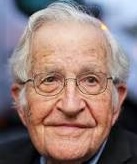
Noam Chomsky (born on December 7, 1928, in Philadelphia, Pennsylvania) is an American linguist, philosopher, cognitive scientist, historical essayist, social critic, and political activist. Sometimes called "the father of modern linguistics", Chomsky is also a major figure in analytic philosophy and one of the founders of the field of cognitive science. He is a Laureate Professor of Linguistics at the University of Arizona and an Institute Professor Emeritus at the Massachusetts Institute of Technology (MIT), and is the author of more than 150 books. He has written and lectured widely on linguistics, philosophy, intellectual history, contemporary issues, and particularly international affairs and U.S. foreign policy. Chomsky has been a writer for Z projects since their earliest inception, and is a tireless supporter of our operations.
ZNetwork is funded solely through the generosity of its readers.
Donate




