

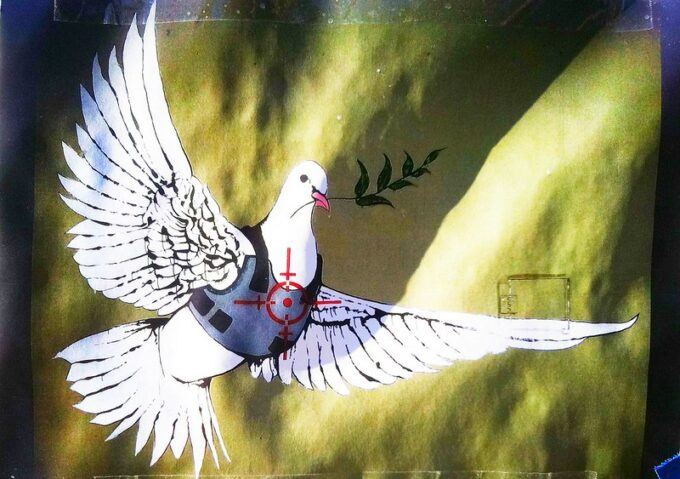
The fifty-third session of the UN Human Rights Council meeting now in Geneva could provide a perfect opportunity to advance peace as a human right and to meaningfully support the many roadmaps and blueprints for peace in Ukraine and proposals for peace in all conflict areas in Latin America, Africa and Asia.
Alas, the Human Rights Council has become predominantly a platform for those who engage in war-mongering and incitement to hatred. Notwithstanding the clear language of Article 20 of the International Covenant on Civil and Political Rights, many states practice flagrant Russophobia, Sinophobia and other phobias. Article 20 stipulates:
“1. Any propaganda for war shall be prohibited by law. 2. Any advocacy of national, racial or religious hatred that constitutes incitement to discrimination, hostility or violence shall be prohibited by law.”
The collective West, however, rejects this crucial provision of the ICCPR. Most Western states, including the US, even formulated “reservations” against this article, so that they could happily continue their demonization of rivals, pre-war incitement to hatred and mid-war fake news and bellicose propaganda.[1]
What does “weaponization of human rights mean”? Simply the instrumentalization of human rights for geopolitical purposes. Indeed, we witness how human rights have been hijacked for aggressive purposes. This “weaponization” has transformed the individual and collective entitlement to assistance, protection, respect and solidarity – based on our common human dignity and equality – into a hostile arsenal to target competitors and political adversaries. In the stockpile of weaponized human rights, the technique of “naming and shaming” has become a sort of ubiquitous Kalashnikov.
Experience shows, however, that naming and shaming fails to alleviate the suffering of victims and only satisfies the strategic aims of certain governments, non-governmental organizations and of a bourgeoning human rights industry that instrumentalize human rights for the purpose of destabilizing others and often enough to facilitate “regime change”, notwithstanding how undemocratic that may sound and regardless of the ius cogens right of self-determination of peoples, and the customary international law principle prohibiting interference in the internal affairs of States. The whole concept of “colour revolutions” is a propagandistic jargon to justify military interventions in other countries. The “Arab Spring” sounds positive, but did we not usher in an “Arab Winter” in Libya, which continues to live in chaos and misery after our “humanitarian intervention” of 2011?
Just before this Human Rights Council session, my new book “The Human Rights Industry” was published by Clarity Press[2], offering a clear diagnosis, identifying the dysfunctions of the UN human rights promotion and protection mechanisms, and providing a prognosis with concrete, implementable, pragmatic proposals for the rehabilitation of the system.
At a time of global challenges, one would expect that the Human Rights Council would endeavour to provide sustainable global solutions. Unfortunately, the Council has become an arena of gladiators which enjoy throwing daggers at each other rather than sitting down, looking for the root causes of human rights violations and devising preventive strategies so as resolve the grievances instead of merely condemning a particular country or a particular politician. Punishment is not the solution to human rights problems, primarily because punishment is always ex post facto, and furthermore because there is no proof that punishment has ever deterred politicians, transnational corporations, weapons contractors, private security companies from committing crimes and abuses.
As at every session, I participate in side-events, where I represent various non-governmental organizations. Here again, I must alert the reader about the phenomenon that not all ngo’s are genuine. Many are directly in the service of governments or their subsidiary agencies. Many are referred to as “gongo’s” or government ngo’s. Others are “mixed bags”, engaging in very positive activities as advocating the protection of journalists, demanding freedom of the media and access to all sources of information, which is indispensable for any functioning democracy. In this category I can mention Amnesty International, Human Rights Watch, Reporters without Borders and P.E.N. International. These ngo’s have repeatedly demanded the release of Julian Assange and other whistleblowers, true human rights defenders. But sometimes good ngo’s engage in inexplicable contradictions and, for instance, endorse or even advocate the imposition of unilateral coercive measures against countries like Cuba, Nicaragua, Syria, Venezuela, although the evidence is overwhelming that such UCM’s harm the most vulnerable in those countries and constitute a form of “collective punishment”. Indeed, sanctions kill.
To argue that such UCM’s are intended to “punish” a country for real or alleged human rights violations is a form of sacrilege or blasphemy. Here again, the medicine is worse than the disease. There are plenty of studies documenting the adverse impact of UCM’s, including that of Jeffrey Sachs and Marc Weisbrot about the counter-productive UCM’s imposed by the US against Venezuela.[3]
I was president of the P.E.N. Centre Suisse romand (the PEN Club of the Swiss-French cantons) in the years 2006-09 and again 2013-17. I am still its delegate to the PEN writers for peace committee. In this capacity I attended the annual meeting of the Committee in Bled, Slovenia, which took place 15-18 May 2023. I had expected concrete proposals for peace in all continents, in the Central African Republic, Mali, Sudan, in Israel/Palestine, in Yemen, and, of course, in Ukraine. Unfortunately, this meeting was marred by an atmosphere of war-mongering and hate, precisely what is prohibited by article 20 ICCPR. There was a clear majority of hawks and a minority of doves. Here again I witnessed, what I am familiar with in the Human Rights Council, how some ngo’s can undermine human rights, in particular the human right to peace, how some ngo’s can engage in incitement to hatred rather than attempting to build bridges of understanding.
I was shocked to hear delegations advocating more weapons for Ukraine and rejecting the possibility of a cease-fire or a diplomatic solution to the Ukraine conflict. I was appalled to hear delegates, who are bound by the Charter of PEN to work for peace, who would refuse dialogue and diplomacy. It was surrealistic. For this reason, I drafted a resolution in the name of PEN Centre Suisse romand concerning the urgent necessity of diplomacy and mediation in the spirit of the Bled Manifesto for Peace. The text of the draft resolution below will be presented at the forthcoming annual meeting of PEN International in September 2023.
Draft Declaration of PEN International’s Writers for Peace Committee on the Necessity of a cease-fire in Ukraine and mediation for a sustainable peace agreement under the UN Charter
We, members of PEN International’s Writers for Peace Committee, express our profound concern over the war in Ukraine and commit ourselves to mediation to reach a peace agreement that will guarantee sustainable peace in Europe and prevent a spill-over to other parts of the world.
We reaffirm our commitments expressed in our Bled Manifesto, inter alia,
… 2. PEN promotes discussion and dialogue between writers from countries
in conflict and across regions of the world where wounds are open and political
will is unable to address tensions.
3. PEN seeks to bring together people from around the world through literature
and discussion amongst writers and with the broad public.
4. PEN considers one of the world’s greatest challenges to be the transition from violence to debate, discussion and dialogue. We aim to be active participants in this process promoting were necessary the principles of international law.”
We welcome all peace initiatives by writers, institutions and world leaders, particularly those blueprints for peace expressed by Latin American (1), African (2), Asian (3) and European (4) leaders. We endorse the words of Nobel Peace Prize laureate Oscar Arias “It is time for bolder efforts to make peace in Ukraine. War, like fire, can spread out of control, and… this particular conflagration has the potential to start a nuclear war…. The world is as close to the nuclear abyss today as it was during the Cuban Missile Crisis. (5)
We call on writers of all countries to do their utmost to advance the Peace vocation of the Charter of PEN and the Peace mandate of the UN Charter.
Notes.
1 https://foreignpolicy.com/2023/05/02/brazil-russia-ukraine-war-lula-diplomacy-active-nonalignment/
2 https://www.nytimes.com/2023/06/16/world/europe/ukraine-russia-african-peace-mission.html
3 https://www.mfa.gov.cn/eng/zxxx_662805/202302/t20230224_11030713.html
5 https://thehill.com/opinion/international/3565996-nuclear-strategy-and-ending-the-war-in-ukraine/”
I also distributed printed copies of my Essay “A Blueprint for Peace in Ukraine”, published in Counterpunch on 20 December 2022[4]. It is indeed worrisome that not only in the Human Rights Council but also in the world of the non-governmental organizations, the values of the Universal Declaration of Human Rights are all too often forgotten, and persons, who should know better, act in a manner incompatible with the principles that they ostensibly profess.
I conclude with the motto of the Peace of Westphalia: Pax optima rerum, peace is the highest good.
Notes.
[1] https://www.ohchr.org/sites/default/files/ccpr.pdf
[2] https://www.claritypress.com/product/human-rights-industry/
[3] https://cepr.net/images/stories/reports/venezuela-sanctions-2019-04.pdf
[4] https://www.counterpunch.org/2022/12/20/a-blueprint-for-peace-in-ukraine/
Alfred de Zayas is a law professor at the Geneva School of Diplomacy and served as a UN Independent Expert on International Order 2012-18. He is the author of ten books including “Building a Just World Order” Clarity Press, 2021.
ZNetwork is funded solely through the generosity of its readers.
Donate




