


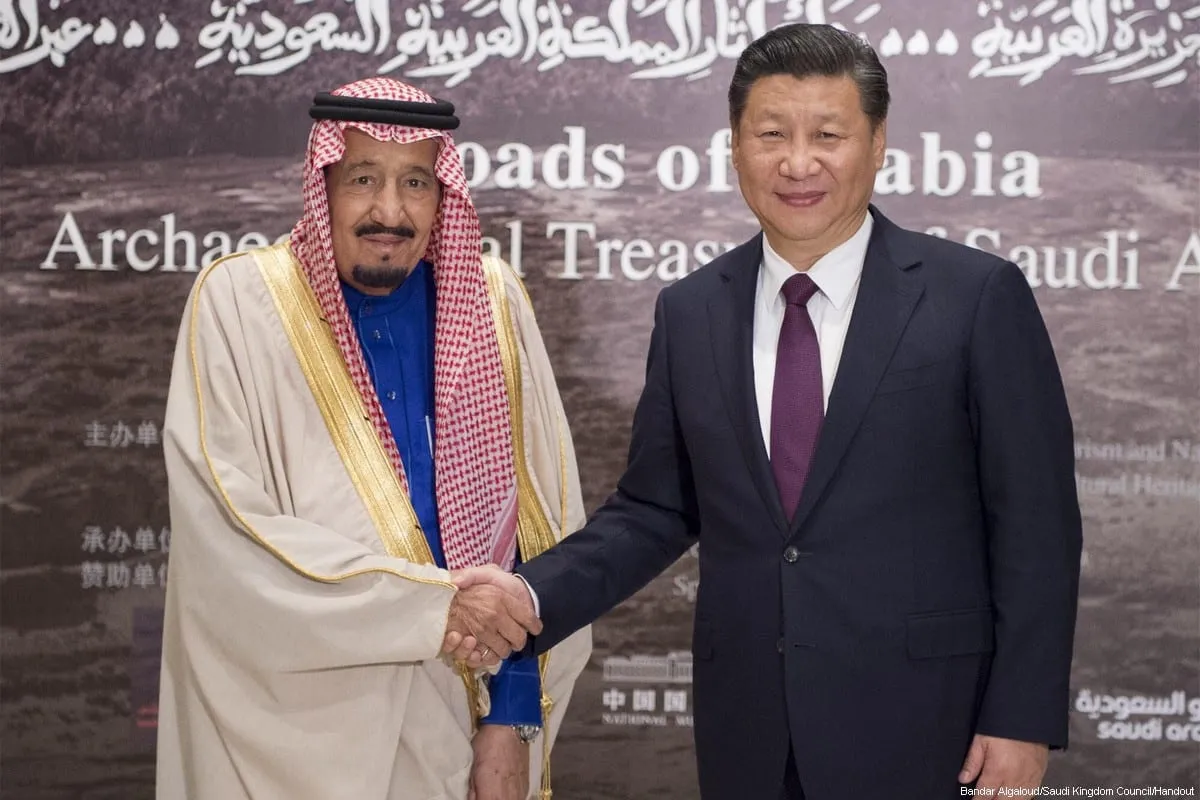
US President Donald Trum’’s state visit to China will go down in history as the day the United States finally acknowledged Beijing’s ascendancy as a global superpower. That acknowledgment does not need to be articulated in a formal statement; it can be clearly read in the subtext of diplomatic behavior, global perception, and shifting media coverage.
During the summit, Trump’s delegation—accompanied by prominent American corporate leaders—engaged with President Xi Jinping not from a position of absolute global dictation, but through a lens of defensive pragmatism. This transactional approach focused on securing bilateral trade commitments and preventing catastrophic economic friction.
The spectacle of the leader of the Western world navigating Beijing’s terms, while actively managing domestic economic anxieties, signals a profound shift. The traditional American posture of undisputed global hegemon has transformed into that of a major power among equals, seeking stable terms of co-existence with an unignorable rival.
The moment is comparable only to Richard Nixon’s historic 1972 visit to Beijing, though the circumstances are entirely different. Back then, the US’s aim was to exploit the Sino-Soviet split and gain leverage over the Soviet Union in exchange for the normalization of diplomatic ties.
In 1972, China was an economically isolated, agrarian society recovering from internal upheaval. Today, Beijing is a financial giant boasting the world’s largest economy by purchasing power parity, a critical hub of global supply chains, and a leader in next-generation technologies like Artificial Intelligence.
Militarily, the People’s Liberation Army has transformed into a powerful navy and high-tech force capable of denying access to the Western Pacific. This vast economic and military expansion translates into unparalleled global influence, altering the balance of power across Asia, Africa, and Latin America.
All this in mind, Trump’s visit to China appears to be more about a declining empire attempting to manage its own contraction—a move that will likely lead to serious concessions.
Nowhere is the US’s dwindling status more apparent than in the Middle East. Decades of disastrous military campaigns, political alienation, and the unraveling of traditional alliances have eroded Washington’s credibility. Regional powers no longer view the US as an indispensable security guarantor, looking instead toward a multipolar future.
China is already the Middle East’s largest trading partner, with interests ranging from massive crude oil imports to sweeping infrastructure investments under the Belt and Road Initiative, cutting-edge telecommunications networks, and multi-billion-dollar clean energy grids.
Yet Beijing’s approach to the Middle East is fundamentally different from that of the US. The latter inherited the colonial legacy of Britain and France. Though Washington resists seeing itself as a colonial power, it behaves like one: leveraging military might to achieve political dominance and economic privileges.
China is different. Free from the baggage of a regional colonial past—and having historical memory as a survivor of Western imperialism itself—China’s expansion utilizes a completely alternative model: economic integration, development, and trade ties. However, this model could alter should circumstances change. If Beijing finds itself forced to defend its massive interests and energy routes, it may adopt a more muscular posture, similar to its current assertive strategy in the South China Sea.
US influence in the Middle East has been waning for years, and the latest US National Defense Strategy, published in early 2026, is proof of that. The document explicitly anchors American military priorities to a homeland-first posture and the containment of China in the Indo-Pacific. By formally invoking the Monroe Doctrine to focus on the Western Hemisphere and emphasizing conditional support for allies, Washington’s own policy papers reveal a strategic retrenchment and an admission of overstretch.
In this context, the destructive US-Israeli escalations against Iran cannot be seen as an American return to the Middle East, but as a desperate attempt at maintaining relevance. This closely echoes the 1956 tripartite aggression against Egypt by Britain, France, and Israel. Just as that ill-fated campaign was a desperate, violent attempt by dying European empires to demonstrate Western relevance after the devastating toll of WWII, current US-Israeli actions are the volatile spasms of a fading hegemony.
Considering China’s global agenda of expansion and integration, Beijing is likely to find itself the new global player in our region, although such a role can be shaped to mean partnership as opposed to dominance.
Aristotle, warning against the horror vacuii, proposed that every space must be filled with something; if the US exits or its presence continues to dwindle, that political space will not remain empty. For the Arab world, the future carries both a challenge and an immense opportunity. An American exit will create political margins that Arab countries must exploit and fill on their own terms. If they do not, others will.
Arabs nations, like others in the Global South, fully understand the danger of vulnerability during seismic global changes as great powers jockey for influence. They also recognize how US behavior—acting as Israel’s enabler while failing to dictate regional outcomes—only contributes to Washington’s strategic desperation.
This desperation could lead to a sudden, chaotic US exit, leaving an aggressive Israel to expand as a local hegemon, or prompt more unstrategic military campaigns with dire consequences. All of this leaves Middle Eastern nations hostage to a volatile US foreign policy, granting opportunities for an expansionist Israel to reign more chaos.
This moment, therefore, calls for total Arab political clarity and unity, insisting on real sovereignty and the freedom to act based on the interests of the people. This new agenda should prioritize human development and economic prosperity, alongside equality and social justice.
Moreover, Arabs should achieve a new political contract that rejects further foreign meddling or military interventions, holding any government that deviates from this principle accountable.
Finally, a unified Arab position must move past mere rhetoric into concrete action to hold Israel accountable, working ceaselessly toward the freedom of Palestine and ending the illegal occupation of Lebanese and Syrian lands.
Arab political outlooks must leverage these issues in all future integrations with global players, including China, to ensure that the century-long cycle of violence wrought by Western colonialism is over for good.


Ramzy Baroud is a US-Palestinian journalist, media consultant, an author, internationally-syndicated columnist, Editor of Palestine Chronicle (1999-present), former Managing Editor of London-based Middle East Eye, former Editor-in-Chief of The Brunei Times and former Deputy Managing Editor of Al Jazeera online. Baroud’s work has been published in hundreds of newspapers and journals worldwide, and is the author of six books and a contributor to many others. Baroud is also a regular guest on many television and radio programs including RT, Al Jazeera, CNN International, BBC, ABC Australia, National Public Radio, Press TV, TRT, and many other stations. Baroud was inducted as an Honorary Member into the Pi Sigma Alpha National Political Science Honor Society, NU OMEGA Chapter of Oakland University, Feb 18, 2020.
ZNetwork is funded solely through the generosity of its readers.
Donate
