

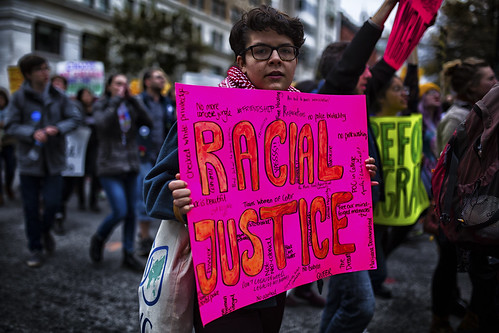
As the United States testifies before the United Nations’ Committee on the Elimination of Racial Discrimination, the lack of progress since 2020 on racial justice is glaring.
The United States is in the hotseat on the global stage on August 12 to answer for its human rights track record in fighting racial discrimination at home. That stage is the United Nations’ Committee on the Elimination of Racial Discrimination, a body of international human rights experts who monitor compliance with a global racial justice treaty.
This is the first time U.S. leaders have appeared before this body since the racial reckoning of 2020 spurred by the murder of George Floyd. In fact, it’s been nearly eight years since the United States last made a visit, after the Trump administration failed to appear at all. And if the report submitted in advance of the meeting is any indication, the U.S. government delegation will insist that existing domestic measures are enough to address the country’s racial problems.
Anyone who has been paying attention to the state of racial justice in the United States, myself included, will not be convinced.
Amid sharp spikes in racist hate crimes targeting Black and Asian communities, the infiltration of law enforcement by white nationalists, state censorship of public school educators teaching “critical race theory,” and continued police killings, the Biden Administration will be hard pressed to claim that it has achieved meaningful progress.
The rise of racist and antisemitic anti-democracy movements creates an imperative for the United States to step up to its international obligations.
The rise of racist and antisemitic anti-democracy movements creates an imperative for the United States to step up to its international obligations and present a bold vision for reform. Instead of expecting an A for effort just for showing up and defending the juridical status quo, the Biden Administration should commit to establishing an independent National Human Rights Institution (NHRI) authorized to implement an ambitious national plan for racial justice.
The United States ratified the racial justice treaty which established the U.N. committee in 1994. In two of its past three appearances before it, the committee has called on the United States to establish a U.N.-accredited NHRI, as 117 countries—including our neighbors to the north and south—have. Not only is the United States an outlier in its failure to establish a NHRI, events since the last review in 2014 demonstrate an even more dire need for one.
An independent NHRI would be charged with effectuating our human rights obligations. It would be an independent body with the power to operate with dedication and integrity—irrespective of who controls the White House or Congress. It would be equipped with investigative authority and adequate resources to serve as an advocate for human rights nationwide. And it would be accountable to the people, especially the communities most impacted by human rights violations, and charged with developing a national action plan for racial justice that includes exploring concrete proposals for reparations.
The Biden Administration argues that we already have institutions that uphold human rights, citing an ostensibly independent judiciary, the Department of Justice, and state, local and Indigenous human rights commissions. Nevertheless, persistent systemic racism renders their efficacy unconvincing.
Ultimately, it is not the international community in Geneva that we are letting down, but our own people back at home. Earlier this year, President Biden insisted that “faith and morality” call us to act to address the “systemic racism that has plagued our nation for far, far too long.” While his administration has taken tentative steps in the right direction—a re-engagement with the U.N. being one of them—they do not meet the needs of this historic moment.
The establishment of a National Human Rights Institution with an ambitious mandate to implement a national plan for racial justice would be something to be proud of, at home and abroad.
This column was produced by Progressive Perspectives, which is run by The Progressive magazine and distributed by Tribune News Service.
ZNetwork is funded solely through the generosity of its readers.
Donate
