


In the cloud of toxic dust thrown up by the Kavanaugh hearings last week, two new Trump initiatives slipped by with less notice than they deserve. Both are ugly, stupid – and they are linked, though in ways not immediately apparent.
In the first, the administration provided the rationale for scrapping President Obama’s automobile mileage standards: because Trump’s crew now officially expects the planet to warm by 4C . In the environmental impact statement they say it wouldn’t make much difference to the destruction of the planet if we all keep driving SUVs.
The news in that statement is that administration officials serenely contemplate that 4C rise (twice the last-ditch target set at the Paris climate talks). Were the world to actually warm that much, it would be a literal hell, unable to maintain civilizations as we have known them. But that’s now our policy, and it apparently rules out any of the actions that might, in fact, limit that warming. You might as well argue that because you’re going to die eventually, there’s no reason not to smoke a carton of cigarettes a day.
Meanwhile, reporters also discovered that the administration has set up what can only be described as a concentration camp near the Mexican border for detained migrant children, spiriting them under cover of darkness from the foster homes and small shelters across the nation where they had been staying.
Not an extermination camp – these aren’t Nazis – but a camp that literally concentrates this “problem” in one place: a tent city in the middle of the desert. Schooling is not available there, as it was in the shelters they came from; instead the kids are given “workbooks that they have no obligation to complete. Access to legal services is limited.”
That camp is linked to climate change because, first, it’s in a desert. If you searched high and low across the North American continent, you could barely find a place hotter and drier than Tornillo, Texas, where in June the average high is 96F and where, as one climate data source succinctly puts it, “there is virtually no rainfall during the year”.
But the link goes much deeper. Most of those migrants are from Central America and Mexico, and they might as easily be described as refugees fleeing gang violence (much of it rooted originally in the US) and a changing climate. Guatemala, El Salvador and Honduras first saw an outbreak of coffee rust linked to higher nighttime temperatures; the El Niño that began in 2015 led to years of unprecedented drought. Deep new droughts this summer wiped out more harvests: “total or partial loss of crops means that subsistence farmers and their families will not have enough food to eat or sell in coming months,” the UN’s Food and Agriculture Organization warned. The author Todd Miller, writing in the Nation, described meeting men trying to jump a train in Guatemala headed north toward the border. “When I asked why they were heading for the United States, one responded simply, “No hubo lluvia.” (“There was no rain.”)
This will, of course, get steadily worse in the years ahead – every climate forecast shows deserts spreading and water evaporating across the region. And of course more migration will follow, in every corner of the world. The World Bank predicts we may see 140 million climate migrants before long, and given the chaos that even a million people fleeing the (partially drought-fueled) crisis in Syria created, we better come to grips. Some of that migration will be internal – perhaps six million people will abandon their coastal property in Florida alone, according to recent reports. And much of it will be international, as people flee because their lives depend on it.
Telling people to stay home is not an option – when there’s no water, or when the floods come each year, or when the sea rises into your kitchen, people have to leave. Period.
And telling people to stay home is not a moral option, either. Because the climate chaos setting off waves of refugees is born above all from the unconstrained migration of carbon dioxide molecules from America over the last century. No wall can prevent the exhaust from our armada of oversized cars from raising the temperature in Mexico; if Guatemala could ship its changed climate back north it doubtless would, but it can’t. We have to realize that global warming stems from the fact that we are a world without atmospheric borders, where the people who have done the least to cause the problem feel its horrors first and hardest. That’s why, over the last half-decade, the environmental and migrant-rights movement have grown ever closer.
The Trump years are a fantasy land where we pretend we can go on living precisely as in the past, unwilling even to substitute electric SUVs for our gas guzzlers, and able to somehow insist that the rest of the world stay locked in place as well. It’s impractical, it’s unfair, and when it ends up with camps for kids in the desert it’s downright evil.

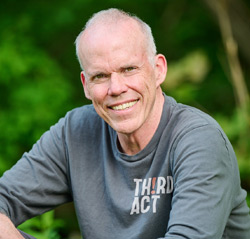
Bill McKibben is an author, environmentalist, and activist. In 1988 he wrote The End of Nature, the first book for a common audience about global warming. He is a co-founder and Senior Advisor at 350.org, an international climate campaign that works in 188 countries around the world.
ZNetwork is funded solely through the generosity of its readers.
Donate




