

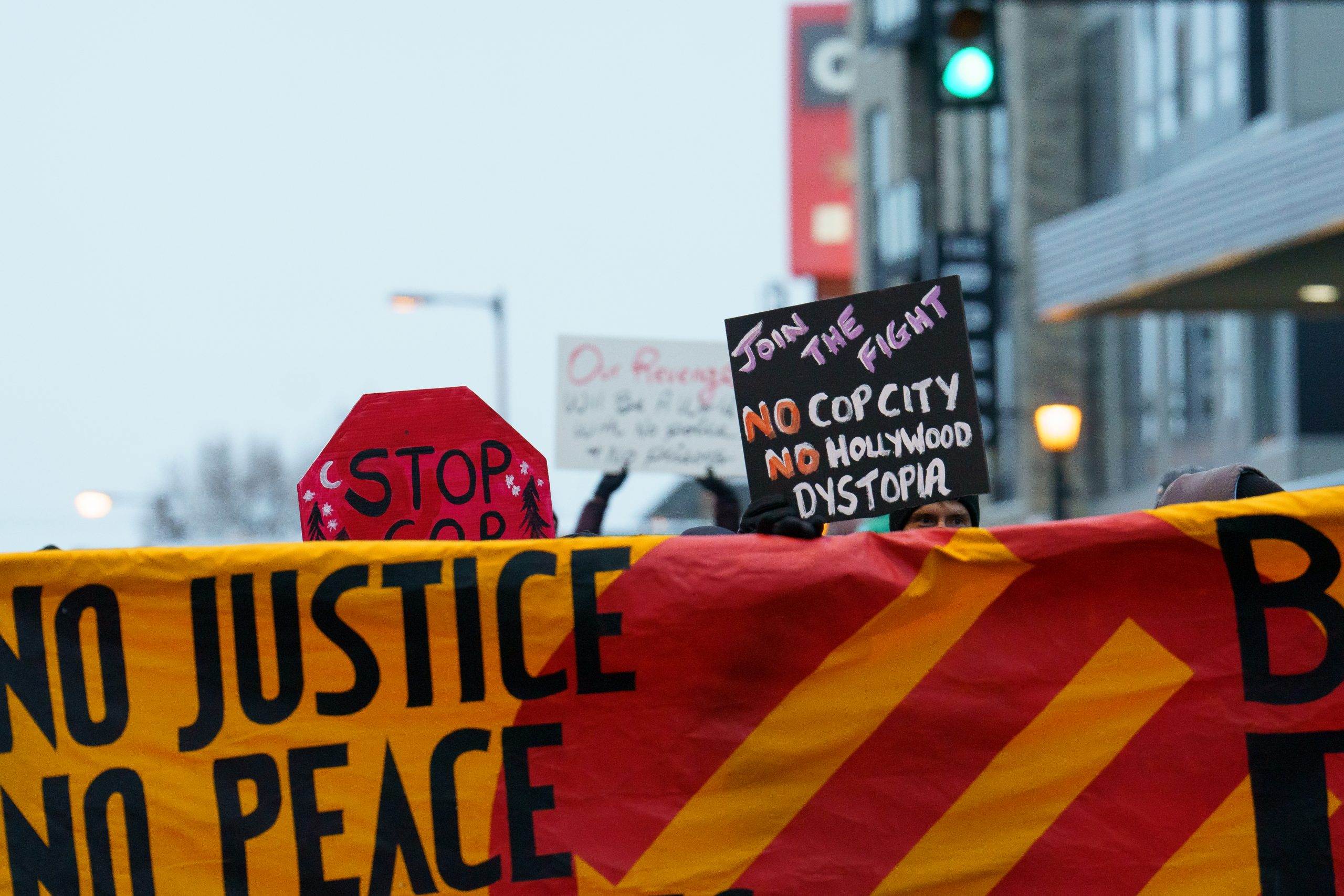
Early last month, Atlanta’s City Council approved the initial $33 million budget for a controversial law enforcement training center that local organizers have infamously dubbed “Cop City” — both for its sheer size (it sits on 85 acres) and for the concentration of resources it will lavish on police. It stands in stark contrast to surrounding communities that are being stripped of basic supports and services.
Despite Atlanta residents testifying for almost 15 hours during public comment the same day (and another seven hours weeks before) with overwhelming opposition to funding the facility, the City Council members voted 11 to 4 to pass the budget, with roughly another $40 million dedicated to it over the next three decades. This was more than double what officials initially said it would cost.
“We know that safe communities are not heavily policed, they are heavily resourced,” Rehana Lerandeau, an Atlanta resident and member of the group Critical Resistance, told the City Council. “We also know that you cannot train the violence out of policing. Policing at its core is a violent institution.”

The affirmative vote — which also flies in the face of an Emory University survey conducted in the spring showing a plurality of Black Atlanta residents oppose the project — represented significant forward movement towards Cop City’s completion. It was undoubtedly a massive blow to #StopCopCity organizers in Atlanta and beyond who have been fighting for months to stop the project from sucking up sorely needed public funds and further aiding in the militarization of police departments both locally and around the country.
However, the decidedly tough loss was also a masterclass in what it means to lose strategically — to accept defeat at one stage of a campaign while celebrating, and foreshadowing, its significance to a much larger and longer struggle.
In Chicago, where I live, organizers will recall the parallel #NoCopAcademy campaign from 2017 – 19, which fought the construction of a $95 million police training facility in the majority Black west side neighborhood of Garfield Park. After an 18-month struggle – during which I was one of the core organizers – attempting to block multiple votes approving the project’s budget and zoning, we ultimately lost the final vote on March 13, 2019, when the Chicago City Council approved the contract with multinational conglomerate AECOM to build the academy by a 38 to 8 margin.
This marked the end of the campaign and it was a devastating loss, but it also represented a massive shift for our city and our social movements in our efforts to defund and abolish police. During the final vote, hundreds of local residents, many of them young people, took over City Hall for hours. They participated in public comment but they also chanted, sang and danced in the halls. The 8 “no” votes were a huge achievement for our campaign, especially given that it was the largest block of council members we’d ever gotten to oppose the project, and because that configuration of the City Council under then-Mayor Rahm Emanuel voted in step with the mayor’s office more than 90% of the time.
But there were even more significant victories coming down the pike that we had no way of predicting. In the aldermanic elections that closely followed the final vote for the cop academy, many of candidates who supported our campaign either kept or won their seats, creating a crucial leftward shift in the City Council from which poor and working Chicagoans continue to benefit. And no one could have imagined that a global pandemic and the subsequent murder of George Floyd would lead to one of the largest protests in U.S. history, with millions of people calling for the defunding of police only a year after campaigns like ours had helped foreground the issue and make the demand plausible.
Chicago organizers walked into that #NoCopAcademy final vote knowing we would lose. But accepting defeat, and accepting defeat on the state’s terms, are two very different things. We understood that it didn’t just matter that we lost, it mattered how we lost. Going out with massive, noisy, and joyous resistance wasn’t just about setting the tone for the day, it was about laying the foundation for future battles — ones that ended up having a much wider impact than any of us could have known on that afternoon in 2019.
In a similar fashion, on the day of the vote last month, #StopCopCity organizers didn’t merely show up to Atlanta City Hall en masse, they transformed it into their own vision for their city. Participants offered free childcare, passed out masks to ensure COVID safety, and communed over hot food that was brought in by continuous waves by volunteers who made sure as many local residents as possible had the opportunity to make their voices safely heard. Knowing full well that City Council members would vote with Atlanta’s 1% and not the constituents who elected them, many of those giving public comment chose not to address the corporate shills, but instead to speak directly to their fellow residents:
“Not a single member of this body is worthy of being addressed today, but you, the people of Atlanta, are worthy of being addressed today,” said Eva Dickerson, turning away from the City Council and to the audience. “I am a teacher, a farmer, and a neighbor, and Atlanta I love you. I believe in you so deeply. Do you remember 2020? When we took this city? When we took these streets? … This is our city. We do not answer to any of these cowards. They answer to us.”

Though not every speaker identified themselves as a police or prison abolitionist, many articulated abolitionist dreams for their neighborhoods, clearly stating again and again that resources were what were needed to keep their communities safe, not more racist policing. Moreover, when the Atlanta City Council did approve the budget for Cop City – including a defensive Michael Julian Bond, who rode his father’s civil rights legacy into public office – organizers were prepared. They immediately announced a new Week of Action against the compound and introduced a referendum that would halt construction, which voters could petition to get onto the ballot this fall. The maneuver was characteristic of a campaign whose genius has always been about creating multiple points of entry for people from across the political spectrum, and supporting a wide range of tactics to achieve its abolitionist ends.
June 5, 2023, like March 13, 2019, was also a lesson in taking losses in stride, not only because we should expect them when directly challenging wealthy and entrenched institutions of violence, but because one “no” vote delivered by an undemocratic sham of a body should propel us into new action, not demoralize us into apathy.
While many Atlanta residents were appalled to see their leaders vote in favor of a project with such resounding disapproval from the public, the resulting disillusionment was itself a form of victory. Locals there, especially those who may not have been previously politically engaged, are collectively learning the same thing we learned in Chicago during the #NoCopAcademy campaign: If we accept that the state does not actually represent the interests of everyday, ordinary people, that it is not actually the democratic apparatus it has fought to convince us it is, then the state is equally incapable of delivering true justice – true victory, true liberation – to everyday people.
The state cannot define “loss” or “victory” for everyday people. A city council cannot give it or take it away. We define these things for ourselves through struggle, through relationship building, through the envisioning and enacting of our own liberation on our own terms.
Victory in Chicago has looked like the recent election of progressive Mayor Brandon Johnson. This is not because individual elected officials are the key to winning abolition, but because Chicago choosing the candidate with a clear platform of funding social programs instead of the same old law-and-order fear mongering of rival Paul Vallas proves that abolition as a narrative is winning – a direct result of campaigns like #NoCopAcademy. It is becoming common sense in our city that the constant ratcheting up of policing and incarceration is not addressing the root causes of violence, and that social programs and the meeting of basic needs are what create real public safety.
We do not yet know if the #StopCopCity campaign will be successful in shutting down its destructive target in Atlanta. But we do know it has revealed the craven nature of local leaders to a much wider audience. We do know they have radicalized a new generation of organizers in Georgia, and built real bonds of solidarity with other abolitionists around the country and world. We know they have given thousands of people accessible entry points into anti-police and anti-militarist organizing. And while we may not know what battles lie ahead, we know that all of these achievements provide the necessary foundations for future victories – victories which only we can imagine and define. We know that, no matter what happens on the local scale, abolitionist organizers have already won a shifting tide of public opinion in the direction of a demilitarized future.
This article is being co-published with The Real News Network.
ZNetwork is funded solely through the generosity of its readers.
Donate
