



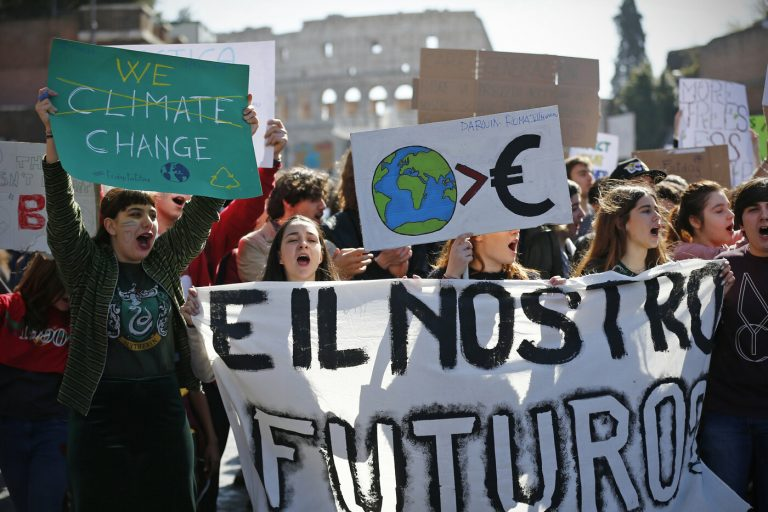
Extraordinary heat, forest fires and droughts but also flash floods and landslides are just some of the extreme weather events that have hit Italy this year.
Like much of southern Europe, the country is already facing grim consequences of climate change. Its experience also shows how doing something about this is harder, or more expensive, than it should be – because of an obscure but powerful global legal system through which multinational corporations can challenge a state’s environmental policies.
In 2015, Italy’s parliament re-introduced a ban on oil and gas exploration close to its coast, following popular protests to protect the environment. In Abruzzo, in the centre of the country, tens of thousands of people took to the streets to protest against a planned project there.
But the company behind that project was a British business, called Rockhopper Exploration, that had a powerful tool to use in response. It filed a case at a branch of the World Bank, which last year ordered Italy to pay it more than €200m in compensation.
Headquartered in Salisbury and listed in London, Rockhopper was founded in 2004 to prospect for oil and gas around the Falkland Islands.
Last year it told its investors that “all costs associated with the arbitration [with Italy] were funded on a non-recourse (“no win – no fee”) basis from a specialist arbitration funder.” It continued: “After payments due to the arbitration funder, Rockhopper expects to retain approximately 80% of the award.”
Rockhopper was able to sue Italy because as a foreign investor in the country it could claim protections under what’s called the Energy Charter Treaty – a deal between dozens of countries, including Italy, that has become increasingly controversial.
It is one of thousands of international agreements, signed between pairs or groups of countries and crisscrossing the globe, which let foreign investors bypass local courts and challenge a wide range of government policies they don’t like at shadowy tribunals.
So far, almost 1,000 cases have been filed through this system at the World Bank. For years, developing countries were the primary ones challenged; increasingly since the 1990s, however, wealthier countries have ended up in the dock too.
Fossil fuels
Together, fossil fuels, mining and other energy projects were the subject of 42% of all the disputes filed at the World Bank from 1966-2022. These include many other cases that have challenged governments’ environmental regulations.
Take for example El Salvador. It was sued by a multinational mining company which didn’t receive permits to dig amidst growing national opposition to mining – fuelled by concerns over the environment and impact on already-stressed water resources.
Or Germany. It was sued by an energy giant which objected to restrictions on the water permit for a coal-fired power plant, intended to limit its environmental impact.
Another €1.4bn claim was filed against the Netherlands in 2021 for its ‘coal exit’ law, which would end the burning of coal for electricity in 2030.
In theory, countries can withdraw from the international agreements that have enabled these cases. Last year, for instance, Germany’s government decided to exit the Energy Charter Treaty. Now the EU seems set to do the same as a block, while Britain has also recently stated it may pull out.
But these treaties typically have what are called “sunset clauses” – or more ominously, “zombie clauses” – that mean their provisions can stay in force for years, even decades, after the treaties themselves have been cancelled or governments have withdrawn from them.
A sprawling system
Italy had withdrawn from the Energy Charter Treaty in 2016, after beginning that process at the end of December 2014. But that didn’t stop Rockhopper using the treaty to file a case against it in 2017.
This is because there is a one year notice period before any withdrawal from this treaty becomes effective. After that, however, its sunset clause means that investors still have another 20 years to claim protections, and file cases, under it.
The threat such timelines pose to action on climate change is clear. The UN warned earlier this year that our world will likely reach the point of catastrophic warming within a decade, unless drastic action is taken to cut out fossil fuels.
On its own, exiting the Energy Charter Treaty is not enough – because of these sunset clauses, but also because this agreement represents only 10% of the cases involving corporations suing governments that have been so far filed at the World Bank.
Most cases have instead been brought using agreements known as bilateral investment treaties (BITs), which are signed between pairs of states and guarantee corporations certain investment rights. Or they have been filed under regional deals like the North American Free Trade Act (NAFTA) between Canada, Mexico and the US.
Dismantling this sprawling system is a mammoth task. But, until that happens, government action on climate change will likely continue to disappoint us.


Matt Kennard is Head of Investigations at Declassified UK. He was a fellow and then director at the Centre for Investigative Journalism in London.
ZNetwork is funded solely through the generosity of its readers.
Donate




