


This week we are in the midst of another spasm of 2024 retrospection, reviving two narratives. The first I’ll call the “if only” narrative. It takes the form of “if only Biden had not insisted on a second term after the midterms,” or “if only Harris had listened to me about [ ].” The second I’ll call the “realignment” narrative, which usually takes the form of, “Democrats are out of step with the median voter” or “Republicans have become the party of multiracial working class.” Crucially, this narrative depends on asserting that Trump would have won an even larger victory if “everyone voted1”—because conceding otherwise would (1) undermine the portrayal of Trump’s victory as genuinely “democratic,” (2) cast doubt on the durability of this conservative realignment, and (3) provide encouragement to those advocating greater voter turnout, which realignment proponents fear primarily empowers left-leaning interests.2
And so, it seems an ideal time to revisit my analysis in “How Trump “Won,’” which I published in early January, before the inauguration, in response to widespread claims from media and even Democrats that America had shifted decisively to the right. (Remember the “vibe shift”?) I explained that Trump’s victory was historically narrow, and reflected less newfound enthusiasm for MAGA than dissatisfaction with Democrats and with the political system itself.3 A key to Biden’s 2020 victory had been high turnout from otherwise-infrequent voters who believed they had too much to lose from a second Trump term. But in 2024, that dread dissipated—and with it, the support from the anti-MAGA voters Harris would have needed to win; millions stayed home, and others likely reverted to their previous partisan preference.4
Four months into Trump 2.0, I believe that we have compelling new evidence for that case hiding in plain sight. Trump’s dismal polling numbers are a constant topic—but few if any have drawn the most important conclusion about this rapid, dramatic shift. Those numbers don’t show that Trump has squandered some deep reservoir of support, or that he has “overreached.” Those polling numbers show that Trump’s earlier support depended on voters not understanding or believing he would do what he said he would do if elected. On tariffs, deportations, and other issues that are cratering his approval ratings, Trump is now doing almost precisely what he said he would do.5 And voters hate it—including the “less engaged” voters who were supposedly too hard to reach before November with warnings about it.6
Therefore the latest polling tells us less about Trump than it does about the catastrophic failure of not just Democratic campaign professionals, but also civil society and the media, to effectively inform voters of the consequences of the choice they had before them. As I articulated in February 2024, the choice was dire and the duty to inform great:
“The 2024 election is … a de facto constitutional referendum. At first blush, “de facto constitutional referendum” may seem a bit much. But, if implemented, the MAGA agenda as expressed by Trump, and delineated in great detail in documents like the Heritage Foundation’s Mandate for Leadership, could change America as quickly and as fundamentally as the Reconstruction Amendments and the New Deal Order – if not more so.
… Democracy is not a spectator sport. It is up to us whether those who reject a MAGA future vote in greater numbers than those who embrace MAGA. … We are in something of a Niemöller moment. When we depend on the campaign smarts of the Democratic Party to forestall a MAGA future, we abdicate our duties as democratic citizens to do everything we can to keep it from happening.”
The current backlash against Trump is exactly the outcome we’d expect to see if my long-standing argument is true: that America has an anti-MAGA majority, but not necessarily a pro-Democratic one. Contrary to conventional wisdom, the reality of American politics today is not a “realignment,” wherein the views and values of most ordinary Americans have become fundamentally more aligned with the views of MAGA Republicans. Rather it’s been a “dealignment” from both parties. Voters, increasingly distrustful of institutions and clamoring for substantial change that neither party is delivering, have punished incumbent parties in nine of the past ten elections—a D-R-D-R presidential alternation pattern unseen in over a century.
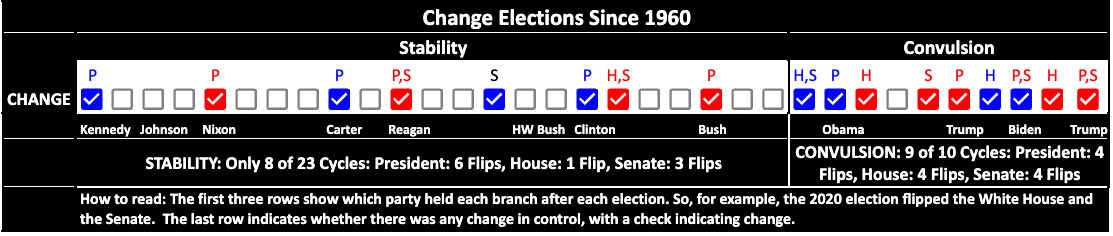
Despite this, otherwise-disaffected voters have turned out in unusually high numbers to defeat MAGA candidates since 2017. That they did not do so in 2024 in sufficient numbers signaled not a shift in their basic values that had caused them to see MAGA as a threat, but a reduced belief in the credibility and seriousness of that threat (the “credulity chasm”), combined with greater disappointment in a Democratic Party that they correctly saw as merely defending broken institutions.
This is not a sustainable trajectory for Democrats, or more importantly for what’s left of American democracy. But we’ll never find our way out of this wilderness if we lie to ourselves about where we are now, or if we continue to follow the same leaders and maps that have, at best, led us in circles by responding with little more more than lip-service to the continuous repeal of our hard won freedoms by the Roberts Court or the rise of MAGA fascism that already had an iron grip on half the states in the union before Trump descended the escalator.
If Voters Knew Then What They Know Now
Recent events and polling should put to rest the idea that 2024 really heralded the beginning of some great pro-MAGA realignment. Trump is now deeply underwater on favorability, both overall and with the specific demographic groups said to have “realigned” towards him (“non-college voters of color” and “young voters”).
This memo from the Research Collaborative gives a thorough rundown of recent polling showing the backlash against Trump’s agenda and actions. Perhaps most notable is his plunging approval on what were supposed to be his two strongest issues—“immigration” and “the economy”—and that 52% of Americans now agree Trump is “a dangerous dictator whose power should be limited before he destroys American democracy,” and 52% of likely voters and 55% of independents support impeaching Trump.
There is much reason to doubt the “If everyone voted, Trump would have won by more” counterfactual on its own terms (see footnote 1). But the much more relevant and important counterfactual is: If voters had known in November what they know now—which could and should have been possible—Trump would have lost.
As you read the rest of this post, keep these numbers in mind: Trump would have lost the Electoral College if: (a) only about 1 in 70 Trump voters in the Blue Wall switched their vote, or (b) if only about 1 in 25 nonvoters had voted for Harris, or (c) if only about 1 in 100 Trump voters switched AND only about 1 in about 80 nonvoters cast ballots for Harris.7 It would have taken an even smaller and more plausible shift for Trump to have lost the popular vote, given that nearly three-quarters of the difference between Biden and Harris’s vote total were in cities and Blue States.
A 2024 Redo
At his essential Substack, Strength in Numbers, G. Elliott Morris just conducted a “redo” survey that literally poses my counterfactual—asking voters how (and whether) they would vote today if the U.S. was holding a do-over election. That survey found that among Trump voters, about 1 in 20 would now vote for Harris and another 1 in 11 would vote for neither, while among Harris voters, only 1 in 100 would now vote for Trump and 1 in 14 would vote for neither. Significantly, a bit more than half of those who did not vote—the group that critics argue have gone MAGA—now favor Harris 3:2.8
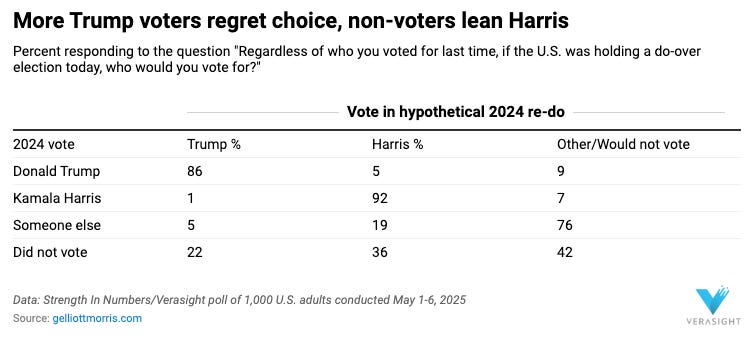
Now, I’m going to put the numbers in the table in context, by illustrating what the election outcome would be if votes were cast along those current preferences. To be clear, I’m not saying that this proves anything; I would never stake my claim on a single survey, and I am sure that Morris did not intend his survey to be used to support exercises like this one. But polling can be useful in a broader suite of evidence, when it’s mostly relied on to corroborate the order of magnitude and directionality of other evidence.9
2024 Voters Vote Again
First, we find that if only those who voted in 2024 voted again, instead of winning by 1.5 points, Trump would have lost by 4.2 points. The first and third numeric columns reflect what actually happened, while the second and fourth columns reflect the survey results.
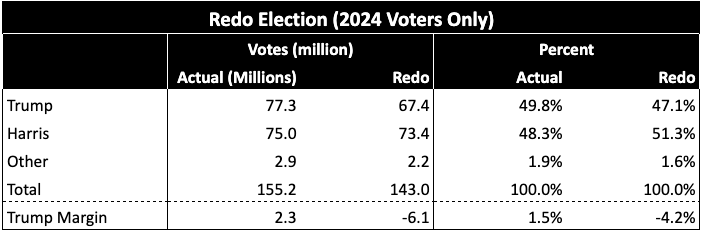
That result is in line with other data: Trump losing by 4 points is the same result indicated by an earlier YouGov redo survey conducted for The Times (UK), which found that “Kamala Harris leads Trump, 48% to 44%, among those who voted in 2024, in the scenario in which they could ‘go back and cast your ballot again.’” And, of course, that margin isn’t far off from 2020, when Trump lost by 4.5 points.
Everyone (Who Wants To) Votes
But, that chart above was just a redo with 2024 voters; we haven’t touched “if everyone voted” yet.10 So, now, applying the Strength in Numbers survey results to all registered voters, we find that if everyone voted (who now wants to), instead of winning by 1.5 points, Trump would lose by even more, 13.7 million votes or 7.9 percent.
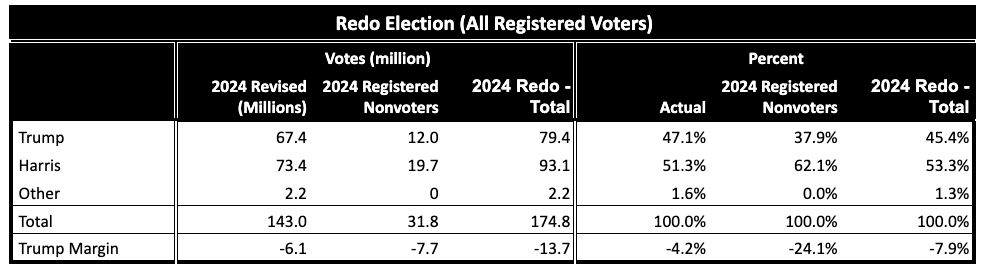
That result is in line with Pew’s Research’s gold standard validated voter survey for 2020, which found that had nonvoters voted, Biden would have won by 8.5 points.11
Again, I hope no one misunderstands this exercise to mean that I am saying this alone “proves” something—but it does illustrate that the magnitude of the backlash against Trump is consistent with the notion prevalent in 2020, that politics had become “ossified.”12 And that corroborates the view that Trump’s actual agenda is not what many either signed up for or believed would happen when they declined to vote.
Regrets: Voters (And Nonvoters) Have a Few
There are other surveys that ask respondents if they “regret” their vote.13 As Morris astutely points out in his Substack, however, this frame is a higher bar, as asking someone to say they “regret” their vote is akin to “ask[ing] a man how much he makes, a woman how much she weighs, or if an Italian likes pineapple on pizza”—many people will lie about their real answers, due to “social desirability bias.” Morris’s “redo” frame avoids that problem by asking voters a hypothetical question instead of asking them to divulge their true feelings.
Still, it’s worth noting that a PRRI survey found that while few 2024 voters “regret” their vote, 1 in 13 Trump voters do, compared to only 1 in 20 Harris voters. And, more relevant to the matter at hand, fully 1 in 3 nonvoters said they regret not voting, nearly half of them strongly so. That works out to about 30 million people, or about the same number that the Catalist voter file reports having voted in 2020 but not in 2024. Remember, that survey was taken in March, before Trump’s approval dropped further.
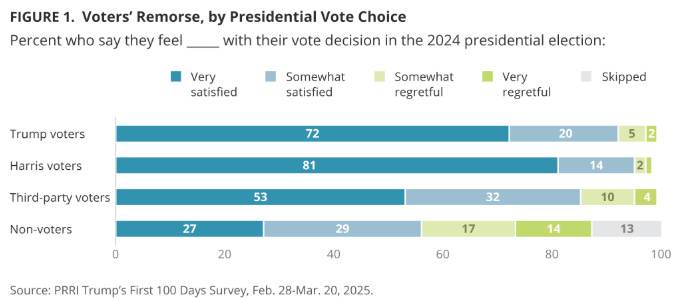
And if there’s any doubt about the reason for said regret, consider that “Among non-voters who regret their decision not to vote, 68% view Trump as a dangerous dictator, compared with 30% who view him as a strong leader.”
Just the Thermostat?
It might be easy for critics to wave this away as the normal “thermostatic” reaction, where Trump’s dwindling approval numbers reflect nothing more than the normal—and inevitable—pendulum swing in public opinion. But, as this graph makes clear, Trump is the only president whose 100-day approval ratings trail his popular vote margin—more so in 2024 than in 2020. Other presidents have enjoyed a “honeymoon” of popularity early in their term, but not Trump. There is no reason to think that an “election redo” survey like Morris’s, taken just 100 days in, would have shown a reversal of the results at all for earlier presidents—much less as dramatic a reversal as we see with Trump. We wouldn’t even have seen it in 2000 after Bush v. Gore, since, as you can see, Bush’s April 2000 approval rating was about plus 20.
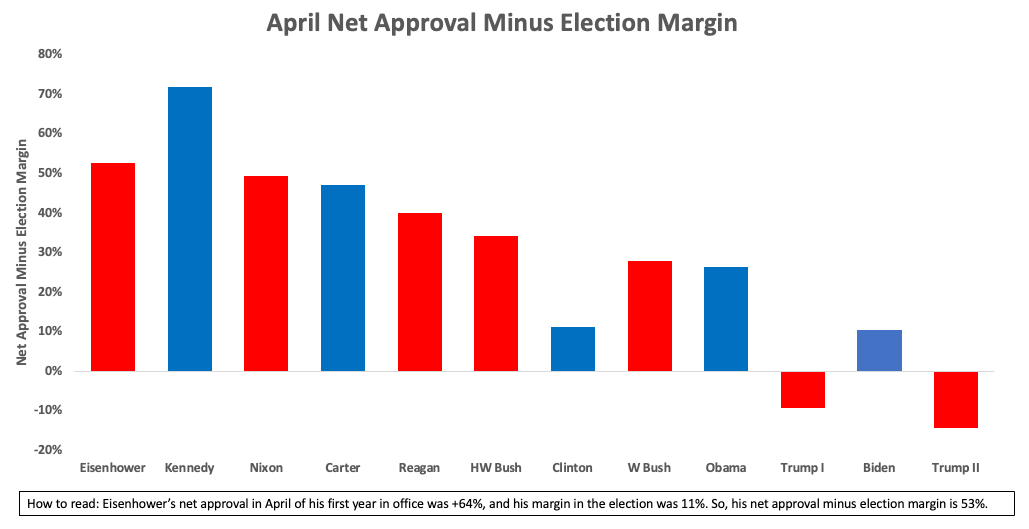
By comparison, it wasn’t until around the 500 day mark (in June of 2022) that Joe Biden’s net approval sank as low as Trump’s is today. And 2024 was the only year in which Biden’s average net approval was lower than Trump’s is today.
A Closer Look at “Less Engaged Voters”
Even before the election, we heard a constant drumbeat of takes claiming that Biden or Harris needed a “low turnout” election to win. Critics of my original analysis have claimed that had turnout been higher, Harris would have lost by even more, because some surveys suggested the historic “realignment” that “less engaged” voters are now further “right” than those who routinely vote. (There is no settled definition for “less engaged voters,” which can make this discourse confusing and slippery.14) This counterfactual—that “if everyone had voted” (or if more nonvoters had decided to turn out) Trump would have won by even more—is now all but conventional wisdom.
In this section, we’ll see that even if that was true then, it is certainly not the case now, as Trump’s approval ratings are consistently worse with those who didn’t vote than with those who did. To do so, we’ll take advantage of several surveys to show how consistently voters are “to the right” of nonvoters, and not the other way around:
- Four 100 days job approval surveys conducted by the New York Times/Siena, the Washington Post/ABC, Pew Research, and Public Religion Research Institute (PRRI);
- The Cooperative Election Survey, which showed Harris winning nonvoters and, more importantly, showed that on a wide variety of values and issues questions, voters were “to the right” of nonvoters;
- The PRRI survey, which also showed that on a wide variety of values and issue questions, voters were “to the right” of nonvoters.
Job Approval
In the following graph, I compare Trump’s electoral margin (the dotted line) with his net approval among voters and nonvoters today, according to four recent high-quality surveys (Pew, NYT/Siena, Washington Post/ABC and PRRI). Those who cast ballots in the 2024 election (green bars) have soured on Trump. Those who didn’t vote (brown bars) are very sour.15
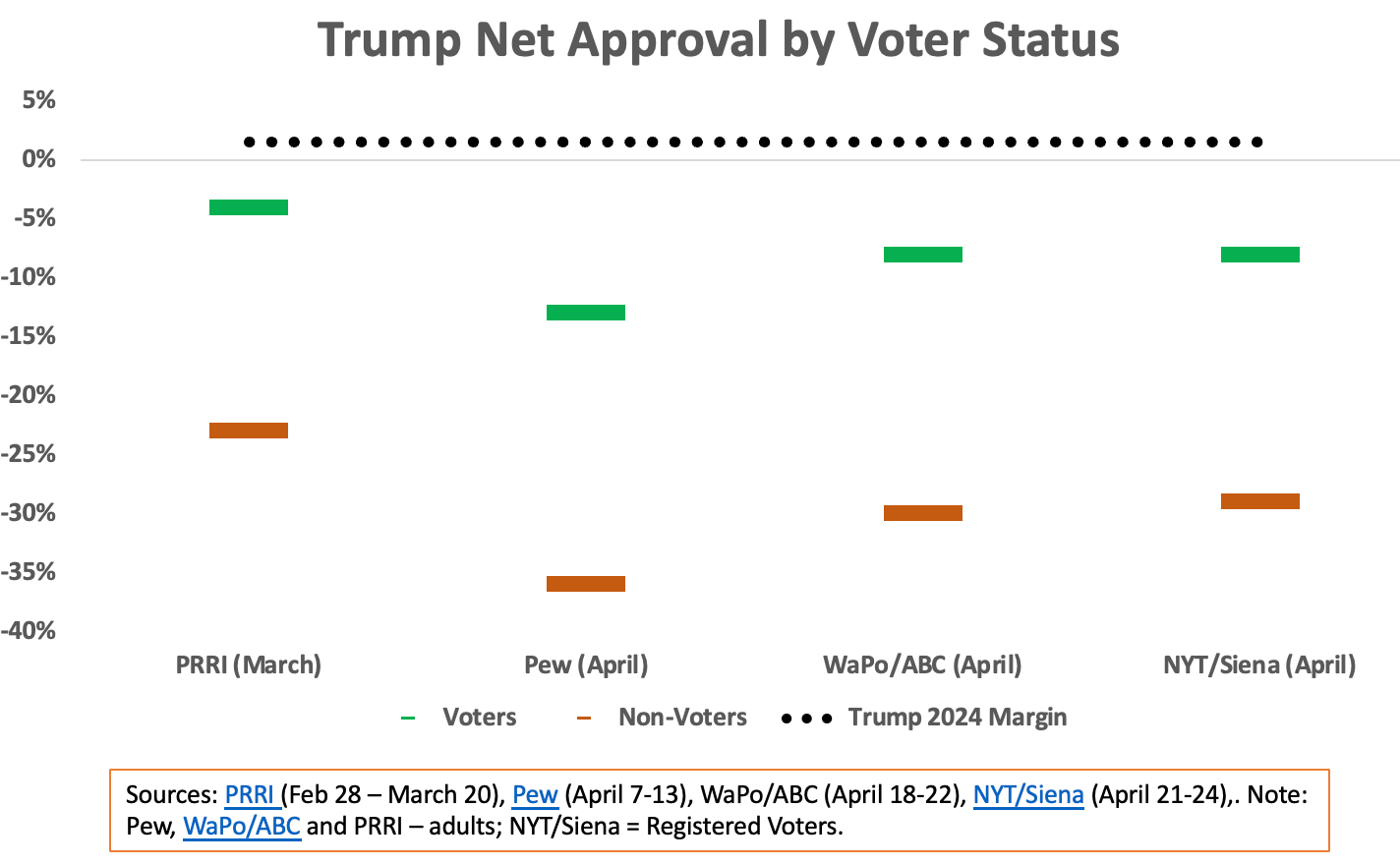
In the rest of this section, we’ll see strong evidence that 2024 nonvoters were less pro-Trump than voters before he took office, too.
2024 Head to Head
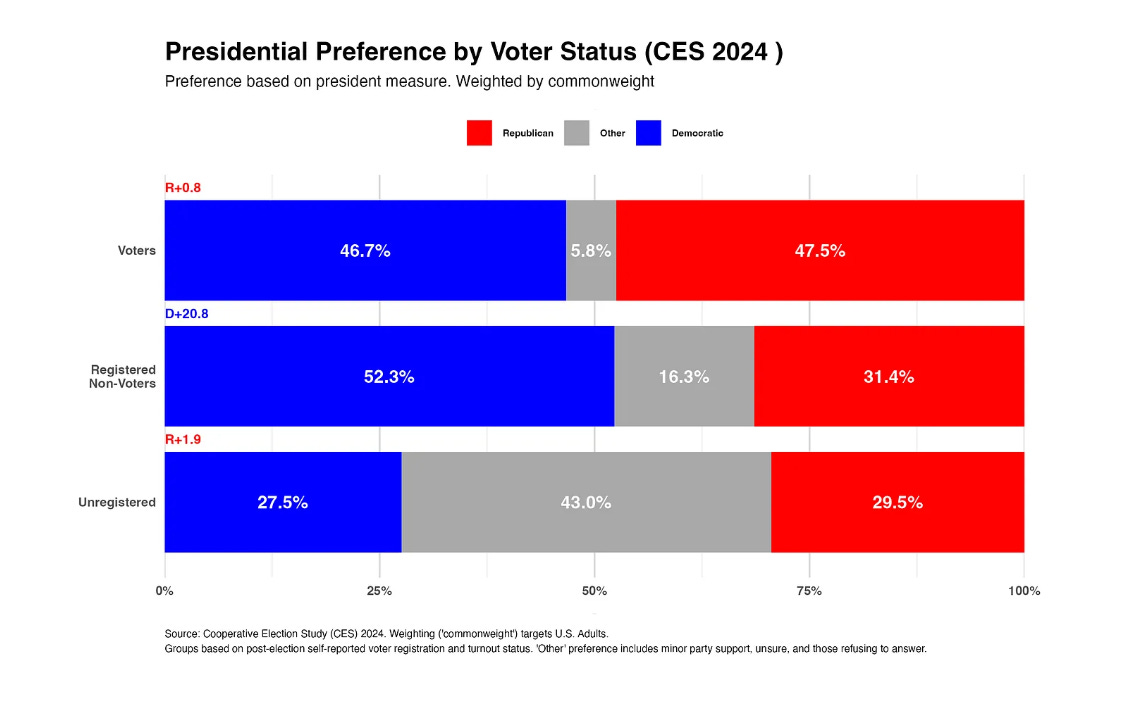
Adam Bonica, Jake Grumbach, Rachel Funk Fordham, and Ernesto Tiburcio recently published strong evidence that nonvoters did not favor Trump in November. See their chart below, based on an analysis of the Cooperative Election Survey (CES). They found that in 2024, registered nonvoters (the middle row) leaned very heavily Democratic, and unregistered citizens (the bottom row) were ambivalent.16
Values and Issues
Now, let’s dig deeper. A frequent error in political analysis is to impute a suite of “conservative” views to Trump voters with no more substantiation than that they are Trump voters, or that they identify themselves as conservatives. Fortunately, the CES includes many questions that get at those underlying values directly. Rather than looking at self-reported ideology of nonvoters and inferring their hypothetical vote choice (and support for MAGA) from that, we can take questions from the CES that explicitly ask whether people support or oppose policies that are clearly either liberal or MAGA. Because CES asked both voters and non-voters these questions, we can see exactly how MAGA the people are that chose not to vote in 2024.
Cooperative Election Survey
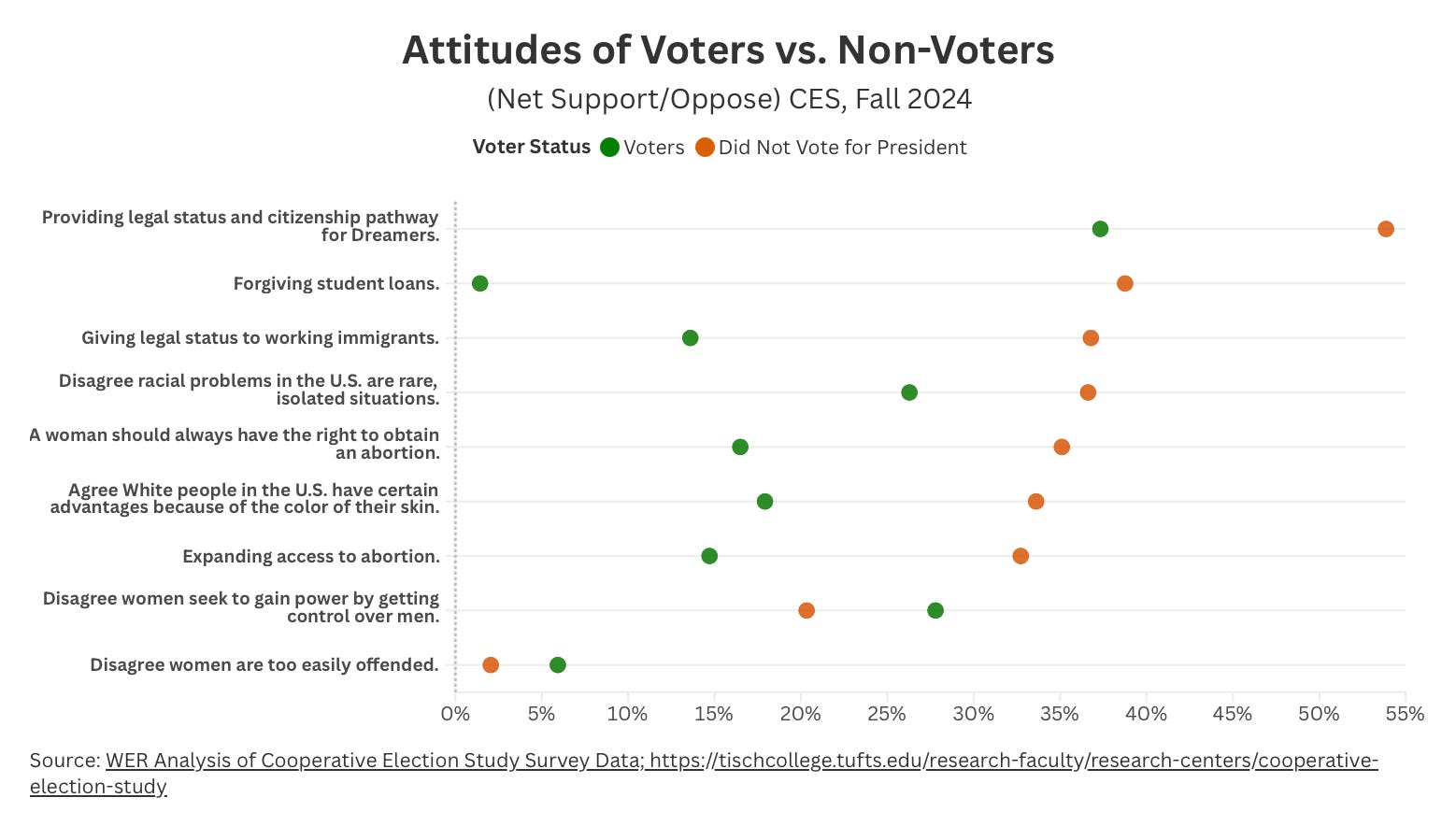
In the next graph, there are two bubbles. Green and brown again represent voters and nonvoters respectively. For each of the questions, I’ve subtracted the “conservative” answer from the “liberal” answer to get a “net favor the liberal position” value.17 As you can see, in almost every case, (1) nonvoters are more liberal than voters, and (2) nonvoters are much closer to Harris than Trump.18
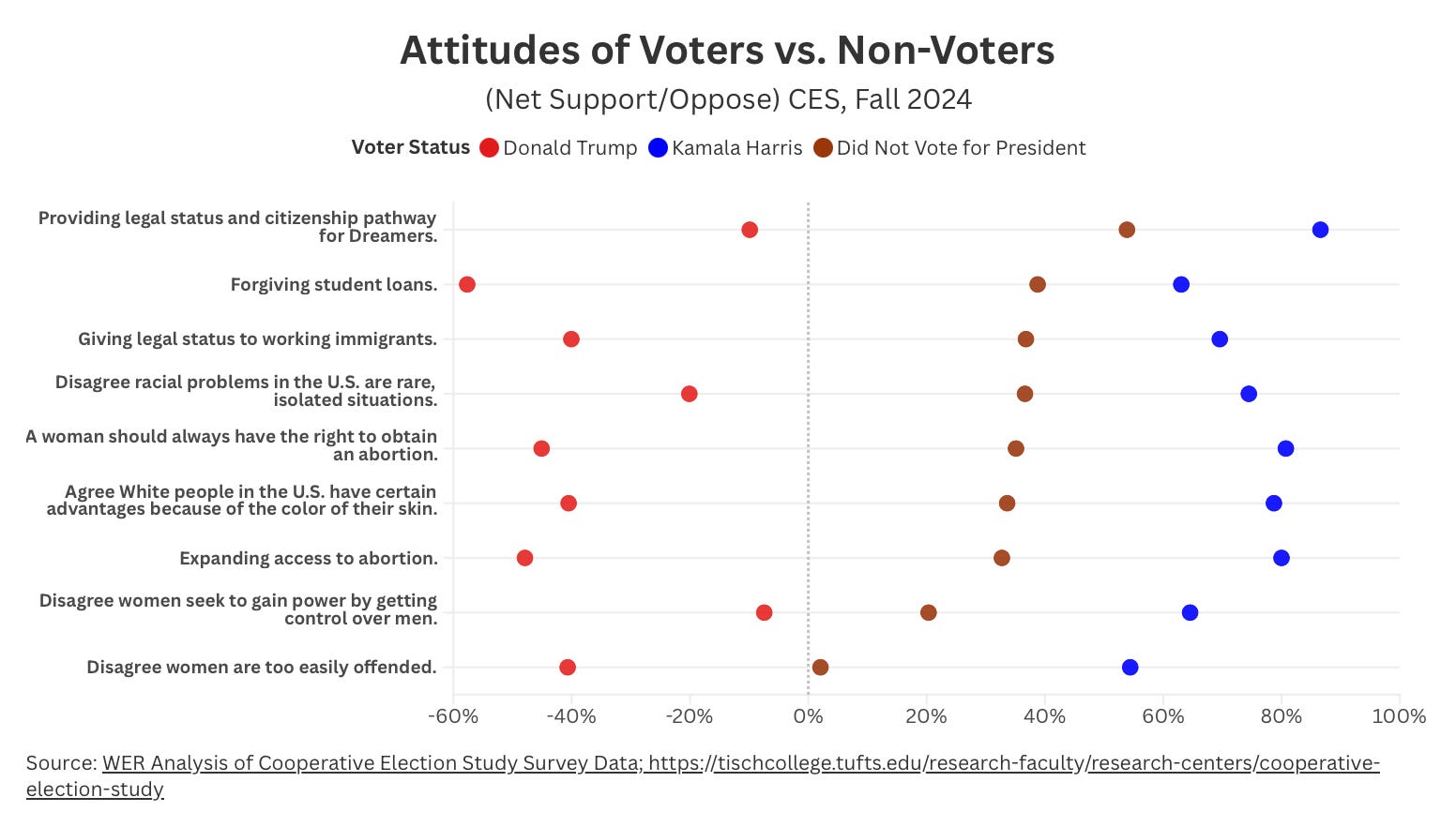
Now, we’ll look at the same set of questions, but this time I’ve added blue and red bubbles to represent Harris and Trump voters; brown bubbles continue to represent nonvoters. Here you can clearly see that (1) on all but one question, Trump voters supported the Trump position, which was not the case for nonvoters for any of the questions; and (2) on nearly all of the questions, nonvoters were much closer to Harris voters.
Also, consider that while only 12 percent of voters in the CES survey responded “Not Sure” when asked to place Trump on a 7-point ideology scale, 31 percent of those who did not vote could not place him on that scale.19 It’s another marker of the credulity chasm, and a rebuke to the idea that there was nothing new for voters to learn about Trump. Furthermore, 21 percent of those voting for Trump placed him as either “middle of the road,” liberal, or could not rate his ideology.
PRRI
PRRI’s Democracy at a Crossroads: How Americans View Trump’s First 100 Days in Office is an especially rich source of insights into what Americans believe, with several questions on the survey making it clear that in terms of their values, nonvoters were more anti-MAGA than those who cast ballots.
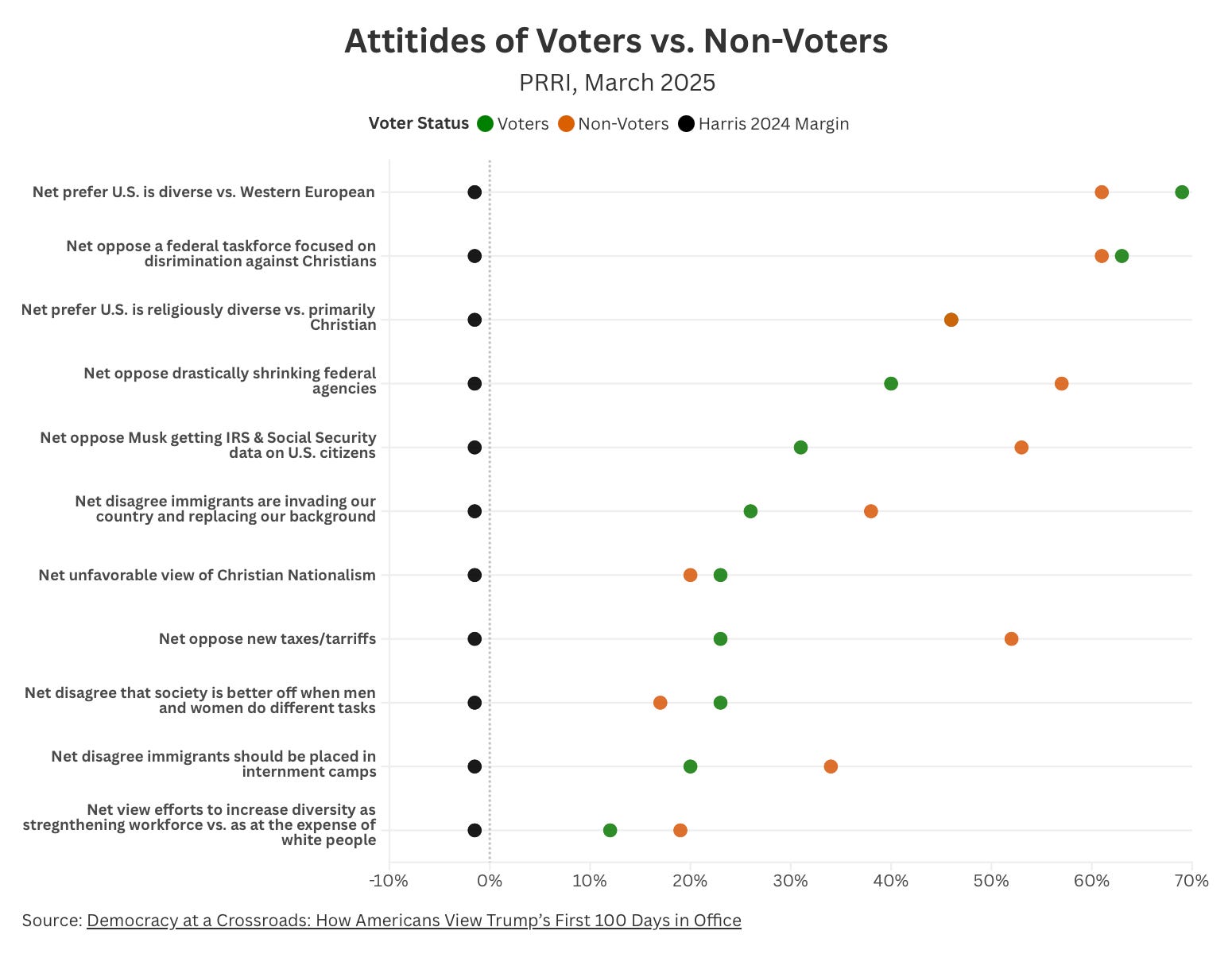
The following chart shows the net response of voters and nonvoters to some key questions about Trump’s policies (most of which, again, he’d promised to implement during the campaign; see footnote 5) and about basic differences in values between MAGA and anti-MAGA. Since most of the questions are agree/disagree or favor/oppose, I’ve presented the net results as the difference between disagreeing with Trump/MAGA minus agreeing with Trump/MAGA, even if that wasn’t the original structure of the question; conceptually that means I’m just presenting net disapproval as a positive number for clarity of presentation. Exact question wording in this footnote.20
Three things stand out:
- In every instance, voters (green bubbles) net disagree/disapprove of MAGA positions by at least a dozen points (diversity in the workplace), and as much as 70 points (prefer overall diversity);
- In almost every instance, nonvoters are even more anti-MAGA than voters;
- Many of Trump’s “anti-woke” efforts are extremely unpopular with voters and even more unpopular with nonvoters.
(The black bubbles represent Harris’s margin in the election, serving as a reminder of how far those numbers are from Trump’s margin.)
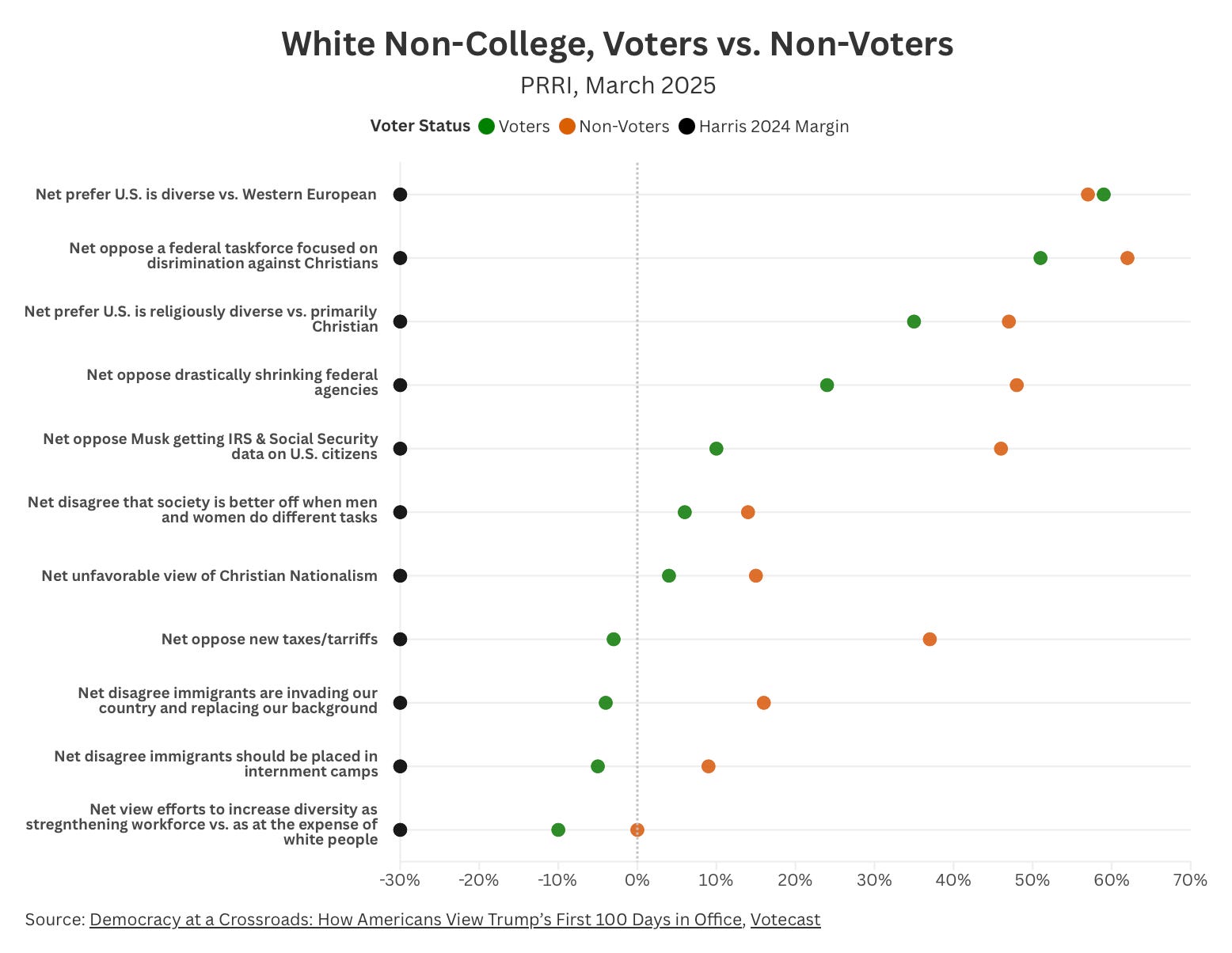
The next graph shows that this holds true for white non-college voters as well; they are generally regarded as the Trumpiest demographic group. Here, the black bubbles on the left margin represent VoteCast’s estimate of Harris’s margin with white non-college voters in the election.21 Once again, we see nearly the identical pattern with respect to voters and nonvoters—in only one instance (barely) were white non-college voters more MAGA than white non-college respondents who didn’t vote. And even white non-college voters disagree with MAGA more than they agree on these questions.
A Very Different Counterfactual
America still has an anti-MAGA majority. Yet Donald Trump is president again, and MAGA Republicans claim congressional majorities. Let’s widen the aperture to see that this is the case most proximately because:
- A Supreme Court majority installed by, and loyal to, a coalition of plutocrats and white Christian nationalists, including three justices he nominated, enabled the candidacy of an otherwise constitutionally disqualified candidate;22
- Joe Biden utterly betrayed his central original campaign promise as president to fight for “the soul of the country”—first by doing too little too late to meet the MAGA threats to the country that had only grown, then by doing nothing to thwart the “oligarchic capture” that he acknowledged only after the election, and then by insisting on running for re-election despite his (at a minimum, inferred) commitment to be a “bridge” candidate and his diminishing capacities;23
- House and Senate Democrats squandered their trifecta, refusing to create filibuster carve-outs in order to enact legislation to (1) hold Trump accountable, (2) sturdy the electoral system (other than reforming the Electoral Count Act24, (3) strengthen the guardrails against executive and judicial overreach, or (4) reverse Roberts Court ipse dixit decisions like Dobbs;
- Senate Democrats, who held the majority for the last two years, failed to either pass the necessary legislation just enumerated (which would have at least made clear that the MAGA Republican House majority was the impediment and which would have forced Trump to take a position on the campaign), or—even during the lame duck when we knew there would be an incoming MAGA trifecta—hold high-visibility investigatory hearings to alert Americans of MAGA threats or the role of the corrupt Roberts Court;
- Mainstream media kept the alarm level artificially low on what a second Trump term would mean for America—most notably, by (1) maintaining a striking disconnect between its substantive reporting on the horror of Trump’s plans and its routine political reporting that ignored the substance of those plans or treated them as normal; (2) “poll-washing,” wherein public polling about Trump’s plans served to both conceal and perpetuate public ignorance about what those plans were25; and (3) paying demonstrably less attention not just to Trump’s unfitness and authoritarian intentions, but to the entire presidential election, in 2024 than in 2020—even though in 2024 we had substantially more evidence of his intentions, and, more importantly, evidence that the guardrails that had constrained him in his first term would be gone in his second;
- The legal establishment failed to consolidate behind the need to hold the January 6th criminals accountable and second guessed those who tried;
- The business community became complacent and inexcusably sanguine about the prospect of a second Trump term—despite having publicly recognized in 2020 that Trump posed serious threats to social stability, and despite ample warnings in 2024 that Trump posed those same threats and more, including serious economic harms from tariffs;
- Civil society institutions, including law and business as well as academia, philanthropy, and even many pro-democracy NGOs, failed to recognize that communicating the gravity of the stakes in 2024 required an unprecedented mobilization beyond the typical boundaries of partisan politics—that this was not merely a strategic imperative for Democrats, but an existential call to action for anyone who had an interest in maintaining a functioning pluralistic democracy; and
- Democratic campaign operatives and centrist opinion leaders failed to meet the moment, and disparaged those who sought to, on a number of fronts
ZNetwork is funded solely through the generosity of its readers.
Donate




