


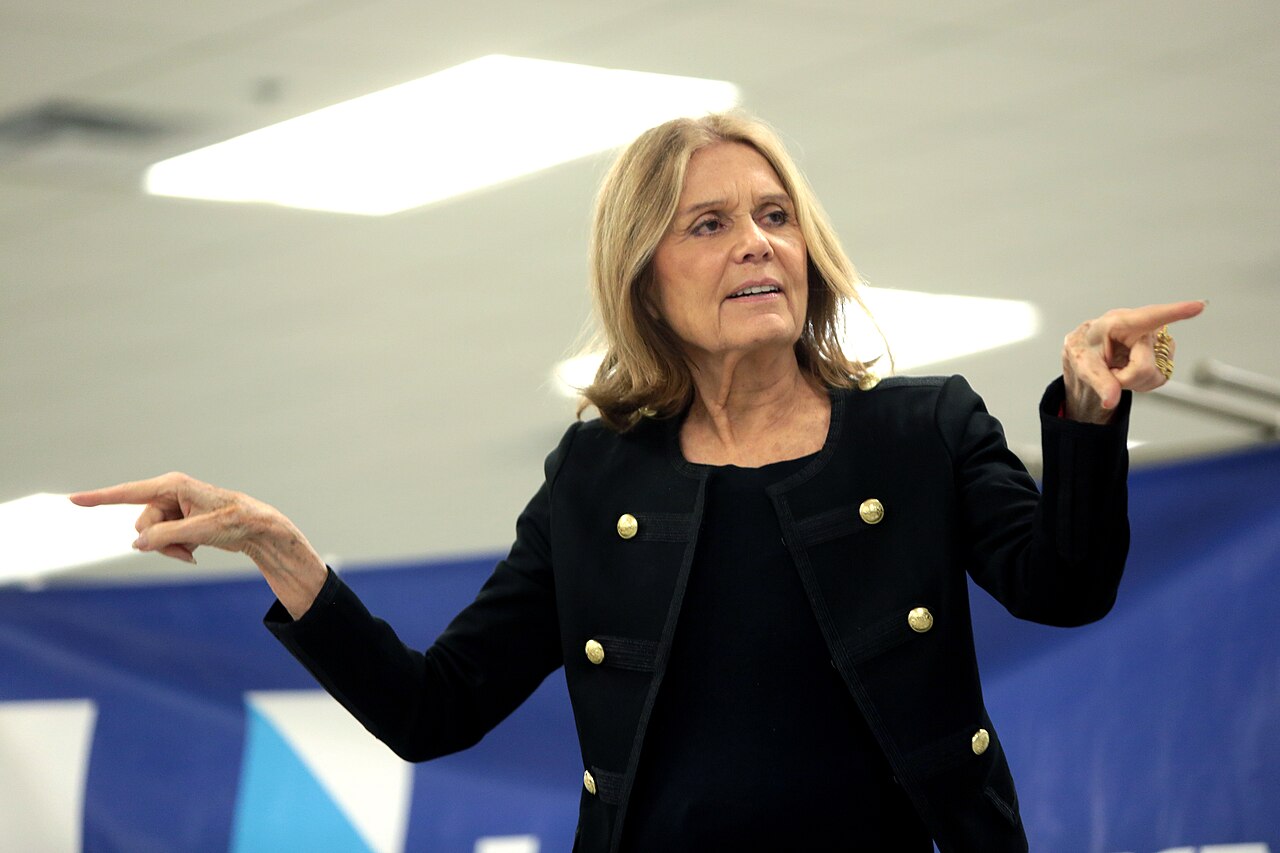
Dolly Parton, Wendell Berry, Cassandra Wilson, Gloria Steinem. The rat-a-tat-tat of death doesn’t stop. My inbox has become a memory mosaic in which diverse remembrances and celebrations mix. While it feels like a lot, it also feels like life.
Mosaics are the opposite of obituaries. An obit writer’s job is to inventory an individual’s accomplishments and describe their singular impacts. Obituaries tell hero-stories. A mosaic is more like a playlist. In mine, the sparkling strum of Dolly shuffles against the magical moonlight only Cassandra could conjure. Or a bookshelf. Wendell Berry contributes to mine from his Kentucky farm, admonishing us to love place as ancestry, and Gloria Steinem writes from the Upper East Side, forever schooling media pundits on the 101 of patriarchs. Robin Morgan’s “Sisterhood is Global” sits on those shelves, too. If only I had Tim Curry’s fishnets.
But here’s the thing: none of those people were my hero.
Take Steinem. Her feminism was not my feminism. I came to the US from London at nineteen, in 1980. By the time I encountered Steinem, my feminism was already firmly set. Mine was informed by Angela Davis and Barbara Smith; by Sheila Rowbotham and Beatrix Campbell; by Joan Nestle, Amber Hollibaugh, Audre Lorde, Zillah Eisenstein and Ellen Willis. The British magazine Spare Rib, founded the same year as Ms., was scrappier and further left.
I don’t know what to call my sort of feminism. At the time, I thought it was the only kind: anti-colonialist, anti-authoritarian, queer-desiring, in-your-face. It took me years to accept that liberal feminism, of Steinem’s sort, was actually a thing. A pink piece of the capitalist cake? A Cold War with a bow on it? I didn’t want either. I still don’t.
In college, in 1983, I wrote my senior paper on whether the women of the guerilla Irish Republican Army were feminists. I argued that they were, and went to Northern Ireland to check. There, I lay with my lionhearted lover, a working-class member of Women Against Imperialism, reading and re-reading the words of June Jordan in Catholic Belfast. I remember dancing at a benefit disco with survivors of domestic violence from both sides of the North’s divide, and bopping home in our separate ways, belting “I Will Survive” past nervous-looking British soldiers on patrol, their rifles pointed at our feet.
Sisterhood was too simple a word. In Yorkshire during the great miners’ strike of 1984, I followed Women Against Pit Closures and watched coal miners and their families beaten bloody by Margaret Thatcher’s cops. On campus, with Maria Hinojosa, I organized a mass protest against Jeanne Kirkpatrick, foreign policy advisor to Ronald Reagan, whose covert aid to the Contras was killing Central American kids. Sisterhood, as far as I could see, was elusive. And I never understood how a war against pornography could soak up so much ink.
Suffice to say, if I’m searching for a hero, Steinem wasn’t mine. She wasn’t socialist or anti-Zionist, or queer enough — and was far too keen on Hillary Clinton — to be the branch around which I’d curl my vine. But she was, and will remain, a part of my trellis.
At FAIR, the media-watch group where I worked for almost a decade, we read a lot of media criticism, but Steinem’s 1990 essay “Sex, Lies & Advertising” first published in Ms., stood out. In it, she didn’t just say advertising corrupts journalism and leave it there. She named names and described precisely how the mechanism worked.1
Food advertisers demanded recipes and entertaining articles that named their products; clothing companies expected fashion spreads crediting their designers explicitly, and beauty firms insisted not only on flattering editorials, but also balked at photos — even of newsmakers — who appeared without make-up. Turning her reporter’s eye on her own magazine and its books, Steinem showed how little the ad buyers actually cared about audience data or research, and how much they cared about control. She recounted how the vice president at Eastern Airlines canceled subscriptions for thousands of copies on Eastern flights because he was offended by ads for lesbian poetry journals in the Ms. classifieds.
Steinem showed how advertising censored and controlled editorial content, and shared bluntly how the chase for money drained her time and wore her down.
A year later, we returned to that essay during the Gulf War, when we learned that CBS executives weren’t just yielding to advertiser threats to pull ads, but offering advertisers assurances in advance that war coverage would be tailored to provide cheerier lead-ins to commercial breaks. The mechanism Steinem exposed in a women’s magazine was now running the network news. 2
Steinem died September 2, at 92. The tributes came in fast from the top. Hillary Clinton said she had “pushed open doors not just for herself but for literally millions of women behind her.” Accolades rolled in from Capitol Hill to Hollywood to Miss Piggy and almost as fast, the critique. Her ties to a CIA-funded student group in the 1950s, and her role promoting neoliberalism; her regressive views on sex work, Palestine and Bernie Sanders.
Now it is the media critic in me that’s feeling defeated.
Year after year, at FAIR, we argued that the money media had room for only one feminist. A quota of one. For decades, Steinem filled it. Hers was the number they’d call whether the topic was fashion or kids or war and peace. (They never called her about war and peace.) They dubbed her a “trailblazer,” but a trail implies others walked it, too. The money media never went looking for them, or for the many — many — trails that crossed or fed into hers.

Like Steinem, Ms. was never alone. The 1986 edition of the Index/Directory of Women’s Media, published by the Women’s Institute for Freedom of the Press, listed 331 women’s periodicals in the United States alone, as well as 81 women’s presses and 48 women’s bookstores. Paula Kassell, a member of the Women’s Institute and founder of the newspaper New Directions for Women, (to which I contributed), told the press, ‘’There is a never-ending fount of women out there who want to communicate and bring people together.”3
But only a few ever passed through the money-media’s turnstile.
Many people tried to widen it. Nearly two decades after the Women’s Institute, FAIR established the Women’s Desk in 1991 to counter white-male bias in news reporting. Jennifer L. Pozner continued that work through Women in Media and News,4 a decade later. In 2005, Steinem co-founded the Women’s Media Center, which, among other things, conducted valuable annual surveys of women’s exclusion from everything from news to TV sitcoms.
Try as we all might (and we were by no means the only ones) the money media’s gatekeepers kept — and still keep — all but their chosen few out of their picture of social justice work and its meaning. The policing works not only to keep us ill-informed and isolated. It often sets us at each other’s throats. Instead of hating the gate and its keepers, we hate the few — Gloria Steinem in this case — whose political positions and public personas are legible and acceptable enough to fit the media’s parameters.
In 2018, I was proud and happy to accept the Pat Mitchell Lifetime Achievement award from the WMC. Gloria was there. She had a friendly way of treating one as an ally, and appreciating ones work, even if wasn’t the same as hers. I’m feeling the same way about her tonight.
The New York Times that calls Steinem the “personification of the women’s movement” and includes the famous photo of Gloria with Dorothy Pittman Hughes, fists raised in her obituary, will always prefer the iconography of solidarity to the analysis from the Combahee River Collective, or This Bridge Called My Back, because those works show how the structures of race, class, and gender oppression are linked, not at the arms, but at the root. That’s not Gloria’s fault. The Times feeds off that same root.
It’s a victory that All Things Considered invited Angela Davis on air this past Saturday to talk about Gloria Steinem.5 Maybe next, they’ll invite her to talk about Angela Davis! As John Collins reported for Weave News in 20196, up to that date NPR’s own archive showed that Davis has never been interviewed by a national NPR reporter or host for a report on a flagship news program — “or if she has, her comments were never aired.”
The media gatekeepers and their gates live on, but they are weaker today, besieged by a mass of individual media-makers on countless platforms where the debates over legacies like Steinem’s are being thrashed out minute by minute. As I look again, many of the social media posts calling for Steinem’s cancellation are being contested by people tracking more closely the actual evolution of her early positions on issues like trans rights.7 That’s progress.
But only if we use it to build lattices, not new pedestals. The tributes made Steinem a saint. The backlash made her a stalking horse. Both required one woman to carry the whole weight of a movement. Movements are easier to weaken or hate when they rest on a single back. But Combahee didn’t need a hero. Neither did Women Against Imperialism or the miners’ wives in Yorkshire. They needed each other.
Dolly Parton, Cassandra Wilson, Wendell Berry, Gloria Steinem. They all made a difference. Not the difference, but a difference. Lattice thinking is not only possible today, it’s necessary, and we need more of it. Besides, binaries are on the way out.
1 https://gloriasfoundation.substack.com/p/sex-lies-and-advertising
2 https://fair.org/uncategorized/gulf-war-coverage
3 https://www.nytimes.com/1986/03/03/style/new-generation-of-women-s-publications.html
4 https://substack.com/@jennpozner
5 https://www.npr.org/2026/09/05/nx-s1-5958641/i-dont-think-i-had-10-in-the-bank-angela-davis-remembers-gloria-steinems-allyship
6 https://www.weavenews.org/stories/2019/04/08/2019-3-31-npr-and-angela-davis-a-tale-of-mythology-and-missed-opportunities
7 https://www.them.us/news/gloria-steinem-trans-rights


Laura Flanders is the host of "RadioNation" heard on Air America Radio and syndicated to non-commercial affiliates nationwide. She is the author most recently, of Blue Grit: True Democrats Take Back Politics from the Politicians (The Penguin Press, 2007) and also BUSHWOMEN: Tales of a Cynical Species (Verso, 2004), an investigation into the women in George W. Bush's Cabinet. Publisher's Weekly called Flanders' New York Times best-seller, "fierce, funny and intelligent."The W Effect: Sexual Politics in the Age of Bush, an essay collection compiled by Flanders, appeared in June, 2004 from the Feminist Press.Before joining Air America when it launched in March 2004, Laura hosted the award-winning " Your Call," Monday-Friday, on public radio, KALW, 91.7 fm in San Francisco.Flanders' TV appearances include "Lou Dobbs Tonight" and "Paula Zahn Now" as well as "The O'Reilly Factor," and "Hannity and Colmes," "Washington Journal," "Donahue," "Good Morning America" and the CBC news discussion program, "CounterSpin."Her writing appears in The Nation, Alternet, Ms. Magazine, and elsewhere and her op-ed pieces have appeared in papers including The San Francisco Chronicle.Flanders was founding director of the Women's Desk at the media watch group, FAIR and for more than ten years she produced and hosted CounterSpin, FAIR's nationally-syndicated radio program. Shie is also the author of Real Majority, Media Minority; the Cost of Sidelining Women in Reporting (Common Courage Press, 1997) about which Susan Faludi wrote, "If only there were a hundred of her." Katha Pollitt called it "Funny, angry, factfilled and brilliant."
ZNetwork is funded solely through the generosity of its readers.
Donate




