

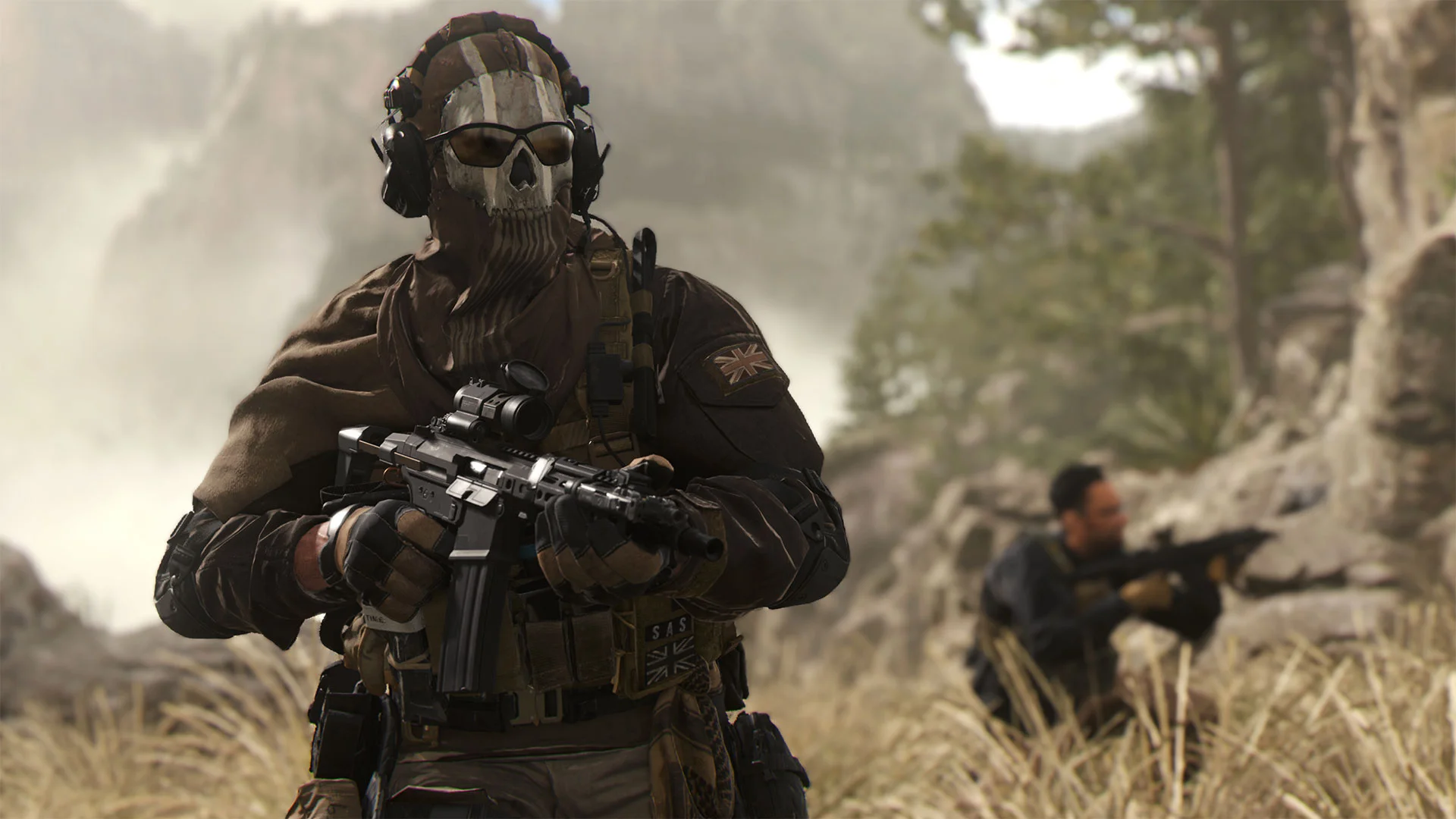
Breaking: for the nineteenth consecutive year, the new Call of Duty video game does not offer a thoughtful pacificist critique of human affairs. Per usual, the newest in Activision’s annual first-person shooter series is not exactly War and Peace. Try War and More War.
Call of Duty: Modern Warfare II opens with a ripped-from-the-headlines war crime set in the recent past. The player must pilot a missile through a remote desert valley to assassinate an Iranian general named Ghorbrani — clearly a thinly veiled reference to the real-life 2020 drone-strike killing of Qasem Soleimani ordered by Donald Trump.
Simulating Soleimani’s extrajudicial murder to kick-start a Tom Clancy–like “What If?” story about a special ops unit preventing World War III is far from the game’s only politically questionable narrative choice. The seventeen-mission globetrotting campaign also sends players to hunt Mexican drug cartel members along the US-Mexico border wall, which involves pointing a loaded assault rifle at civilians in a Texas town to “de-escalate” the situation. The game also turns a tourist neighborhood in Amsterdam into a war zone in order to nab some terrorists.
Considering the ugliness of the spectacle, it’s not surprising that many journalists have responded by hurling insults. Critics have called Modern Warfare II “tone deaf,” “cynical,” and “spineless” with “moments of violence that feel uncomfortable at best and morally questionable at worst.” All of that rings largely true. But it strikes me that we’re still having the same shallow conversations about media messages and their impact on players.
Is the most harmful thing about Call of Duty really just its writers’ dogshit takes on global politics? What if the real danger is not that players will be indoctrinated, or even turn to real-world violence, but that they’re being trapped in an extractive and ever-worsening cycle of gaming addiction that diminishes their quality of life while lining corporate pocketbooks?
War Games People Play
I don’t mean to sound overly dismissive of the “Call of Duty is Problematic” crowd. After all, I’m a former game critic and credentialed member of the finger-wagging content police.
On Christmas morning ten years ago, the front page of the New York Times quoted me expressing reservations with Medal of Honor: Warfighter, a Call of Duty clone that directly marketed guns and knives to gamers. I’d just written a viral essay about how upset I was that anyone could shoot a branded assault rifle in Medal of Honor and then buy the real thing through the game’s official website, which, as I told the Times, “felt like a virtual showroom” for real-life weapons.
I cited as an example my nephew Aidin, a Call of Duty devotee who had just been suspended for taking a gun to school. A little nagging voice in my head wondered if Aidin was on the path to committing gun violence, and if Call of Duty and similar games were the gateway drug to get him there. Weren’t these shooters just an overt marketing tool for the peddlers of death in the civilian firearms industry?
Many of my media colleagues agreed with me, and in the face of a growing backlash, Medal of Honor publisher Electronic Arts severed its licensing ties to gun manufacturers.
Yet something funny happened in the decade since I wrote that essay: I’ve been proven wrong in my belief in a direct correlation between war games and real-life behavior. First-person shooters keep attracting millions more users, but gun homicides dipped through most of the 2010s. There’s been a recent uptick in gun homicides since 2020, but the rate of gun deaths remains below the levels of previous years. My nephew stopped touching guns shortly after my dad passed in 2017. Turns out that my father, who had an extensive gun collection, was initiating Aidin into gun culture, and Call of Duty was merely an extension of an interest cultivated by a family member.
Meanwhile, psychological studies — even ones that cite my essay as an influence — have struggled to find a strong link connecting digital and a positive affinity toward guns, much less real-life gun violence. And notably, the US military isn’t getting a substantial Call of Duty bump. According to Activision, more than four hundred million people worldwide have played a Call of Duty game at least once, most of them American. But the Pentagon says recruiting numbers are at their lowest since the end of the Vietnam War, with the Army missing its targets by thirty thousand soldiers.
The reasons for this are varied: the pandemic cut off access to military prospects at high schools, an improving job market has meant less financial pressure to settle for the Army, and high obesity rates among young people are ruling out military service. Not only are video games insufficient to offset these trends, but in February Army major Jon-Marc Thibodeau claimed that video games were making quality recruiting harder. “The ‘Nintendo Generation’ soldier skeleton is not toughened by activity prior to arrival,” he said.
Gaming is becoming the only game in town, with over 90 percent of children playing in some form or another, and so the military is not giving up. Recruiters have attempted to infiltrate Twitch, Discord, and other first-person shooter gaming communities looking for prospective soldiers, prompting Alexandria Ocasio-Cortez to sponsor a House amendment to ban the military from such activities. “War is not a game,” she said on Twitter. “We should not conflate military service with ‘shoot-em-up’ style games and contests.”
AOC’s efforts are commendable, and these recruitment activities should be illegal. Nevertheless, it’s increasingly clear that despite the military’s best efforts, gamers aren’t necessarily conflating war games with war and trading their Xbox controllers for assault rifles after playing Call of Duty. They’re just gripping their controllers ever tighter.
Bad Company
Activision Blizzard occupies the lowest circle of hell in an industry defined by the worst aspects of capitalism and corporate greed.
Admittedly, I’m biased. In the mid-aughts, I worked as a Q&A tester in the company’s Santa Monica, California headquarters, paid a mere ten dollars an hour to sit endlessly in what we called “the Dungeon,” a cramped, sweaty, windowless basement where we searched for bugs in the then upcoming Call of Duty: World at War. Almost everyone toiling in the Dungeon daily was a temporary contractor — without health care or unions — who could be laid off at any time, which often happened between projects. You’d finish a game and then be shown the exit, staring down weeks, even months, without compensation.
My former colleagues have made some inroads in unionizing these days, but Activision keeps trying to bust them up. Last month, the National Labor Relations Board ruled that the company had unlawfully retaliated against unionizing workers at Raven Software, a subsidiary that primarily works on Call of Duty, where workers made history when they formed a union in May.
The software giant has also been hit with multiple lawsuits holding that its “open ‘frat boy’ environment fostered rampant sexism, harassment, and discrimination with 700 reported incidents occurring under CEO Robert Kotick’s watch.” Last year, a report from the Wall Street Journal found that Kotick knew for years about rampant sexual harassment at the company but failed to act. And last week, a Swedish state-run pension fund sued Activision and Microsoft, claiming that their massive $69 billion merger announced earlier this year was rigged to protect Kotick’s pocketbook.
How is Activision worth as much as the annual GDP of Croatia? A lot of that money is bilked from gamers through predatory “microtransactions” — a $67 billion industry involving in-game transactions that ask players to choke up real money to buy digital goods to gain a competitive edge, or splurge in the haze of gaming on attractive cosmetic items. Often these microtransactions are designed to mimic slot machine–style gambling with a randomized reward system. Roughly 40 percent of the staggering $5.1 billion Activision Blizzard reportedly made in 2021 came from in-game purchases like Call of Duty’s “Battle Pass” and various gun decorations.
These games and microtransactions are intentionally designed to psychologically trap gamers in a cycle of addiction. In 2019, the World Health Organization recognized “Gaming Disorder” as a mental health condition, and it was officially added to the International Classification of Diseases this year, with an estimated sixty million addicted, according to one estimate. Half of millennials and Gen-Zers play games more than eight hours a day, and nearly a quarter play more than thirteen hours a week — a figure that’s increased since the pandemic lockdowns incentivized more screen time.
Those figures coincide with plunging mental health and increasing rates of depression among young people, as well as worsening physical health indicators. Americans are increasingly sedentary, isolated, and alienated. Video games, while often providing an amusing distraction and a convenient way to connect socially online, too often function as a salve, one that can never truly satisfy what ails us. For the sake of gaming, Americans are sacrificing their physical and mental health, forgoing real-life relationships for online gaming friendships, and forking over increasingly large portions of their already-too-low wages in a fog of addiction.
That’s why ultimately, what I find most distressing about Call of Duty in 2022 isn’t its inherently conservative we-need-a-good-guy-with-a-gun politics. It’s that with contemporary video games, the medium is the message, and too much of our daily existence is made up of pixels to shoot at.
ZNetwork is funded solely through the generosity of its readers.
Donate




