

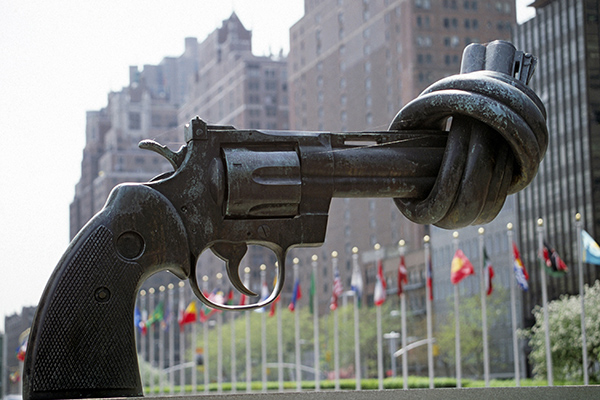
A commonly held myth is that war concludes well with peace. In fact, conflict research shows that the losing side may accept defeat in a public-facing manner, only to fester and plot to get revenge later.
Violence and war generally lead to further violence and war. Although it may lead to short-term “peace,” violent conflict rarely works to build sustained peace.
The exceptions, Writes Princeton professor Jean Arnault, are peace treaties that are not retributive or humiliating:
One approach, perhaps best described as “constitutive,” views the substance of the peace agreement as key to the overall process, which will reflect its strengths and weaknesses, virtues and shortcomings. A “good” agreement will result in durable peace; a “bad” agreement will result in delays, setbacks, or even the collapse of the peace process.
But what if the war could have been avoided in the first place?
It is true that conflict is inevitable. War and violence are not. Where violence leaves winners and losers, constructive ends that foster working relationships are never constructed from violence. It is nonviolent action that produces working relationships. Nonviolent action as a response to conflict is essential to building and sustaining a culture of peace. But what is nonviolence? When has nonviolence been successful? And how does it contribute to building sustainable peace?
Nonviolence is, according to Dr. Martin Luther King Jr., “A Courageous Confrontation Of Evil By The Power Of Love.” It is the reaction to violence through nonviolent acts. One does not surrender to violence, but uses alternative methods in response to it.
Numerous examples point to successful nonviolent movements.
The 1979 revolution in Iran toppled the Shah through nonviolent methods of protesting. Although what came out of the revolution was a theocracy, the revolution itself was nonviolent.
The Egyptian revolution in 2011 ousted Egyptian President Hosni Mubarak. For 18 days, the people of Egypt revolted nonviolently until President Mubarak stood down.
People Power Revolution in the Philippines saw nonviolent demonstrations lead directly to the departure of Ferdinand Marcos, the prevention of a civil war that seemed inevitable, and regaining democracy in their country.
The Cedar Revolution in Lebanon was a series of nonviolent demonstrations with the goal of forcing Syria to withdraw its military troops from the country. This goal was achieved as Syrian troops left Lebanon on April 27, 2005.
Indeed, there is Empirical Research by Harvard professor Erica Chenoweth and former State Department official Maria Stephan on the many cases in which nonviolent insurgency overthrew dictatorships at success rate nearly double that of successful violent uprisings.
It is evident here that civil resistance and nonviolence have generated enough power to create change in society.
There are More Than 300 different methods of civil resistance or nonviolence. It is more than just protest, but statements, boycotts, strikes, walk-outs, teachings, noncooperation, and much more.
Key to nonviolence is the strain it creates on the ruling elites that challenges the dominant structure. Collective social strain forces leaders, militaries, and perpetrators to change their methods. In the Chenoweth and Stephan study, they found that if 3.5 percent of a population become involved participants in a nonviolent campaign, the likelihood of success is almost guaranteed. Imposing costs on those in power can be done without shooting anyone.
With this, power is taken from the few, and the power is dispersed among the people. Because of this, nonviolence also can contribute to building democratic societies.
Nonviolence is the answer to the increased international crises of the world. One suggestion I can offer is to learn about past and present nonviolent campaigns and teach the people around you. Once the world knows about the power of nonviolence, ideally, they will see it as a viable, and vital, option in the face of conflict.
To quote Martin Luther King Jr, “At the center of nonviolence stands the principle of love.”
~~~~~~~
Haley Morrow is a Conflict Resolution masters candidate at Portland State University and PeaceVoice Associate Editor.
ZNetwork is funded solely through the generosity of its readers.
Donate




