

On October 29, just before meeting with China’s President XI Jinping, President Trump posted on the right-wing social media network Truth Social that “because of other countries [sic] testing programs, I have instructed the Department of War to start testing our Nuclear Weapons on an equal basis.”
The U.S. stopped testing nuclear weapons in 1992 – that is, detonating nuclear warheads. It regularly tests “delivery vehicles,” the missiles that would be used to carry the nuclear weapon to its intended target. The most recent of these tests took place early on Wednesday, November 5, when an intercontinental ballistic missile (ICBM) was launched from Vandenberg Space Force Base, on the coast of California. It’s possible that Trump simply does not understand the difference between these two things.
Observers speculated that Trump’s nuclear test announcement was a response to Russia’s recent test of its Burevestnik missile, which is nuclear-capable – meaning it could carry a nuclear warhead, though it did not during the test – and powered by nuclear energy. Some pointed out that it would be the Department of Energy, rather than the Pentagon, that would carry out a test detonation of a nuclear weapon. Trump’s use of the phrase “on an equal basis,” given that China and Russia are not detonating nuclear weapons, was comforting to some.
Whatever he meant, it’s worth considering how this latest episode of existential terror imposed from above highlights what depths of apocalyptic misbehavior are now considered normal when it comes to how nuclear weapons countries behave toward one another.
The missile Russia tested was designed to deliver a nuclear weapon without being intercepted by missile defense systems, using nuclear power to extend its flight time much longer than non-nuclear powered missiles. The Russian government also claimed to have tested its Poseidon torpedo, also nuclear-capable and nuclear-powered, and designed to be used in coastal waters to create a huge wave of irradiated water that would wash ashore.
Neither of these, nor the ICBM test, amount to a “nuclear test.” But, should the U.S. conduct a test explosion of a nuclear warhead, it would be adding to the environmental burden that has led to nearly half a million deaths, by one scholarly estimate, from the over 1,000 test nuclear detonations the U.S. has carried out. (This is about half of the over 2,000 total tests carried out worldwide between 1945 and 2017.) The health and environmental effects of this testing are ongoing, and the United States hasn’t come close to cleaning up after its earlier nuclear tests.
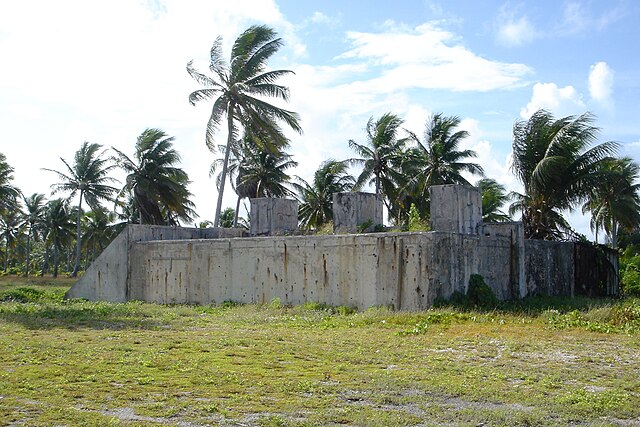
To take just one example, waste from tests conducted in the Marshall Islands is still sitting in the Runit Dome, a cracking concrete structure on Runit Island in the Enewetak Atoll that is under constant threat from worsening storms as a result of climate change. U.S. nuclear testing has rendered Marshallese ways of life untenable for the long term, with no real prospects for full remediation on the horizon. (ICBM tests launched from Vandenberg are aimed at the Marshall Islands’ Kwajalein Atoll, a less dramatically destructive but still significant burden on a place that has long paid a high price for the maintenance of U.S. nuclear weapons.)
Still, even if Trump is responding to recent nuclear tests that didn’t happen, this is largely in keeping with how nuclear-armed countries tend to justify changes in their nuclear policy as reciprocal responses to unprovoked aggression, no matter what the facts are. What’s more certain, however, is that if the U.S. tests a nuclear weapon, Russia and China are far more likely to begin testing nuclear weapons of their own, as Russia has already threatened. This would lead to more environmental damage, more health consequences across the globe, and more normalization of nuclear explosions as part of the business of doing politics.
It seems as if much of the press has lost sight of the actual stakes here. The Washington Post’s coverage of Trump’s announcement, for one, skipped over all the reasons a nuclear test might actually be undesirable and instead merely named “far-reaching consequences for relations with adversaries” as the real thing its readers should be worried about. If that is indeed the main concern, conducting multiple missile tests a year that signal the U.S.’s willingness to use ICBMs should be viewed for what it is – a gesture that keeps nuclear war on the mind of governments around the world as a real possibility, a norm of global politics rather than a collective fate that must be avoided at all costs.
The reality is, Americans share the unfortunate situation of everyone else in the world of being first and foremost potential victims of nuclear weaponry, vulnerable to the whims of the leaders they have theoretically empowered to control the country’s thousands of nuclear weapons, nearly all of which are much, much more powerful than those dropped on Hiroshima and Nagasaki. Nuclear arsenals have been maintained using advanced computer modeling for decades. The fact that nuclear test explosions have entered even the far reaches of possibility, even for an administration which embraces brutal violence with such open enthusiasm, is cause for alarm and collective action against the threat that nuclear weapons pose to human life.
It’s easy to dismiss a “test” as something less than the full terrifying reality of nuclear weapons use. In some cases, this is true. Underground nuclear tests are less immediately hazardous to human and environmental health than atmospheric tests, which the U.S. stopped conducting in 1962. An ICBM test does not involve the detonation of a nuclear weapon.
But the scale and political importance of a nuclear weapon test means any indication of a willingness to use it under any circumstances has political significance. Historians have noted that one of the main reasons the United States ultimately decided to use nuclear weapons on Hiroshima and Nagasaki was to test whether they would work as expected.
We should not let nuclear testing once again become part of nuclear-armed countries’ business as usual. A nuclear explosion is a nuclear explosion, and the fallout will be all of ours to deal with.
ZNetwork is funded solely through the generosity of its readers.
Donate




