


In several influential European countries, solidarity with Gaza and the Palestinian people is finally translating into action. Though such action may seem belated to the tens of thousands of lives lost in the genocide-stricken Strip, it is, nonetheless, critical for the future of the Palestinian cause.
The political shift underway in Europe is a development of strategic importance. This is not because Europe’s voice carries a higher value on the scale of global solidarity, but because of the central role the continent has historically played in the inception of Israel, as well as the sustained political and financial support for its settler-colonial project.
For decades, this support has provided a political and economic shield, allowing Israel to operate outside the bounds of international law. As Europe forms a core part of the Western political, legal, and economic landscape, any fundamental shift in perception here, coupled with the deeply embedded solidarity in the Global South, could finally serve as the catalysts needed to isolate Israel on the international stage—a critical prerequisite for badly needed accountability.
Though Ireland has historically served as a model of sensible and ethical politics on Palestine, other examples cannot be overlooked. They include Sweden, Norway, Belgium, and Slovenia. These countries’ positions, especially since the start of the Israeli genocide in Gaza, have been largely shaped by the degree of popular protests and civil society mobilization. Their actions, though varied, signal a growing chasm between European public opinion and the traditional pro-Israel policies of many governments.
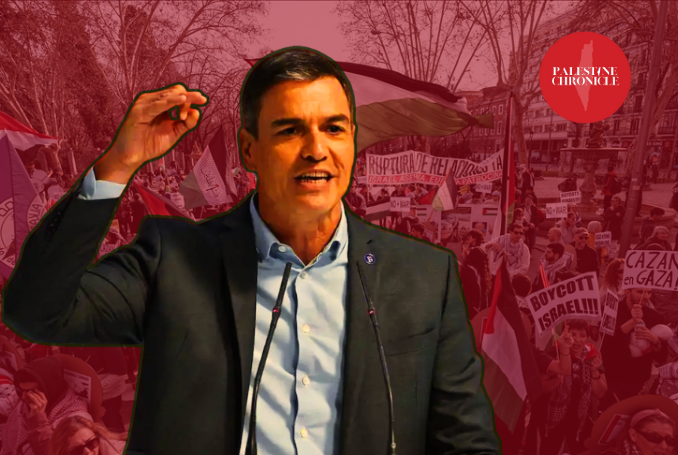
Spain, however, represents a critical and comprehensive case. The change underway in Madrid is a near-ideal model because it is built on three interconnected pillars: a vibrant and well-organized, civil-society-based solidarity; a fundamental change in official political discourse and, most importantly, meaningful, quantifiable action.
On June 6, 2024, Spain made a bold and historic move by formally deciding to join South Africa’s case at the International Court of Justice, accusing Israel of committing genocide against the Palestinian people. That step, though moral and logical, was particularly significant when compared to the positions of other major European powers. Germany, for instance, has labored to defend Israel against such an accusation, while Britain, through its Foreign Minister David Lammy, argued that the UK was not yet convinced Israel’s actions constituted genocide.
Spain’s current position was not entirely a surprise. It was a culmination of a shifting political attitude that had been building for some time. In November 2023, then-Minister for Social Rights, Ione Belarra, openly accused Israel of “planned genocide” in a powerful speech. This public declaration marked a significant shift in official discourse, moving beyond polite diplomatic platitudes to a language of moral clarity.
This new discourse ultimately led to Madrid’s recognition of Palestine as a state, a joint declaration that included Ireland and Norway. The decision not only added to the growing list of nations recognizing Palestinian statehood but also opened the stage for yet more similar recognitions. While some countries are using their position on a Palestinian state as a distracting tactic from their failure to take any punitive action, Spain’s actions appear to be on a different political wavelength. Indeed, on September 8, Spain declared a set of new sanctions against Israel, including a ban on weapons sales and a prohibition on military ships carrying equipment from using Spanish ports.
For many in Spain, even these steps are seen as too paltry and insignificant in the face of a war that has wiped out more than 20,000 children. The Spanish people are right to expect more meaningful steps from their government, and their demands are rooted in a history specific to Spain’s collective experience.
In 1974, Spain joined many countries in the Global South in voting in favor of UN General Assembly Resolutions 3236 and 3237, which recognized Palestinian self-determination. A few years later, Prime Minister Adolfo Suarez made a historic gesture by receiving PLO Chairman Yasser Arafat in Madrid. These initial gestures of support continued for a time. However, following the Madrid Talks, Spain slowly rebranded itself as a neutral intermediary, eventually repeating the same European rhetoric about Israel’s “right to defend itself” and the like.
Spain’s ability to maintain this position was made possible, in part, by the fact that the Palestinian Authority was far more concerned about maintaining its status as the official representative of the Palestinian people — and the international funds and legitimacy that came with it — than with holding Israel accountable to international law. Then, it seemed impractical for civil society to try to hold its government to higher standards than those demanded by the Palestinian leadership itself.
The Israeli genocide in Gaza, however, shattered that dynamic. The unceasing Israeli extermination campaign in Gaza, and the Palestinian resistance in the Strip, rendered the PA virtually irrelevant on the global stage and recentered Gaza as the true representative of the Palestinian collective experience and the full extent of Israel’s criminal actions.
This meant that the Spanish people themselves became partly in charge of their government’s position on Palestine. In September 2024, over 200 trade unions and NGOs called for a 24-hour general strike, raising the ceiling of their demands to the complete severance of all political, economic, and military ties with Israel. Every step taken by Prime Minister Pedro Sánchez’s government since has been a direct response to, and an attempt to satisfy, these demands.
What is taking place in Spain is true grassroots solidarity, unburdened by doublespeak or political bravado. It is a genuine civil society action centered on a shared historical experience and struggle against state-sponsored violence and fascism. While every nation has a unique story, the Spanish experience is proving to be a model worthy of study, emulation, and certainly of deep respect.


Ramzy Baroud is a US-Palestinian journalist, media consultant, an author, internationally-syndicated columnist, Editor of Palestine Chronicle (1999-present), former Managing Editor of London-based Middle East Eye, former Editor-in-Chief of The Brunei Times and former Deputy Managing Editor of Al Jazeera online. Baroud’s work has been published in hundreds of newspapers and journals worldwide, and is the author of six books and a contributor to many others. Baroud is also a regular guest on many television and radio programs including RT, Al Jazeera, CNN International, BBC, ABC Australia, National Public Radio, Press TV, TRT, and many other stations. Baroud was inducted as an Honorary Member into the Pi Sigma Alpha National Political Science Honor Society, NU OMEGA Chapter of Oakland University, Feb 18, 2020.
ZNetwork is funded solely through the generosity of its readers.
Donate




