

The Syrian civil war (2011 –…) is an arena of deep structural and ideological conflicts that transcend traditional political analyses. Far beyond being merely a local power struggle, this war serves as a laboratory where two contrasting responses to the global ontological crisis of the nation-state and hegemonic modernity collide.
The social and political vacuum created by this crisis has been sought to be filled, on the one hand, by the paradigm of Democratic Modernity, and on the other, by counter-revolutionary formations centered on Theocratic Authoritarianism.
The neo-Jihadist structures that have emerged in the Syrian field are apparatuses attempting to re-establish the chaos born from the collapse of modernity through religious authority (Sharia).
Within these formations, Hayat Tahrir al-Sham (HTS) distinctly separates itself from the classic Al-Qaeda line, representing a “hybrid” organizational typology that skillfully adapts the codes of modern political legitimacy and the diplomatic language of the international system to its own advantage.
This hybrid structure of HTS aims for international acceptance at the discursive and diplomatic level while preserving its rigid Salafi-Jihadist ideological core.
The core issue here is that the rhetoric of “moderate jihadism” is not so much a product of HTS’s own internal dynamics, but rather a creation of global geopolitics and the security logic of external actors.
The organizational and political transformation of the Salafi-Jihadist gang organization HTS has been largely shaped by the power balances surrounding it, forcing it to assume the role of a geopolitical buffer zone in line with the international system’s consent.
This is an indication of the Salafi-Jihadist gang organization’s pragmatic capacity for adaptation.
The evolution of HTS should be examined across three fundamental stages in terms of organizational identity, strategy, and codes of legitimacy.
This evolution can also be assessed within the context of Max Weber’s thesis on the transition of charismatic authority to rational-bureaucratic authority.
Stage 1: Radical Roots and Representation of Global Jihad (2012 – 2016)
The gang organization, founded as Jabhat al-Nusra, undertook the mission of bringing Al-Qaeda’s global jihad vision to the Levant arena during this period.
Jabhat al-Nusra, competing with DAESH in terms of both ideological homogeneity and operational effectiveness, aimed for a similar theocratic social model.
The main focus of the organization’s regional strategy in these years was attacks against Rojava, Northern and Eastern Syria, the Kurdish regions, and the fighters of the YPG and YPJ.
These attacks were not merely military objectives; they were also the result of perceiving the secular, autonomous, and women-focused alternative social model, coded as Democratic Modernity, as an ideological threat to the theocratic order envisioned by the Jabhat al-Nusra gang group.
In this period, the enemy was not just the Ba’ath regime and the Syrian state, but an alternative quest for ontological order.
Stage 2: “Localization” and the Construction of Authoritarian Bureaucracy (2016 – 2019)
The rebranding efforts, initiated in 2016 and led by the gang leader Muhammad al- Jolani, are characterized by a strategy of seemingly severing the organization’s ties with Al-Qaeda.
The name changes (from Jabhat al-Nusra to Jabhat Fatah al-Sham, and then to HTS) are not just tactical maneuvers but semiotic indicators of the search for international acceptance.
During this period, Jolani sought to institutionalize his charismatic field leadership by constructing a rational-bureaucratic authority in the Idlib region.
This apparatus, established not as a democratic administration, evolved into a centralized, authoritarian, and theocratic micro-state model where Sharia was instrumentalized. This bureaucratization is a result of the HTS gang organization’s effort to transform its military power into a permanent political structure.
Stage 3: Legitimation and Tendencies towards Diplomatic Normalization (2019 – Present)
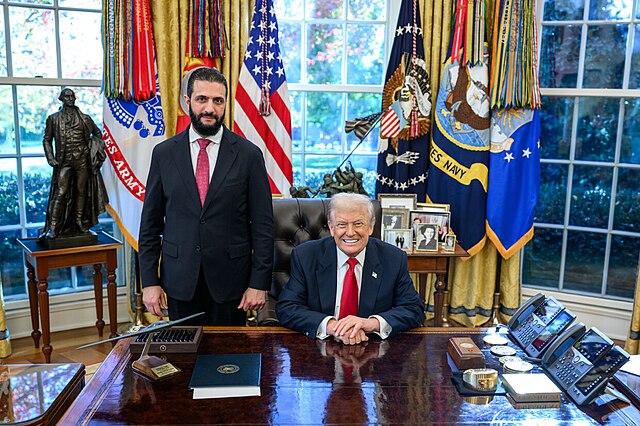
In this stage, HTS began to be presented in international media (on platforms like PBS and The Atlantic) through Jolani’s image in a suit, as a “moderate” local actor. This image constructed a figure of the “manageable jihadist” suited to the security logic of the West.
This situation can be deeply explained by Michel Foucault’s concept of the “productive nature of power.” Global actors have reproduced a form of jihadism that suits their own security concerns and poses no threat to them, positioning HTS as a regional geopolitical buffer.
This discourse of “normalization” clearly exposes the pragmatic double standards of international diplomacy and reveals that counter-terrorism policy is often determined by the balance of interests, rather than being subject to ethical principles.
The distinction between HTS’s theocratic model and the Democratic Modernity paradigm developed by the Kurdish Freedom Movement under the leadership of the YPG and YPJ constitutes the ideological heart of the conflict in Rojava, Northern and Eastern Syria, and the broader Syrian arena.
Democratic Modernity opposes the centralizing, hierarchical, patriarchal, and homogenizing nature of the modern state, proposing a multicultural, horizontal, ecological, and women-focused model of societal self-governance.
The model of Jolani and HTS is the complete antithesis of this paradigm.
Gender: It institutionalizes patriarchal guardianship by removing women from being social subjects.
Identity Politics: It seeks to produce a singular “Ummah identity” based on theological imposition, suppressing ethnic and sectarian differences.
Authority: It suppresses local councils and grassroots democracy, creating a centralized authority apparatus based on theological legitimacy.
In this context, the “localization” rhetoric of Jolani and HTS is not a genuine social adaptation but an attempt to fill the hegemonic vacuum created by the crisis of nation-state modernity with an authoritarian theocratic power apparatus.
The fundamental factor ensuring Jolani and HTS’s longevity in the field is not ideological flexibility, but the strategic role assigned to them by global and regional actors.
In this context: Turkey’s Strategic Use and Proxy-ization:
Jolani and HTS have served as both a buffer zone and a tool for oversight and control over the paramilitary jihadist gang groups called the Syrian National Army (SNA) in the Turkish state’s policy toward Rojava, Northern Syria.
The complex and de facto parallel operation with the SNA has moved HTS into the position of an invisible geopolitical proxy actor.
Within this framework, the “localization” of the gang leader Jolani and the jihadist organization HTS masks a process of geopolitical proxy-ization, where its existence is sustained as part of a broader regional strategy, rather than building its own autonomy.
Also in this context: The Controlled Threat Perception of the US and the West:
While Washington and other Western powers remain committed to officially keeping Jolani and HTS on their terrorist lists, they are de facto evaluating it as an “overlookable” and “controlled threat” in the Syrian arena.
This pragmatic and ambivalent approach reflects the fundamental contradiction in international security discourse: the rhetoric of counter-terrorism has transformed from a moral principle into an application of Realpolitik determined by the balance of geopolitical interests.
The HTS example reignites core questions of contemporary political theory and reveals two fundamental findings.
The Contradiction of Discourse and Essence: An organization is not considered to have undergone ideological transformation by changing its rhetoric and image; this is merely a strategic adaptation. HTS’s theocratic-authoritarian essence is masked by diplomatic maneuvers.
The Subordination of Legitimacy to Power Relations: Political legitimacy is constructed not only upon social consent but also as a function of global and regional power relations.
The political experience of Jolani and HTS clearly demonstrates the institutionalization of the “controlled chaos” strategy in the era of post-modern warfare.
In opposition to this order, the Democratic Modernity paradigm recalls the possibility of an alternative life and political order shaped by societal self-governance, ethical solidarity, and ecological principles.
This conflict, which is decisive for the future of the Middle East, proves that non-state actors are no longer just combatants, but also subjects that construct worlds.
The answers to these questions concern the balance of security, justice, and the future, not only for Syria but for the entire global system.
ZNetwork is funded solely through the generosity of its readers.
Donate
