

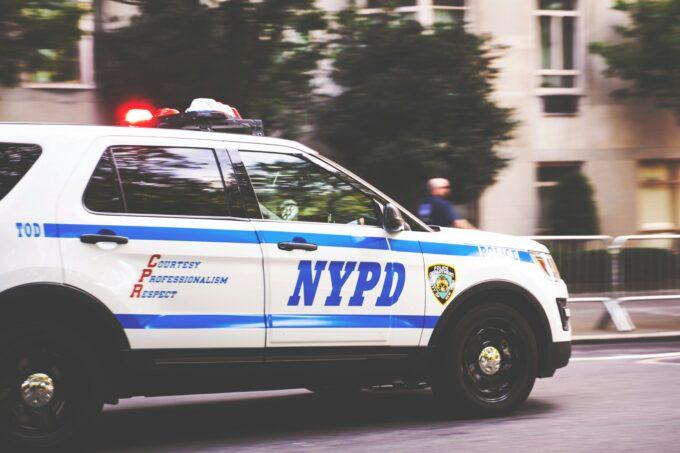
In a lawsuit complaining that the New York City Police Department failed to protect a woman from assaults by a Zionist mob, the city’s lawyers are arguing that police have no legal obligation to protect individuals from assault.
This defense and its legal precedent are a salient reminder that police do not create safety. Despite billions in funding and never-ending calls for more training, more body cameras, more specialized teams – the police have consistently proven that they only function to uphold existing power systems, not to “protect and serve” our communities.
Last year, I was horrified to watch countless online videos of the incident that led plaintiff Amanda Luci to sue the city. On April 24, 2025, Luci heard a helicopter outside of her apartment in Brooklyn, leading her to wander outside to investigate what was going on.
She discovered an ongoing protest outside the headquarters of Chabad-Lubavitch, a global Orthodox-Hasidic movement. The space planned to host Israeli Defense Minister Itamar Ben-Gvir for a speech – and Pro-Palestinian protestors gathered outside to protest the war criminal’s appearance.
Ben-Gvir is an active leader in the genocide of Palestinians in Gaza over the last two and a half years, killing tens of thousands of civilians, including countless children. He recently poured champagne on the Knesset floor to celebrate the passage of new Israeli legislation approving the death penalty for Palestinian political prisoners imprisoned by Israel.
According to the complaint, Luci arrived near the end of the protest and stood near dozens of cops, hoping their presence would guarantee her safety while observing the protest. However, one of the Zionists, seeing a woman in a scarf, presumed her to be a Pro-Palestinian supporter, and a mob of men swarmed her, while the police simply watched.
In videos of the assault, which quickly went viral on social media, Luci was swarmed by the mob of men and boys, who kick, spit, and screamed at her. As she tried to navigate her way home after the police didn’t intervene, the mob chased her, flashing strobe lights in her face and threatening to rape her.
While horrifying, the behavior of these Zionists did not surprise me. My friends and I have all been threatened with rape by Zionists while attending Pro-Palestinian protests. Supporters of settler-colonialism and bombing children, unsurprisingly, tend to skew misogynistic.
Also unsurprising is the lack of intervention from the NYPD as Luci was assaulted. As Luci’s lawyers explain in the complaint, the NYPD is specifically trained to view Pro-Palestinian supporters as “extremist” and “antisemitic.” Pro-Israel nonprofits have taught the NYPD that the keffiyeh, a scarf representing generations of Palestinian identity, is an antisemitic symbol.
This partiality to Zionism reflects a pattern of explicit bias against liberation movements and the left in the NYPD’s training. Training materials for the Strategic Response Group, an “elite” task force often deployed to protests, characterize Black Lives Matter, Occupy Wall Street, and anti-Trump movements as “violent” crowds.
The police, like the Zionists, may have mistaken Luci’s scarf to be a keffiyeh and presumed her to be an “extremist.” When a mob of men surrounded Luci, the NYPD acted in alignment with their training and took no action to protect her. In a March 13 letter to the judge, the city’s lawyers argued that police have no obligation to protect people from assault.
While counterintuitive to the “protect and serve” motto of many police departments, this argument actually has legal precedent. According to the “public duty doctrine,” a government’s duty is to protect the public as a whole, not specific individuals.
The public duty doctrine has been used for decades to dismiss lawsuits filed against police departments alleging negligence. In a 1981 case, a woman called 911 multiple times to report a break-in, and the police took no significant action. When she was later assaulted by an intruder, she sued the police for negligence. The D.C. Court of Appeals sided with police, holding that the police did not have any specific duty to protect her.
“It is well settled that the allegation that a police officer refused to take police action is not a cognizable constitutional violation,” the city’s lawyers wrote to the judge for Luci’s case.
Abolitionists have said for generations that the police don’t keep us safe – and the data backs it up.
“Research does not conclusively show that cops decrease homicides, violence, or crime – and any relationship between increased policing and decreased crime is smaller than previously indicated and not sustainable over time,” says a new report co-authored by the Community Research Hub and Interrupting Criminalization.
During a post-pandemic national rise in homicides, cities like Houston and Nashville, which increased their police budgets, still experienced a rise in homicides. Bloated police budgets had no effect on crime levels. The billions we spend on policing should go to proven crime prevention methods, such as employment programs and green spaces. Investments that improve community livelihood reduce crime.
Police, while failing to prevent crime, contribute violence of their own. On average, American police officers have killed over 1000 people annually since 2013.
Police violence dates back to their origin as slave catchers: patrols intended to capture Black people traveling north to free states. They have disproportionately policed, arrested, and murdered Black people ever since. No amount of funding for body cameras and implicit bias training has made their actions any less racist. They protect the system that created them.
In theory, Amanda Luci, as a white woman, is exactly who police are designed to protect. This is the question bolstering the fantasy of police (one I grew up believing): who will protect me from a mob of men?
As Luci’s case demonstrates, the answer isn’t police.
Of the dozens of police officers present, one joined Luci. He walked next to her while the mob harassed and attempted to grab Luci. The officer never told the men to stop and eventually accompanied Luci to a police car. The Zionist mob cheered as she entered the car – as if she had been arrested.
Luci wasn’t there to protest genocide. And yet, the mere perception that she might have been was enough to embolden a mob to attack her – and seemingly discourage police from intervention.
Police are loyal to the power systems they enforce. For decades, the U.S. has sent billions of dollars in weapons to support Israel’s genocidal ambitions, and American police have been thoroughly trained to brutalize any opposition.
Whether at protests or 911 calls, the police have demonstrated time and again that they will not protect people. And with the public duty doctrine, the courts have defended this reality.
For those who cling to the fantasy that police protect people, Luci’s case is a salient reminder that police don’t protect people, only power.
This article was originally published by Counter Punch; please consider supporting the original publication, and read the original version at the link above.
ZNetwork is funded solely through the generosity of its readers.
Donate




