

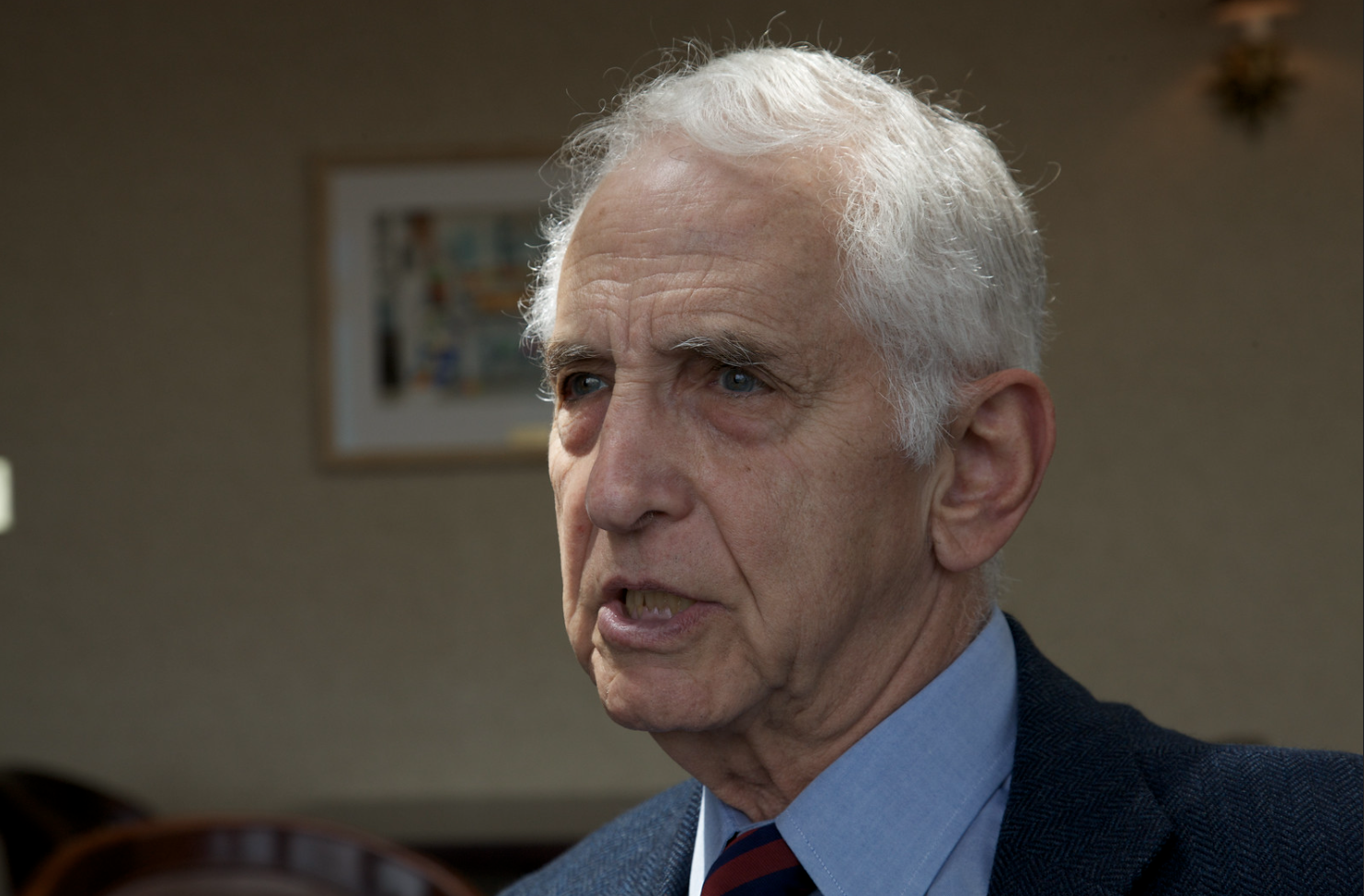
(Photo: Christopher Michel)
Even as Pentagon Papers whistleblower Daniel Ellsberg closes in on the end of an incredible and impactful life, the Washington Post and the pundit class still cannot resist using Ellsberg as a prop to misleadingly assert that he is history’s best example of a “Good Leaker.”
Devlin Barrett, a national security correspondent who covers the FBI and the United States Justice Department for the Post, spoke to Ellsberg and invited him to compare what he did to the leak of Pentagon documents, which were allegedly posted to a Discord chat group by Air National Guard reservist Jack Teixeira.
The framing somberly noted how Ellsberg faces terminal pancreatic cancer, and to him, the war in Ukraine is eerily similar to the Vietnam War he helped end. “I’m reliving a part of history I had no desire to live again. And I hoped I wouldn’t. And by the way, that makes it easier to leave,” Ellsberg declared.
But Barrett and the Post brought in Steven Aftergood, who is known in Washington, D.C., for his work with the Federation of American Scientists’ Government Secrecy Project, to comment on Ellsberg. Aftergood held up Ellsberg as the “archetypal” leaker of government secrets and pits him against many of the more recent whistleblowers, who Ellsberg himself has supported.
“He actually read and understood all of the material he released. He knew what he was doing. And he acted with thoughtful discrimination by withholding four volumes of material on diplomatic negotiations that he considered particularly sensitive,” Aftergood argued.
Aftergood added, “Government officials had told the public lies before, but rarely had they been exposed with such merciless clarity as they were in the Pentagon Papers.”
Furthermore, Aftergood described Ellsberg as an “example” because he “took responsibility” and “did not try to evade the consequences of his decisions.” That supposedly “won the respect even of his adversaries and critics.”
It is unclear who these “adversaries and critics” might be.
Henry Kissinger was secretary of state under President Richard Nixon, and he dubbed Ellsberg the “most dangerous man in America.” Robert McNamara, the defense secretary who commissioned the classified Pentagon Papers study, wanted to hurt Ellsberg “very badly.” Later in their lives, they never showed Ellsberg respect for facing the “consequences.” So, Aftergood cannot be referring to them.
Aftergood was obviously referring to NSA whistleblower Edward Snowden. A popular talking point promoted by President Barack Obama’s administration is that Snowden “fled into the arms of an adversary [Russia]” and that country engaged in a “concerted effort to undermine confidence in [US] democracy.”
Ellsberg has wholeheartedly backed Snowden. “In my estimation, there has not been in American history a more important leak than Edward Snowden’s release of NSA material—and that definitely includes the Pentagon Papers 40 years ago.”
What Aftergood, Barrett, and the Post did is similar to the tactic that prosecutors employed in the extradition proceedings against WikiLeaks founder Julian Assange when Ellsberg took the stand to defend Assange.
Lead prosecutor James Lewis of the Crown Prosecution Authority emphasized that Ellsberg had withheld four volumes of the Pentagon Papers and made the same point that Aftergood made. But Ellsberg informed Lewis that he was wrong about the reason why Ellsberg did not disclose the volumes.
Ellsberg did not want to give the U.S. government an excuse during the war for breaking off negotiations to end to the conflict. It did not bother him at all if the names of U.S. intelligence sources were exposed.
As Ellsberg described, the 4,000 pages of original government documents that he disclosed contained thousands of names of Americans, Vietnamese, and North Vietnamese. There was even a clandestine CIA officer, who was named.
Nowhere in the Pentagon Papers was there an “adequate justification for the killing that we were doing,” Ellsberg recalled. “I was afraid if I redacted or withheld anything at all it would be inferred I left out” the good reasons why the U.S. was pursuing the Vietnam War.
Ellsberg was concerned about revealing the name of a clandestine CIA officer, though he mentioned the individual was well-known in South Vietnam. But he left it in the documents so no one in the government could get away with lying about redactions in the papers.
Just like U.S. Army whistleblower Chelsea Manning, who released entire databases on the wars in Iraq and Afghanistan to WikiLeaks, Ellsberg believed the public needed to have access to the complete record. (Needless to say, Manning is not a “good leaker” to Aftergood.)
In the extradition proceedings and in almost every instance where a whistleblower has courageously risked their livelihood, Ellsberg said the pundit class has used him as a “foil” against any “new revelations” of systematic government abuses of power. They have claimed certain leaks were different than his leaks to make it easier to discredit people who took great risks to reveal the truth.
The inconvenient fact is that many of these “Bad Leakers” from the past 50 years are individuals who Ellsberg has championed. But soon the media establishment and wider pundit class will no longer have to worry about a longtime person of conscience getting in the way of their narrative.
Ellsberg will no longer be around to correct them, and they will be able to focus on helping the FBI identify and hunt down leakers after they squeeze out all the scoops that they can from their disclosures.
ZNetwork is funded solely through the generosity of its readers.
Donate




