


Gaza requires urgent international attention.
What is happening in the besieged and devastated Strip at the moment by far exceeds an unfolding humanitarian disaster; it is a calculated geopolitical reshaping. Israel is actively executing a plan to permanently occupy the vast majority of Gaza, with consequences that require little elaboration considering what we already know about the ongoing genocide.
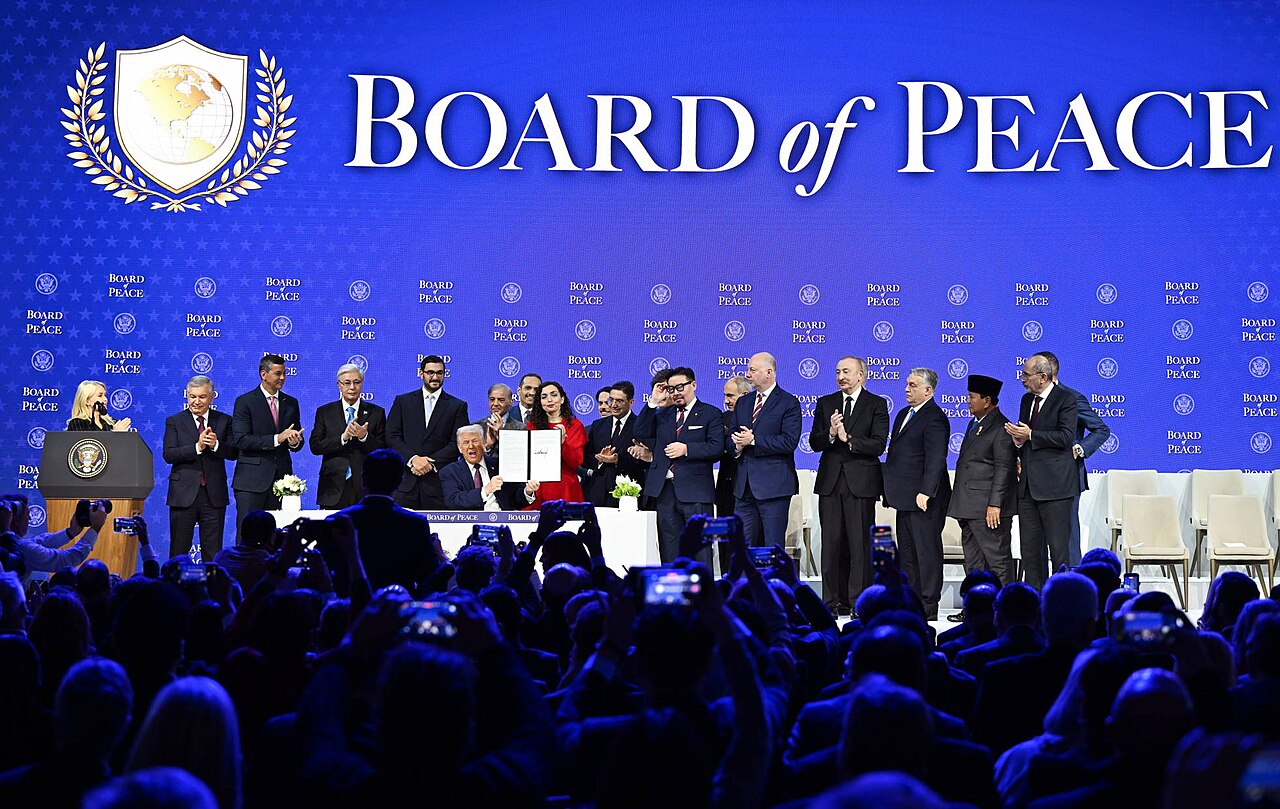
Currently, much of the international debate centers on a single official: Bulgarian diplomat . The former United Nations Special Coordinator has been designated by the United States as the Executive Director of the Trump administration’s newly established ‘Board of Peace’—an international council founded to oversee the implementation of Washington’s 20-point Gaza roadmap.
The issue, however, is much bigger than a single Washington-backed bureaucrat. A growing number of Palestinians and political analysts Mladenov of manufacturing the very conditions that continue to obstruct progress on the agreement’s transition to its second phase.
Under the framework, the official transition to this second phase—which Trump and the Board of Peace declared to have begun in January 2026—demands sweeping, one-sided Palestinian concessions, most notably the total disarmament of armed factions.
This demand is a recipe for the failure of the entire project, especially given that Israel has completely failed to implement the most basic requirements of the agreement’s first phase. It has refused to halt its routine military incursions, has failed to withdraw its forces to the originally mandated ” demarcation, and continues to deny entry permits to the technocratic committee slated to assume civil governance of the Strip.
Mladenov’s insistence on Palestinian disarmament before the agreement can advance—without a single guarantee of Israeli compliance—conveniently flips the narrative. It cynically reframes systematic starvation and the blockade of medical and construction supplies as a Palestinian failure to honor commitments.
In reality, Mladenov holds no real cards; he is merely a cog in a larger machinery controlled by Benjamin Netanyahu. The Israeli Prime Minister has made it explicitly clear that he has no intention of following any peace roadmap, planning instead for the permanent, incremental takeover of Gaza.
Speaking at a conference in an occupied West Bank settlement on May 28, Netanyahu explained his strategy with total clarity, abandoning all diplomatic doublespeak: “We are currently squeezing Hamas; we now control 60% of the territory of the Strip—you know this. We were at 50, we moved to 60. My directive is to move to…” he said, pausing as an audience member shouted “100!”
Netanyahu smiled and responded: “Let’s go step by step. First of all, 70. Let’s start with that. We’re pressing them from all sides, we’ll deal with the remnants.”
This is the actual blueprint of the Israeli government, declared openly to domestic audiences. The admission was so brazen that even US Secretary of State Marco Rubio expressed frustration at Netanyahu’s candor. Testifying before Congress on June 2, Rubio remarked, “We have a plan—it doesn’t call for that,” referring to further Israeli territorial expansion.
Yet, Rubio quickly reverted to Washington’s standard line: “And at the end of the day, we understand that what we want, and I think what the Israelis would ultimately want, is a Gaza that is governed by a non-Hamas entity.”
While the immediate priority for Palestinians is not governance but life-saving food, clean water, medicine, and basic survival, Netanyahu and Rubio view the entire crisis through a political lens. The US-Israeli plan is predicated on achieving, through diplomatic strangulation and engineered famine, what they failed to fully achieve through military might.
A rare, decisive answer came from United Nations spokesperson Stéphane Dujarric, who summed up the UN position plainly: “One hundred percent of Gaza should be for the Palestinian people.” The problem, however, is that the UN’s rhetoric is backed by no real enforcement mechanisms.
The international community has walked directly into a trap, outsourcing the future of the Gaza Strip to the Trump administration and its Board of Peace. Even the designated technocratic committee has been rendered entirely irrelevant, excluded from a decision-making process left solely to diplomats beholden to the White House.
The situation on the ground remains catastrophic. Since the fragile, heavily compromised ceasefire took effect on October 10, regular Israeli violations and airstrikes have killed nearly 1,000 Palestinians and wounded thousands more—the vast majority women and children. When added to the horrific toll of the initial two years of war, the official number of Palestinians killed has surpassed 73,000, with over 173,000 injured.
Furthermore, credible epidemiological studies and medical journals have concluded that the true death toll is vastly higher.
With nearly the entire population of Gaza living in sub-standard tents and surviving on the meager rations permitted through Israeli checkpoints, it is the highest form of immorality to demand political concessions in exchange for basic sustenance.
Netanyahu’s “step-by-step” annexation does not hinge on what Palestinian factions decide to do; his expansionist timeline is shaped independently of Palestinian compliance.
Arab, Muslim, and allied nations must fundamentally shift their diplomatic strategy. They must firmly insist on completely delinking humanitarian aid from the future governance or demilitarization of the Gaza Strip.
Starvation cannot be tolerated as political leverage for war criminals. Netanyahu is emboldened by a history of international impunity, speaking openly of expanding his military footprint regardless of the consequences of such action.
The international community must remind Israel’s government that the survival of millions of Palestinians cannot be held hostage to the political ambitions of an extremist coalition.
– Dr. Ramzy Baroud is a journalist, author and the Editor of The Palestine Chronicle. He is the author of eight books. His latest book, ‘Before the Flood,’ was published by Seven Stories Press. His other books include ‘Our Vision for Liberation’, ‘My Father was a Freedom Fighter’ and ‘The Last Earth’. Baroud is a Non-resident Senior Research Fellow at the Center for Islam and Global Affairs (CIGA). His website is www.ramzybaroud.net—


Ramzy Baroud is a US-Palestinian journalist, media consultant, an author, internationally-syndicated columnist, Editor of Palestine Chronicle (1999-present), former Managing Editor of London-based Middle East Eye, former Editor-in-Chief of The Brunei Times and former Deputy Managing Editor of Al Jazeera online. Baroud’s work has been published in hundreds of newspapers and journals worldwide, and is the author of six books and a contributor to many others. Baroud is also a regular guest on many television and radio programs including RT, Al Jazeera, CNN International, BBC, ABC Australia, National Public Radio, Press TV, TRT, and many other stations. Baroud was inducted as an Honorary Member into the Pi Sigma Alpha National Political Science Honor Society, NU OMEGA Chapter of Oakland University, Feb 18, 2020.
ZNetwork is funded solely through the generosity of its readers.
Donate





1 Comment
Hello, it seems an unfortunate deletion leaves out the name of the Bulgarian diplomat. Additionally, I think the link to Al Jazeera involves the wrong article. Just thought these observations would be helpful.