


Six months ago, Russia invaded Ukraine. The United States, NATO, and the European Union wrapped themselves in the Ukrainian flag, laid out billions for arms shipments, and imposed draconian sanctions intended to severely punish Russia for its aggression.
Since then, the people of Ukraine have been paying a price for this war that few of their supporters in the West can possibly imagine. Wars do not follow scripts, and Russia, Ukraine, the United States, NATO, and the European Union have all encountered unexpected setbacks.
Western sanctions have had mixed results, inflicting severe economic damage on Europe as well as on Russia. Meanwhile, the invasion and the West’s response to it have combined to trigger a food crisis across the Global South. As winter approaches, the prospect of another six months of war and sanctions threatens to plunge Europe into a serious energy crisis and poorer countries into famine. It is in the interest of all involved to urgently reassess the possibilities of ending this protracted conflict.
For those who say negotiations are impossible, we have only to look at the talks that took place during the first month after the Russian invasion, when Russia and Ukraine tentatively agreed to a fifteen-point peace plan in talks mediated by Turkey. Details still had to be worked out, but the framework and the political will were there.
Russia was ready to withdraw from all of Ukraine, except for Crimea and the self-declared republics in the Donbas region. Ukraine was ready to renounce future membership in NATO and adopt a position of neutrality between Russia and NATO.
The agreed framework provided for political transitions in Crimea and Donbas that both sides would accept and recognize, based on self-determination for the people of those regions. The future security of Ukraine was to be guaranteed by a group of other countries, but Ukraine would not host foreign military bases on its territory.
On March 27, President Volodymyr Zelenskyy told a national TV audience, “Our goal is obvious—peace and the restoration of normal life in our native state as soon as possible.” He laid out his “red lines” for the negotiations on TV to reassure his people he would not concede too much, and he promised them a referendum on the neutrality agreement before it would take effect.
Such early success for a peace initiative was no surprise to conflict resolution specialists. The best chance for a negotiated peace settlement is generally during the first months of a war. Each month that a war rages on offers reduced chances for peace; as each side highlights the atrocities of the other, hostility becomes entrenched and positions harden.
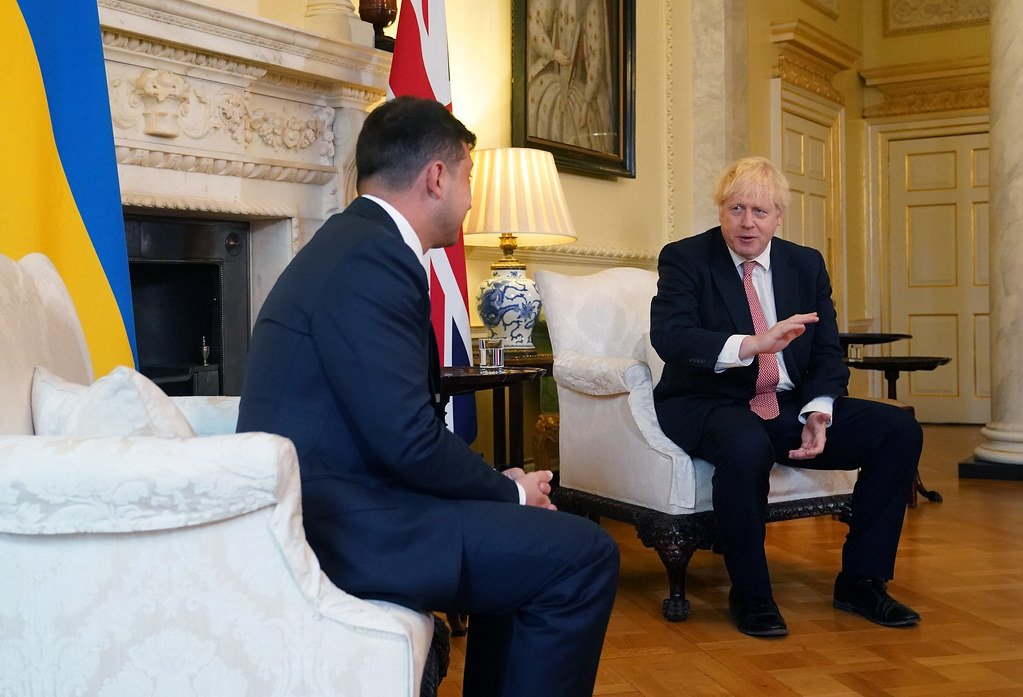
Ukrainian and Turkish sources have revealed that the U.K. and U.S. governments played decisive roles in torpedoing those early prospects for peace. During U.K. Prime Minister Boris Johnson’s “surprise visit” to Kyiv on April 9, he reportedly told President Zelenskyy that the U.K. was “in it for the long run,” that it would not be party to any agreement between Russia and Ukraine, and that the “collective West” saw a chance to “press” Russia and was determined to make the most of it.
The same message was reiterated by U.S. Defense Secretary Lloyd Austin, who followed Johnson’s visit to Kyiv on April 25. Turkish diplomats told retired British diplomat Craig Murray that these messages from the United States and United Kingdom killed their otherwise promising efforts to mediate a ceasefire and a diplomatic resolution.
In response to the invasion, much of the public in Western countries accepted the moral imperative of supporting Ukraine as a victim of Russian aggression. But the decision by the U.S. and British governments to kill peace talks and prolong the war, with all the horror, pain, and misery that it entails for the people of Ukraine, has neither been explained to the public, nor endorsed by a consensus of NATO countries. Johnson claimed to be speaking for the “collective West,” but in May, the leaders of France, Germany, and Italy all made public statements that contradicted his claim.
Addressing the European Parliament on May 9, French President Emmanuel Macron declared, “We are not at war with Russia,” and that Europe’s duty was “to stand with Ukraine to achieve the cease-fire, then build peace.”
But American and British officials continued to pour cold water on talk of renewed peace negotiations. As the implications of this fateful turn became clear, dissent began to emerge, even within the U.S. business and media establishment. On May 19, the very day that Congress appropriated $40 billion for Ukraine, including $19 billion for new weapons shipments, with not a single dissenting Democratic vote, The New York Times editorial board penned a lead editorial titled, “The War in Ukraine Is Getting Complicated, and America Isn’t Ready.”
The Times asked serious unanswered questions about U.S. goals in Ukraine, and tried to reel back unrealistic expectations built up by three months of one-sided Western propaganda, not least from its own pages. As the board acknowledged, “A decisive military victory for Ukraine over Russia, in which Ukraine regains all the territory Russia has seized since 2014, is not a realistic goal…Unrealistic expectations could draw [the United States and NATO] ever deeper into a costly, drawn-out war.”
More recently, warhawk Henry Kissinger, of all people, publicly questioned the entire U.S. policy of reviving its Cold War with Russia and China and the absence of a clear purpose or endgame short of World War III. “We are at the edge of war with Russia and China on issues which we partly created, without any concept of how this is going to end or what it’s supposed to lead to,” Kissinger told The Wall Street Journal.
After six months of a U.S. and NATO proxy war with Russia in Ukraine, we are at a crossroads. Further escalation should be unthinkable, but so should a long war of endless crushing artillery barrages and brutal urban and trench warfare that slowly and agonizingly destroys Ukraine, killing hundreds of Ukrainians with each day that passes.
The only realistic alternative to this endless slaughter is a return to peace talks to bring the fighting to an end, find reasonable political solutions to Ukraine’s political divisions, and seek a peaceful framework for the underlying geopolitical competition between the United States, Russia and China.


Medea Benjamin is the co-founder of CODEPINK and the co-founder of the human rights group Global Exchange. She has been an advocate for social justice for more than 40 years. She is the author of ten books, including Drone Warfare: Killing by Remote Control; Kingdom of the Unjust: Behind the US-Saudi Connection; and Inside Iran: The Real History and Politics of the Islamic Republic of Iran. Her articles appear regularly in outlets such as Znet, The Guardian, The Huffington Post, CommonDreams, Alternet and The Hill.
ZNetwork is funded solely through the generosity of its readers.
Donate




