


November marked the anniversary of major events in 1989: “the biggest year in world history since 1945,” as British historian Timothy Garton Ash describes it.
That year “changed everything,” Garton Ash writes. Mikhail Gorbachev’s reforms within Russia and his “breathtaking renunciation of the use of force” led to the fall of the Berlin Wall on Nov. 9—and to the liberation of Eastern Europe from Russian tyranny.
The accolades are deserved; the events, memorable. But alternative perspectives may be revealing.
German chancellor Angela Merkel provided such a perspective—unintentionally—when she called on all of us to “use this invaluable gift of freedom to overcome the walls of our time.”
One way to follow her good advice would be to dismantle the massive wall, dwarfing the Berlin wall in scale and length, now snaking through Palestinian territory in violation of international law.
The “annexation wall,” as it should be called, is justified in terms of “security”—the default rationalization for so many state actions. If security were the concern, the wall would be built along the border and made impregnable.
The purpose of this monstrosity, constructed with U.S. support and European complicity, is to allow Israel to take over valuable Palestinian land and the main water resources of the region, thus denying any viable national existence for the indigenous population of the former Palestine.
Another perspective on 1989 comes from Thomas Carothers, a scholar who served in “democracy enhancement” programs in the administration of former President Ronald Reagan.
After reviewing the record, Carothers concludes that all U.S. leaders have been “schizophrenic”—supporting democracy if it conforms to U.S. strategic and economic objectives, as in Soviet satellites but not in U.S. client states.
This perspective is dramatically confirmed by the recent commemoration of the events of November 1989. The fall of the Berlin wall was rightly celebrated, but there was little notice of what happened one week later: on Nov. 16, in El Salvador, the assassination of six leading Latin American intellectuals, Jesuit priests, along with their cook and her daughter, by the elite, U.S.-armed Atlacatl battalion, fresh from renewed training at the JFK Special Warfare School at Fort Bragg, N.C.
The battalion and its cohorts had already compiled a bloody record through the grisly decade in El Salvador that began in 1980 with the assassination, by much the same hands, of Archbishop Oscar Romero, known as “the voice of the voiceless.”
During the decade of the “war on terror” declared by the Reagan administration, the horror was similar throughout Central America. The reign of torture, murder and destruction in the region left hundreds of thousands dead.
The contrast between the liberation of Soviet satellites and the crushing of hope in U.S. client states is striking and instructive—even more so when we broaden the perspective.
The assassination of the Jesuit intellectuals brought a virtual end to “liberation theology,” the revival of Christianity that had its modern roots in the initiatives of Pope John XXIII and Vatican II, which he opened in 1962.
Vatican II “ushered in a new era in the history of the Catholic Church,” theologian Hans Kung wrote. Latin American bishops adopted “the preferential option for the poor.”
Thus the bishops renewed the radical pacifism of the Gospels that had been put to rest when the Emperor Constantine established Christianity as the religion of the Roman Empire—”a revolution” that in less than a century converted “the persecuted church” to a “persecuting church,” according to Kung.
In the post-Vatican II revival, Latin American priests, nuns and laypersons took the message of the Gospels to the poor and the persecuted, brought them together in communities, and encouraged them to take their fate into their own hands.
Reaction to this heresy was violent repression. In the course of the terror and slaughter, the practitioners of liberation theology were a prime target.
Among them are the six martyrs of the church whose execution 20 years ago is now commemorated with a resounding silence, barely broken.
Last month in Berlin, the three presidents most involved in the fall of the Wall—George H. W. Bush, Mikhail Gorbachev and Helmut Kohl—discussed who deserves credit.
“I know now how heaven helped us,” Kohl said. George H.W. Bush praised the East German people, who “for too long had been deprived of their God-given rights.” Gorbachev suggested that the United States needs its own perestroika.
No doubts exist about responsibility for demolishing the attempt to revive the church of the Gospels in Latin America during the 1980s.
The School of the Americas (since renamed the Western Hemisphere Institute for Security Cooperation) in Fort Benning, Ga., which trains Latin American officers, proudly announces that the U.S. Army helped to “defeat liberation theology”—assisted, to be sure, by the Vatican, using the gentler hand of expulsion and suppression.
The grim campaign to reverse the heresy set in motion by Vatican II received an incomparable literary expression in Dostoyevsky’s parable of the Grand Inquisitor in “The Brothers Karamazov.”
In this tale, set in Seville at “the most terrible time of the Inquisition,” Jesus Christ suddenly appears on the streets, “softly, unobserved, and yet, strange to say, everyone recognized him” and was “irresistibly drawn to him.”
The Grand Inquisitor “bids the guards take Him and lead Him away” to prison. There he accuses Christ of coming to “hinder us” in the great work of destroying the subversive ideas of freedom and community. We follow not Thee, the Inquisitor admonishes Jesus, but rather Rome and “the sword of Caesar.” We seek to be sole rulers of the earth so that we can teach the “weak and vile” multitude that “they will only become free when they renounce their freedom to us and submit to us.” Then they will be timid and frightened and happy. So tomorrow, the Inquisitor says, “I must burn Thee.”
Finally, however, the Inquisitor relents and releases “Him into the dark alleys of the town.”
The pupils of the U.S.-run School of the Americas practiced no such mercy.

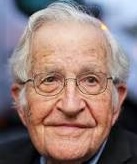
Noam Chomsky (born on December 7, 1928, in Philadelphia, Pennsylvania) is an American linguist, philosopher, cognitive scientist, historical essayist, social critic, and political activist. Sometimes called "the father of modern linguistics", Chomsky is also a major figure in analytic philosophy and one of the founders of the field of cognitive science. He is a Laureate Professor of Linguistics at the University of Arizona and an Institute Professor Emeritus at the Massachusetts Institute of Technology (MIT), and is the author of more than 150 books. He has written and lectured widely on linguistics, philosophy, intellectual history, contemporary issues, and particularly international affairs and U.S. foreign policy. Chomsky has been a writer for Z projects since their earliest inception, and is a tireless supporter of our operations.
ZNetwork is funded solely through the generosity of its readers.
Donate




