


The Indian physicist and veteran food sovereignty activist speaks to Amy Hall about a lifetime of keeping smiling while fighting the lies of the ‘poison cartel’
You’re a long-standing opponent of GMO crops. Given the current food crises around the world, particularly with the war on Ukraine, are you concerned that there will be a renewed support for them?
I call the group of companies that continue to make chemicals – and make GMOs for selling more chemicals – ‘the poison cartel’. They are Bayer, which bought Monsanto, Syngenta which is owned by ChemChina, and Dow and DuPont which merged then split into three companies, including Corteva.
They use every opportunity to push GMOs. They’ve tried so hard to use the Ukraine war to roll back Europe’s farm-to-fork strategy [which includes targets to reduce the use of chemicals in agriculture]. It’s purely propaganda because genetic engineering is not a yield-increasing technology; the yield comes from the whole plant. GMOs are totally irrelevant to increasing yield.
You’ve talked a lot about the violence of agriculture and the ‘war’ that’s happening around it. Where are the main fronts of this war currently?
One main area is the GMOs of the next generation – gene-edited crops which are being pushed for deregulation. For a while you had UK prime minister Boris Johnson who said he wanted to ‘liberate the GMO’. His first task was not to liberate the people; it was to liberate the GMO. There’s a [Genetic Technology – Precision Breeding] Bill in the UK [parliament] which is trying to deregulate GMOs.
The industry has tried so hard to make it look like I’m saying something trivial when I talk about violence. I studied the Green Revolution, because the state of Punjab had erupted in violence – 15,000 people were killed. Bhopal’s pesticide plant leaked, thousands were killed and thousands are dying still. These chemicals kill and where did we get them? Every chemical in agriculture has its origins in war – and its consequences are warlike against the Earth and people.
In 2020 and 2021 the massive farmer protests in India made international headlines. How are you feeling about the future for Indian farmers now?
The farmers stopped their protest because the government made commitments. Those commitments have not been fulfilled and the farmers are saying ‘if you continue to lie to us and cheat us, we will protest again’. India, age after age, has risen to defend the right to farm. Every fourth farmer in the world is in India and there’s an attempt to grab this huge market. But there’s definitely resistance from the farmers – they will not be pushed to extinction.
You’ve faced a lot of pushback from powerful people, organizations and corporations. How do you deal with that?
Well, I wouldn’t call it pushback because that means they would have to push me back into something [she laughs]. It’s propaganda attacks.
If someone did a serious critique, I would really want to engage with it. I don’t think they’ve ever led to a cancellation of any of my talks but I remember once I went to a university in Wisconsin and there was huge security. I said to the president: ‘Are you having student movements? Are there protests going on?’ He said: ‘There have been huge attacks on us for inviting you and they have announced they will disrupt your lecture. So, the security is to protect you.’
People say: ‘She lies about farmers’ suicides.’ No, those figures are government figures. What I do is show the reasons farmers got into debt – the high-cost chemicals. The names of the farmers are from the government; the linkage is what my work is about.
They’ll say: ‘Oh she lies about ecological agriculture feeding the world.’ At the end of the day, that’s the only way we will be able to feed the world.
They just cook up a narrative. I guess because of my deep passion and love for truth I take all these untruths, lies and falsehood with a bit of a smile and I keep on.
What are the main lessons you’ve learned that you feel would be useful for other people to know?
I think fearlessness. The interesting thing is that each ecological problem has behind it this major economic interest. Whether it’s mining, or illegal GMO introduction in India.
I learned from my parents that if you follow your conscience there’s nothing to be afraid of; there’s no external power that’s more powerful than your conscience.
Is there anything happening with food or agriculture that you’re particularly excited about at the moment?
The fact that small farmers are being celebrated again – that gives me hope that this linear trend of bigger and bigger, fewer and fewer farms, has got an alternative.
Second, when I start to look at what I call ‘nonviolent agriculture’, ecological farming, [I see that] there’s so much happening and it’s being given different names – agroecology, regenerative agriculture – and it’s just thriving and the knowledge and the sciences are thriving with it. That to me is exciting because the chemical lobby is still stuck with the old rhetoric that soil is an empty container and seed is an empty vessel.
It’s becoming even more clear that the corporations are finding in seed and food the place for their profits and that’s why they are jumping into the food system. Mr Gates has taken over – he’s one of the world’s biggest farm-land owners. One of the worst injustices is that the poor and vulnerable are the ones who are left to live on diets of junk food which will make them sick. The big change for me is ensuring that the huge subsidies that are today subsidizing the chemical industry, the GMO industry, the junk food industry, should shift to supporting good food for the last person in society. That money is so huge that everyone could be fed with good ecological local food.

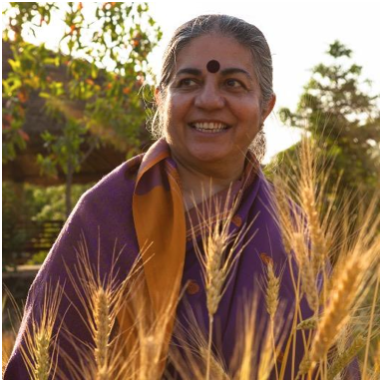
Vandana Shiva (born 5 November 1952) is an Indian scholar, environmental activist, food sovereignty advocate, ecofeminist, and anti-globalisation author. Based in Delhi, she has written more than 20 books. Shiva is one of the leaders and board members of the International Forum on Globalization, and a figure of the anti-globalisation movement. She has argued in favor of many traditional practices, as in her interview in the book Vedic Ecology (Ranchor Prime). She is a member of the scientific committee of the Fundacion IDEAS, Spain's Socialist Party's think tank, a member of the International Organization for a Participatory Society, and the founder of Navdanya, a movement for biodiversity conservation and farmers’ rights. She is also the founder and director of the Research Foundation for Science, Technology and Natural Resource Policy. Shiva fights for changes in the practice and paradigms of agriculture and food. She received the Right Livelihood Award in 1993, an award established by Swedish-German philanthropist Jakob von Uexkull, and regarded as an "Alternative Nobel Prize”.
ZNetwork is funded solely through the generosity of its readers.
Donate




