


Rio de Janiero is a city of U turns. The most frequent road sign is “Retorno” – return.
And Rio plus 20 followed that pattern. It was a great U turn in terms of human responsibility to protect the life sustaining processes of the planet.
20 years ago at the Earth Summit, legally binding agreements to protect biodiversity and prevent catastrophic climate change were signed. The Convention on Biological Diversity and the United Nations Framework Convention on Climate Change propelled governments to start shaping domestic laws and policies to address two of the most significant ecological crisis of our times.
The appropriate agenda for Rio+20 should have been to assess why implementation of the Rio Treaties has been inadequate, report on how the crises have deepened, and offer legally binding targets to avoid a deepening of the ecological crises.
But the entire energy of the official process was focused on how to avoid any commitment. Rio+20 will be remembered for what it failed to do in a period of severe and multiple crises, not for what it achieved.
It will be remembered for offering a bailout for a failing economic system through the “Green Economy”- a code phrase for the commodification and financialisation of nature. The social justice and ecology movements rejected the Green Economy outright. A financial system which collapsed on Wall Street in 2008, and had to be bailed out with trillions of tax payers dollars, and continues to be bailed out through austerity measures squeezing the lives of people, is now being proposed as the savior for the planet. Through the Green Economy an attempt is being made to technologise, financialise, privatize and commodify all of the Earth’s resources and living processes.
This is last contest between a life destroying world view of Man’s Empire over the Earth and a life protecting world view of harmony with nature, and recognition of the Rights of Mother Earth. I carried 100,000 signatures from India for the Universal Declaration on the Rights of Mother Earth which were handed over to the UN secretary General Ban Ki Moon.
It is a reflection of the persistence and strength of out movements that while the final text has reference to the Green Economy, it also has an article referring the Mother Earth and the Rights of Nature. Article 39 states
“We recognize that the planet Earth and its ecosystems are our home and that Mother Earth is a common expression in a number of countries and regions and we note that some countries recognize the rights of nature in the context of the promotion of sustainable development. We are convinced that in order to achieve a just balance among the economic, social and environment needs of present and future generations, it is necessary to promote harmony with nature.”
This in fact is the framework for the clash of paradigms that dominated Rio+20-the paradigm of the Green economy to continue the economy of greed and resource grab on the one hand, and the paradigm of the Rights of Mother Earth, to create a new living economy in which the gifts of the Earth are sustained and shared.
While the Rio+20 process went backwards, some governments did move forward to create a new paradigm and world view. Ecuador stands out for being the first country to have included the Rights of Nature in its Constitution. At Rio+20 the Government of Ecuador invited me to join the President for an announcement of the Yasuni initiative, through which the government will keep the oil underground to protect the Amazon forest, and the indigenous communities.
The second government which stood out in the community of nations is our tiny neighbour Bhutan. Bhutan has gone beyond GDP as a measure of progress, and has adopted Gross National Happiness. More significantly, Bhutan has recognized the most effective way to grow Happiness is to grow organic. As the Prime Minister of Bhutan said at a conference in Rio
“The Royal Government of Bhutan on its part, will relentlessly promote and continue with its endeavour to realize the dreams we share of bringing about a global movement to return to organic agriculture so that the crops, and the earth on which they grow, will become genuinely sustainable ? and so that agriculture will contribute not to the degradation but rather to the resuscitation and revitalization of nature.”
Most governments were disappointed with the outcome of Rio+20. The movements were angry and protested. More than 100,000 people marched to say this was not “the Future we Want” – the title of the Rio+20 text.
I treat Rio+20 as a square Bracket (UN jargon on text that is not agreed and often gets deleted). It is not the final step, just a punctuation. Democracy and political processes will decide the real out come of history and the future of life on Earth. Our collective will and collective actions will determine whether corporations will be successful in privatising the last drop of water, the last blade of grass, the last acre of land, the last seed, or whether our movements will be able to defend life on Earth, including human life, in its rich diversity, abundance and freedom.

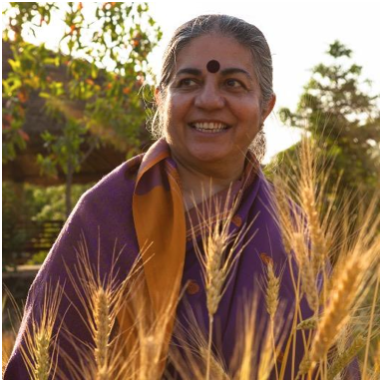
Vandana Shiva (born 5 November 1952) is an Indian scholar, environmental activist, food sovereignty advocate, ecofeminist, and anti-globalisation author. Based in Delhi, she has written more than 20 books. Shiva is one of the leaders and board members of the International Forum on Globalization, and a figure of the anti-globalisation movement. She has argued in favor of many traditional practices, as in her interview in the book Vedic Ecology (Ranchor Prime). She is a member of the scientific committee of the Fundacion IDEAS, Spain's Socialist Party's think tank, a member of the International Organization for a Participatory Society, and the founder of Navdanya, a movement for biodiversity conservation and farmers’ rights. She is also the founder and director of the Research Foundation for Science, Technology and Natural Resource Policy. Shiva fights for changes in the practice and paradigms of agriculture and food. She received the Right Livelihood Award in 1993, an award established by Swedish-German philanthropist Jakob von Uexkull, and regarded as an "Alternative Nobel Prize”.
ZNetwork is funded solely through the generosity of its readers.
Donate




