


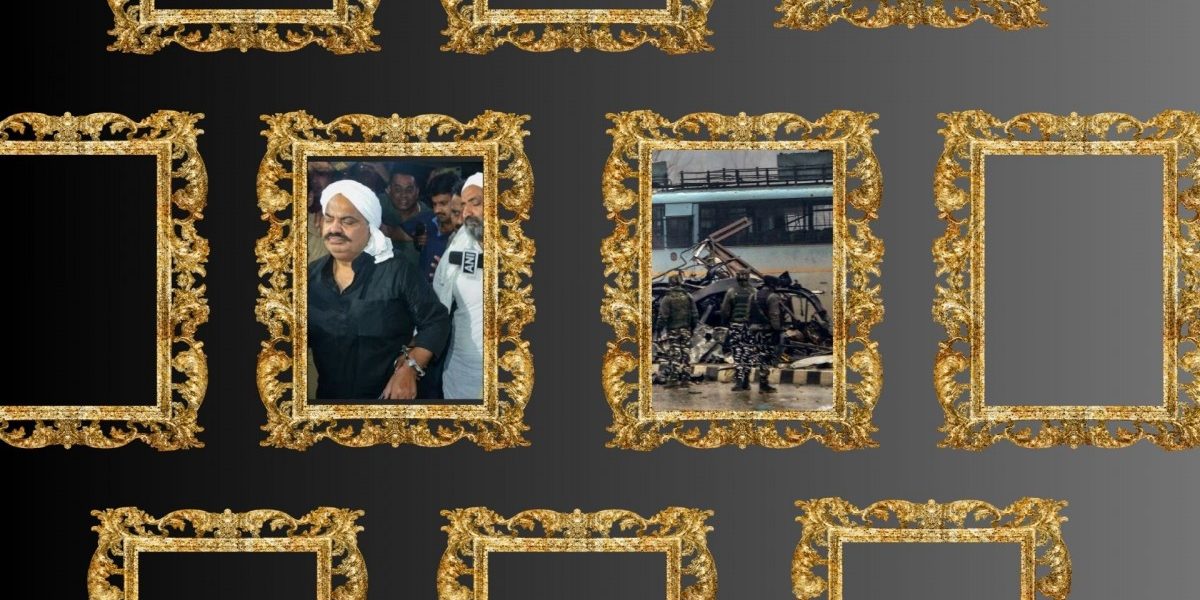
First, the most recent one. The facilitated killing of the ex-MLA, Atiq Ahmed, and his brother, Ashraf on a Prayagraj street under “police protection”.
Here are some questions that scream to be answered:
Is it an accepted practice in criminal procedure to walk the highest risk under-trials for a medical examination?
Given that the accused had intimated a court in writing of danger to their lives, why were they not either carried to a doctor in a security vehicle, or why wasn’t a doctor called to the prison to examine them, as is normally done in such cases?
Is it a routine practice to call the media for a briefing at 10 o’clock in the night to chat with the accused as they are walked to their medical examination?
How did the three young men who pumped 18 bullets into Atiq and Ashraf in full view of the media and in intimate proximity to the police escort who were detailed to protect the prisoners, come together to conceive and organise the murders? What is their pre-history, if any, in relation to the victims of their crime?
Who raised the clearly audible “Jai Shri Ram” slogan as their bullets were being fired?
Who arranged and paid for three sophisticated and expensive automatic pistols of a banned Turkish make for these gunmen?
How did they get wind of the fact that the accused would be exposed, walking to a hospital on a particular late night hour?
How did they get the idea of posing as media persons?
How did they know that the media would be there, unprecedentedly, in the first place?
Did the presence of the media enable their entry into the select event, as no other stratagem might have, and their success in approaching their victims in a seemingly permissible way?
Did the presence of the media furnish an excuse for the murdered person’s police escort not to fire their weapons at the shooters, lest, as they have claimed cannily, some media person was hit? This from a police force who have come to be lauded for shooting first and deflecting legal questions later?
How is the fact that the murderers were sent to judicial custody instead of on police remand, as always happens, to be interpreted?
Some senior scions, including ministers, of the ruling party in Uttar Pradesh have said publicly that these murders should be understood merely as acts of “divine retribution”. Are we then to understand that the most evolved form of justice is one wherein those in power determine a priori who is guilty or not, as if by extra-sensory divination, side-stepping a constitutionally mandated criminal justice system?
What happens to the fundamental right to life provision, life which may be taken only through stipulations of the law?
Or the presumption of innocence until proven guilty?
Is this a new definition of the rule of law that India, that is Vishwa Guru, must now follow and pass on to a world that is clueless about how to fix those whom good nationalists designate as guilty?
Religious precedent: in 17th century in Italy, an impoverished Count, name of Guido, was accused of having murdered his wife, Pompillia.
The poor man pleaded his innocence no end. Ten different people gave ten varying accounts of the killing (remember the movie Roshomon?).
So finally, the harried Count appealed his case to the then Pope, Innocent XII.
Presto, the Pontiff took one hard look at the suspects and pointed his finger at the guilty one.
Moral: those in a state of Grace have a direct perception of the truth, and so require nothing as trivial as evidence.
The 19th century English poet, Robert Browning was to write a long poem about this, titled The Ring and the Book.
Now the Pontiff of the Gorakhnath Math, no less than a Pope in clout, may indeed be India’s inspiration to an alternate justice system; imagine how many evil ones have come to meet their no-nonsense comeuppance during his sternly virtuous reign.
Nevertheless, from the perspective of us, unredeemed mortals, it is good news that the top court has agreed to hear pleas for an independent enquiry into the flamboyantly staged killings at Prayagraj nee good old Allahabad (actually Illahabad, because named after that hated Mughal Akbar’s canny experiment with religious pluralism, which he called Deen-e-Ilahi).


Akbar’s court. Photo: Wikimedia Commons
Pulwama, February 14, 2019
The day when a truly horrendous “success” was notched up by those hostile to the Indian state in blasting 40 jawans of the CRPF to an instant, blazing death in Pulwama in Kashmir valley.
A vehicle came in from a side-road, loaded, it turned out, with no less than 300 kilograms of RDX, and banged into the nearest vehicle in the unprecedentedly long convoy.
That unconscionable atrocity happened some weeks before the General Elections of 2019.
The mass killing was immediately attributed to Pakistani agents; an Indian “surgical strike” followed sometime after the event.
The Bharatiya Janata Party won the elections handsomely.
But here is something now to ponder (and ponder deeply): In an elaborate interview given recently by the then Governor of Jammu & Kashmir, Satya Pal Malik, to the veteran journalist, Karan Thapar, at The Wire, Malik has made some worrying disclosures.
The then-governor has claimed that the CRPF had requested the ministry of home affairs, then under Rajnath Singh to make some aircraft available to airlift the soldiers out of the valley.
This it seems was needed in view of two crucial facts: one, that a convoy as large as 78 vehicles traveling by road would a very risky procedure at any point of time in the valley; two, especially in the light of intel about side-roads not being safe.
Asked how many side or link roads/lanes there were enroute where the blast took place, Malik said between eight to 10.
Asked further if these link roads had been sanitised, Malik says ‘no’.
Malik says the request was turned down by the Ministry of Home Affairs, and that had he been asked, he would have provided the required five aircraft.
Malik goes on to disclose that he had informed the prime minister, who was then in Corbett Park, that the tragedy had happened because of “our fault (‘hamari galti se hua’).”
At which, Malik claims, the prime minister told him to “keep quiet (tum ab chup raho).”
Indeed, Malik continues, the National Security Adviser, Ajit Doval, likewise advised him to keep the matter under wraps.
Significantly, Malik makes the observation that he understood the government meant to use the happening by blaming it on Pakistan.
Asked by the interviewer, Thapar, if the intent was to use it for electoral gains, Malik says “exactly.”
Now imagine if such disclosures had been made by a governor under a Congress or any opposition-ruled regime, the right-wing would have been screaming to hell for accountability.
Or, had it happened in the ‘oldest democracy’ or in the US, the Justice department would have swung into action pronto, investigating wherever the facts led the law.
Look at what is happening to poor Donald Trump these days, and Modi’s resonant public endorsement of him seems to have not helped one bit either.
Tailpiece
Now, I wager that no Indian escaped watching Ghulam Nabi Azad rubbishing Rahul Gandhi, post the publication of his autobiography; this for the reason that there was hardly a single electronic channel that omitted to interview Azad about the inanities of his transactions with the Congress party. (That Jagadish Shettar has done something identical to the ruling BJP seems not to have drawn the same quality of attention.).
But I also wager that fewer number of Indians may have heard or seen anything of the Malik interview with Karan Thapar.
Can this abject surrender of the media be happening without a gag order in place? Think.
Citizens, especially those who never fail to flagellate about national security issues and the glory of the armed forces (Modi off and on calls them “my Jawans”) must pause, chew, and arrive at what conclusions these disclosures warrant.
And, as in the case of the Prayagraj executions, one hopes that the Supreme Court, reading the far-reaching import of the disclosures made by no less than an erstwhile governor, will take it upon itself to issue notices in the matter, so the nation knows at some point the truth or otherwise, of what Satya Pal Malik has said.
His name, ‘Satya’ does after all, translate as ‘truth’.


Badri Raina is a well-known commentator on politics, culture and society. His columns on the Znet have a global following. Raina taught English literature at the University of Delhi for over four decades and is the author of the much acclaimed Dickens and the Dialectic of Growth. He has several collections of poems and translations. His writings have appeared in nearly all major English dailies and journals in India.
ZNetwork is funded solely through the generosity of its readers.
Donate




